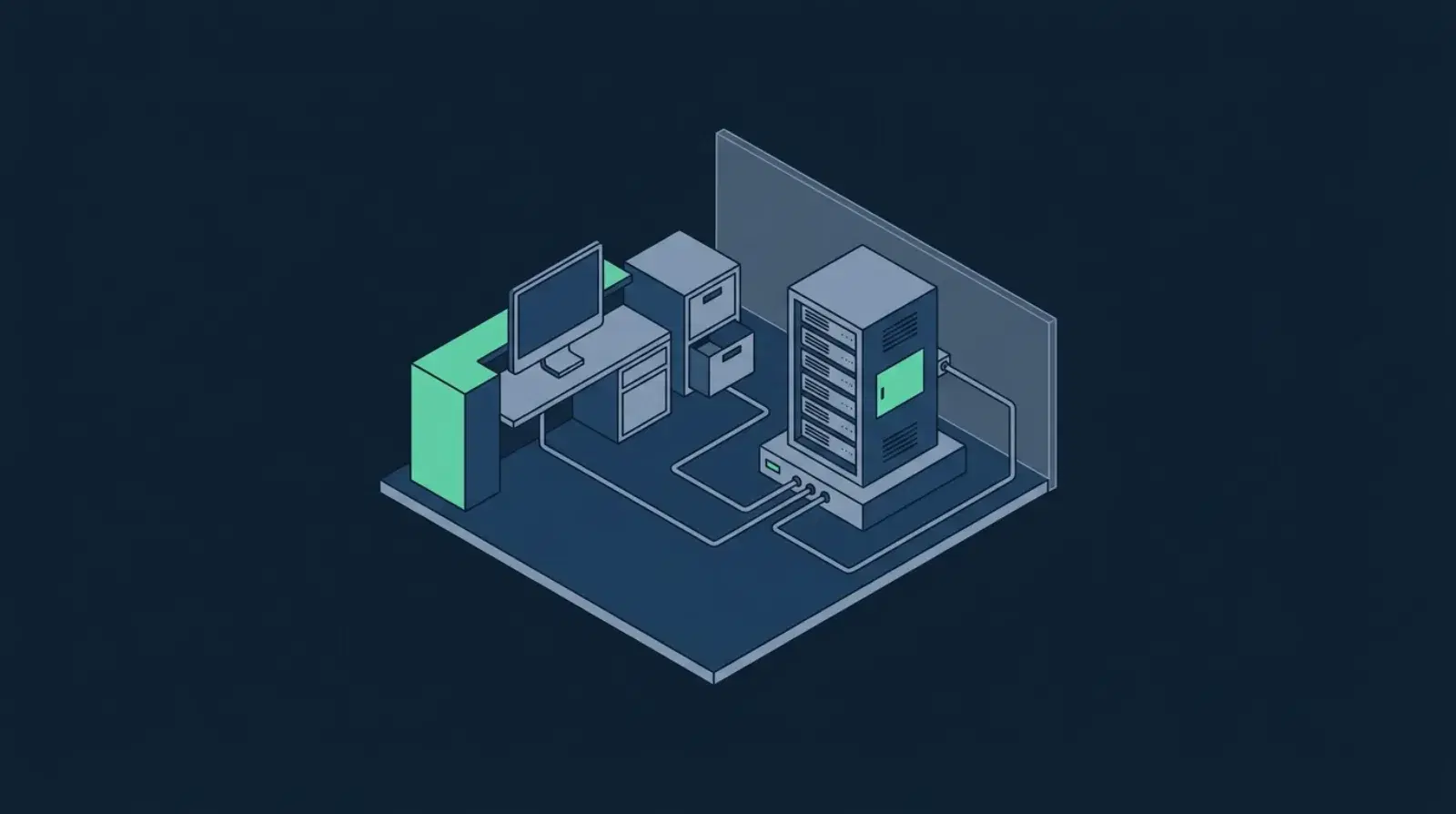
Data sovereignty for Australian healthcare AI means patient data stays under Australian jurisdiction and never reaches a public AI tool. Under the Privacy Act 1988, patient data is sensitive information, the highest protection tier, and APP 8 restricts cross-border disclosure. That rules out pasting patient details into ChatGPT, but it does not rule out AI.
Why is healthcare AI different in Australia?
Healthcare in Australia operates under the Privacy Act 1988, the Australian Privacy Principles (APPs), and (in many states) state-level health records legislation. Patient data is "sensitive information" under the Act — the highest protection tier.
That's not a reason to avoid AI. It's a reason to deploy it properly.
The mistake we see most: clinics enthusiastically pasting patient details into ChatGPT or Claude on the open web — and quietly creating a notifiable data breach risk.
What are the three deployment models for healthcare AI?
1. Public cloud AI (e.g. ChatGPT, Claude.ai)
What it is: Patient data sent to a US-hosted LLM via the open web.
Risk: Likely breach of APP 8 (cross-border disclosure) and APP 11 (security). High.
Use it for: Nothing involving patient data. Fine for general admin templates only.
2. Australian-hosted, controlled-access cloud AI
What it is: AI hosted in Australian cloud regions (AWS Sydney, Azure Australia East, GCP Sydney) with audit logging, BAA-equivalent agreements, and no model-training on your data.
Risk: Manageable. Most clinics can use this with proper consent, contracts, and access controls.
Use it for: Patient comms, intake processing, recall scheduling, FAQ agents.
3. On-premise / self-hosted AI
What it is: AI models running inside your clinic's network — patient data never leaves the building.
Risk: Lowest. Effectively the same risk as your existing practice management system.
Use it for: Anything involving clinical notes, sensitive diagnoses, or where legal counsel demands zero egress.
What can a clinic safely automate today?
Even with strict data sovereignty constraints, plenty of high-value automation is available:
- Online booking & reminders — no clinical data needed
- Patient intake forms — captured into your practice management system, not the LLM
- Recall and recall reminders — name + appointment type only, no diagnoses
- Patient FAQ agent — trained on hours, services, costs, parking; no patient lookups
- Billing reconciliation — financial data, not clinical
- Referral letter triage — on-premise only
What should you never do with patient data?
- Paste patient case notes into ChatGPT for summarisation (without on-premise model)
- Use generic AI tools that train on your data
- Send identifiable patient info to overseas LLMs
- Skip patient consent for AI-augmented workflows
- Assume your existing privacy policy covers AI — it probably doesn't
What does a compliant allied health deployment look like?
For a Melbourne physiotherapy practice we worked with, the deployment looked like:
| Workflow | Deployment | Data exposure |
|---|---|---|
| Online booking | Australian cloud | Name + appointment type |
| SMS reminders | Australian cloud | Name + appointment time |
| Intake forms → Cliniko | Australian cloud | All intake data, encrypted in transit, never sent to LLM |
| FAQ agent | Australian cloud | No patient data — public info only |
| Clinical note summarisation | On-premise model | Stays inside clinic LAN, zero egress |
| Recall campaigns | Australian cloud | Name + treatment type (consent given) |
Result: full Privacy Act compliance, ~50% reduction in admin time, zero patient complaints.
What are the practical steps?
- Map your data flows. Where does patient data live now? Where does it move when staff use AI tools?
- Update your privacy policy. Specifically mention AI use, what data goes where, and consent.
- Get explicit patient consent for any AI-augmented workflow involving their data.
- Choose deployment model per workflow. Not everything needs to be on-premise — but anything clinical probably does.
- Audit logging. Every AI access to patient data should be logged for at least 7 years.
- Vendor due diligence. Whoever builds this should be Australian, contracted, and willing to sign a Data Processing Agreement.
Why do generic AI vendors fall short here?
Most off-the-shelf AI tools are US-based, train on customer data by default, and won't sign Australian-law-aligned data agreements. Even when they will, the tooling rarely supports on-premise deployment.
For Australian healthcare specifically, you typically need a custom build that:
- Hosts in Australian cloud regions or on-premise
- Uses models that don't train on your data
- Logs every access
- Encrypts at rest and in transit
- Integrates with your practice management system safely
What does it cost?
- Australian-cloud deployment: $3,000–$8,000 AUD build + low monthly run costs
- On-premise deployment: $8,000–$15,000 AUD build + hardware (often a single GPU server) + maintenance
For most clinics, the time savings pay this back inside 3–6 months — and the compliance posture is dramatically better than the "paste it into ChatGPT" status quo.
Next Step
Book a free automation audit — we'll review your current workflows, flag any data sovereignty risks, and quote a deployment that's actually compliant.
For more on what we build for clinics, see our healthcare industry page.