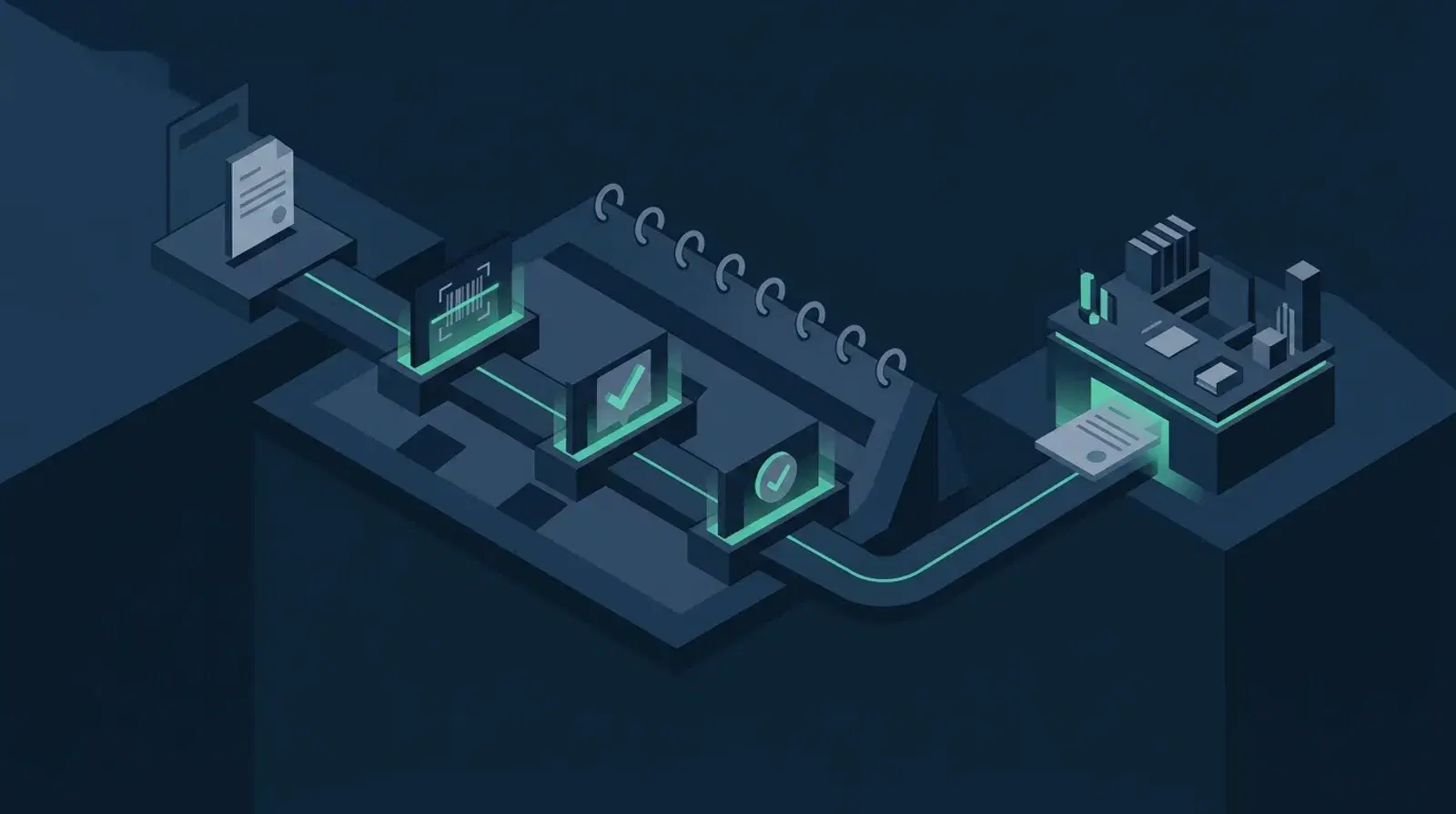
Insurance broker renewal automation is the practice of triggering renewal preparation off the policy expiry date rather than off someone remembering. A system watches the expiry field, and at fixed intervals before it — commonly 90, 60 and 30 days — assembles the expiring policy, flags premium movements and cover changes, and queues the broker to have the conversation. The preparation is automated. The conversation is not.
Why does the renewal run break down in the first place?
Renewals rarely get missed because a broker forgot they existed. They get missed because the prep never got done in time, and a renewal you haven't prepared is a renewal you can't confidently call about.
The pattern is familiar in any brokerage running a few hundred policies. Renewals cluster — a quiet fortnight is followed by a week with twenty expiries. The prep for each one is identical in shape and slightly different in detail, which is exactly the work humans are worst at doing consistently under time pressure. So the well-prepared renewals are the ones that happened in a quiet week, and the rushed ones are the clients who got a call the day before expiry, or the week after.
The cost of that is not evenly distributed either. A rushed renewal on a small personal-lines policy is an inconvenience. A rushed renewal on your largest SME account is how you lose it to a broker who called ninety days out with a market comparison already done.
What actually happens at 90, 60 and 30 days?
The cadence matters because each interval does a different job. Collapsing them into a single reminder at thirty days is how most brokerages end up with the rushed-call problem they were trying to solve.
At 90 days, the system does the heavy lifting nobody has time for: it pulls the expiring policy and its schedule, retrieves the claims history for the period, and assembles a snapshot of where the risk sits now versus where it sat at inception. For commercial accounts, this is also the point where a remarketing decision is genuinely open — there is enough runway to approach the market properly. The output is a prepared file, not an email to the client.
At 60 days, the system flags movement. Premium up or down against last year, and by how much. Cover or excess changes buried in the insurer's revised wording. Anything in the claims history that will make this a difficult conversation. This is the interval that decides whether the renewal is routine or needs a broker's judgement, and it is the one most manual processes skip entirely — which is why premium increases so often surprise the broker at the same moment they surprise the client.
At 30 days, the system handles the chase. Renewal invite issued, confirmation outstanding, follow-ups sequenced. This is the pure-admin interval, and the one where automation replaces the most human hours for the least loss of judgement.
What does the renewal prep actually cost you today?
Take a brokerage with 800 active SME policies. Spread across the year that is roughly 15 renewals a week, though in practice they clump.
Done manually, the prep behind a single renewal — pulling the expiring policy, checking claims, comparing the revised schedule against last year's, drafting the invite — runs to about 40 minutes before the broker picks up the phone. Fifteen renewals a week at 40 minutes is 10 hours a week gone, purely on getting ready to have conversations.
Automate the assembly and flagging, and what remains is human review of a prepared file: call it 8 minutes per renewal. That is 2 hours a week instead of 10. You have recovered 8 hours every week, roughly 400 hours a year, and at a loaded cost of around $55/hour that is about $22,000 of capacity annually — from one workflow, in a brokerage of modest size.
Those figures are arithmetic on assumptions you should replace with your own. The point is not the number. The point is that the recovered hours land on the part of the job that grows the book, because the part being automated was never the part clients valued.
What has to stay human?
More than automation vendors tend to admit, and this is where broking differs from most industries we automate.
The renewal conversation itself is the product. A client who receives an automated renewal invite and nothing else has been processed, not advised, and they will notice — usually at the moment a competitor calls them. Any system that sends the invite and closes the loop without a broker in it is optimising the wrong variable.
Retail client advice obligations sit with your licensee and with you, not with a workflow. A system can assemble the comparison; it cannot decide the cover is appropriate for the client. A system can flag that the premium moved 18%; it cannot judge whether to absorb, remarket or have a hard conversation.
And any renewal where the flagging step surfaced something material — a big premium movement, a cover change, adverse claims history — should route to a broker with the flag attached, not proceed on rails. The automation's job at that point is to make sure the right human is looking at it early, which is precisely what a manual process fails to do.
How does this sit with your compliance obligations?
Two things matter here, and both are answerable.
The first is the record. Automated renewal prep produces a better audit trail than a manual one, not a worse one, provided it is built that way: every document pulled, every flag raised, every invite issued, timestamped and attached to the policy. When your licensee audits the file, "the system logged it" is a stronger answer than "I remember calling them." Build the logging in from the start — retrofitting an evidence trail onto a workflow that did not keep one is far more expensive than it sounds.
The second is where client data is processed. A brokerage holds a great deal of personal information, and routing it through an offshore API to prepare a renewal is a decision with Privacy Act consequences that most brokers have not consciously made.
It is worth being precise about why. Under s 16C of the Privacy Act, if you disclose personal information to an overseas recipient and they mishandle it, that is treated as your breach — accountability does not transfer with the data. And the OAIC's guidance on commercially available AI products confirms privacy obligations apply to what you feed into an AI system, not just what it produces. A renewal file is a substantial amount of personal information to be feeding anywhere.
Deployment on infrastructure you control, or in an Australian region, keeps that answer simple — this is the same reasoning behind our data sovereignty work, and for a licensee-supervised business it tends to be the question that gets asked first.
Where should a brokerage start?
Not with the whole cadence. Start with the 30-day interval, because it is the most mechanical and the easiest to verify.
Stand up the renewal-invite-and-chase sequence for a single class of business while everything else runs unchanged. Have a human check every output for the first few weeks — you are earning trust in the system, and you will find edge cases in your own data that no vendor demo would surface. Measure the hours it actually saves over 30 days against your estimate.
Then move backwards: the 60-day flagging, then the 90-day assembly. Working backwards is deliberate. The 30-day work is the least judgement-dependent and proves the plumbing; by the time you automate the 90-day assembly you know the system's outputs are trustworthy enough to build a market approach on.
If you want the specifics for your book — which systems hold the data, where the flagging logic sits, what it costs — that is what our insurance broker automation engagements map out.
Ready to stop preparing renewals by hand?
If ten hours a week of renewal prep sounds about right for your brokerage, it is worth a conversation. Book a discovery call and we will map the renewal run as it works today, show you where the automated cadence would sit, and give you the honest maths on what it would save — built by the engineers who would run the project, with your data staying in Australia.
Sources
- NIBA, Insurance Brokers Code of Practice — record-keeping and client obligations
- OAIC, Guidance on privacy and the use of commercially available AI products (October 2024)
- OAIC, APP 8: Cross-border disclosure of personal information — s 16C accountability for overseas recipients
- ASIC, Regulatory Guide 271: Internal dispute resolution — relevant where a renewal conversation becomes a complaint
The hours and dollar figures above are worked arithmetic on stated assumptions, not survey data. Replace them with your own renewal volume and loaded hourly cost. This article is general information, not legal, compliance or financial advice.