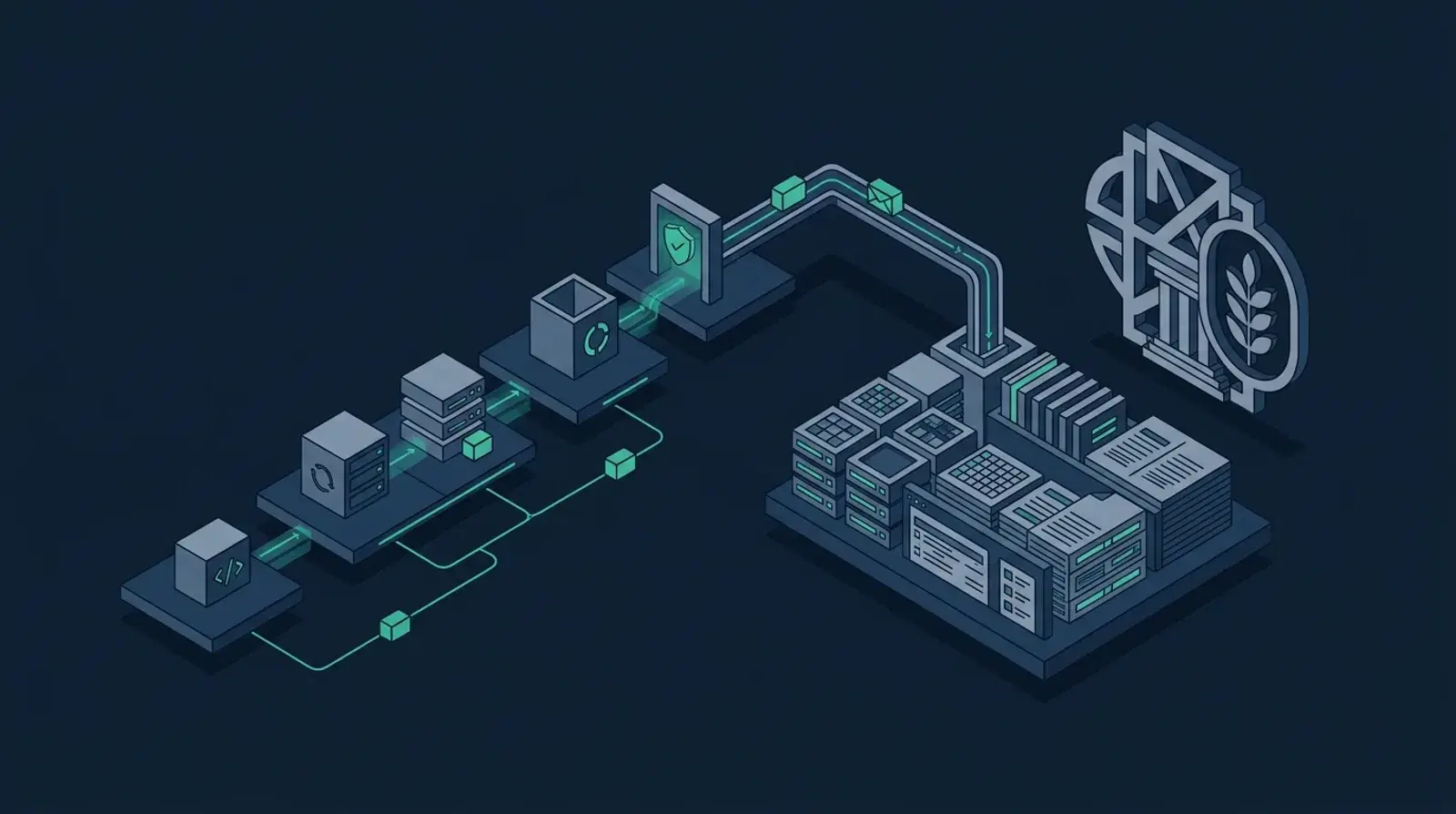
The R&D Tax Incentive is an Australian Government program that offsets part of the cost of eligible research and development. For companies with aggregated turnover under $20 million, it takes the form of a 43.5% refundable tax offset on eligible R&D expenditure — refundable meaning it can produce a cash refund even when the company has no tax to pay, which is the situation most pre-revenue startups are in. It is jointly administered by AusIndustry and the ATO, and eligibility is their decision, not your developer's.
How does the incentive actually work?
Two numbers determine which version of the program you are in.
If your aggregated turnover is under $20 million and you are not controlled by tax-exempt entities, you can claim a 43.5% refundable tax offset. Refundable is the important word — the offset first reduces any tax liability, and the balance is paid to you in cash. A pre-revenue company with no tax payable can still receive the money.
If aggregated turnover is $20 million or more, or you are controlled by exempt entities, you are in the non-refundable tier instead, where the offset reduces tax payable and any excess is carried forward.
The claim runs through your company tax return, but registration is separate: you must register your R&D activities with AusIndustry within 10 months of the end of the income year in which they took place. For a standard 30 June year-end, that is 30 April. This deadline is the single most common way founders lose an otherwise valid claim — the work qualified, the evidence existed, and nobody registered in time.
One forward-looking note: the Government announced changes to the R&DTI in the 2026–27 Budget, taking effect from 1 July 2028. If you are planning multi-year R&D, it is worth having your advisor factor that in.
What actually counts as R&D in a software build?
This is where most founders' intuition is wrong, in both directions.
The program distinguishes core R&D activities — experimental activities whose outcome cannot be known in advance, conducted to generate new knowledge — from supporting R&D activities, which are directly related to core activities.
"We built a new app" is not, by itself, R&D. Assembling well-understood components in a conventional way is software development, however difficult or valuable it is commercially. The test is not novelty in your market; it is technical uncertainty that you resolved by experiment.
What can qualify in a software build is the part where you genuinely did not know whether the approach would work: a novel algorithm whose performance characteristics were unknown, an architecture pushed past documented limits, integration behaviour nobody could predict without testing. The distinguishing feature is a hypothesis, an experiment, an observed result, and a conclusion — the actual shape of experimental work.
Two practical consequences follow. First, the qualifying portion of a build is usually a subset of it, not the whole thing, and a claim asserting otherwise invites scrutiny. Second, you cannot reconstruct this after the fact. If nobody recorded the hypothesis, the experiments run, the results and what you concluded, you are trying to prove experimental work from a commit log. That rarely goes well, and it is entirely avoidable.
Where do most claims go wrong?
Four failure modes, and all four are structural rather than bad luck.
No contemporaneous evidence. The most common. Records assembled twelve months later, from memory and git history, to support a claim about experimental work. The remedy is to keep the evidence trail while building — decisions, hypotheses, what was tried, what happened — which costs almost nothing when it is a habit and is nearly impossible to retrofit.
Claiming the entire build. Registering every hour of a project as R&D when the experimental portion was a fraction of it. This is the pattern that attracts review, and it can taint the parts of the claim that were legitimate.
Missing the registration window. Ten months after the income year end. No evidence quality rescues a late registration.
Offshore development without an advance finding. Activities conducted overseas are generally not eligible unless you have obtained an overseas finding from AusIndustry in advance. Founders who offshore a build to reduce cost frequently discover this after the fact, and by then the option has closed. Building onshore keeps the question simple — which is one practical reason we build in Melbourne rather than subcontracting offshore.
How should the build itself be structured?
If you intend to claim, the structure of the engagement matters as much as the code.
Own the IP and direct the work. The company claiming the incentive should be the one that owns the resulting intellectual property, directs the R&D, and bears the project risk. An arrangement where a development agency owns the IP and simply licenses it back does not put your company in the position the program contemplates. Every build we do assigns full source code and IP to the client from day one, and that is a deliberate structural choice rather than a generosity.
Keep the evidence trail as a build artefact. Not a document written at claim time. What was uncertain, what was tried, what happened, what was concluded — recorded as the work happens, in the repository, alongside the code it describes.
Separate the experimental work from the routine work in your records. Building the login screen is not R&D. If your records do not distinguish the two, your advisor has to, from worse information than you had.
Build onshore, or get an advance finding before anyone starts.
Who decides eligibility?
Not us, and not any software company.
AusIndustry and the ATO decide. We are software engineers, not registered tax agents. We do not assess your eligibility, calculate your offset, or lodge anything. That work belongs to a registered R&D tax advisor or accountant, and the eligibility call is always theirs. What we do is build the software and produce the technical evidence trail, then hand it to them in a form they can actually use. If you do not have an advisor, we can introduce you to one.
One thing worth being blunt about: we never charge a percentage of an R&D refund. You pay a fixed price for the software, quoted upfront. Contingent, refund-based fees are precisely the practice that has drawn regulatory attention to this program, and we do not offer them under any circumstances. If a development agency offers to work for a share of your offset, that is information about them.
What does this mean for your MVP budget?
Do not build a cash-flow plan on an offset you have not received.
The honest framing is that a successful claim reduces the effective cost of the qualifying portion of your build, in cash, in the following financial year. It is not a discount at the point of sale, it is not guaranteed, and the amount depends on how much of the work qualified — a determination made by people other than your developer.
Plan to fund the build in full. Treat a successful claim as capital that arrives later and extends your runway, not as a reduction in what you need today. Founders who invert this — who commit to a build they can only afford if the offset lands — are taking a risk on someone else's determination.
If you want the specifics for your project, that is what our MVP development engagements cover: a fixed price for the software, structured so the experimental work and its evidence trail are separable and legible to your advisor.
Ready to build something claimable?
If you are planning a build and want the R&D question handled properly rather than as an afterthought, it is worth a conversation. Book a discovery call and we will scope the work, show you where the experimental portion is likely to sit, and explain exactly what evidence we would produce for your advisor — fixed price, your IP, built in Australia.
Sources
- ATO, Rates of R&D tax incentive offset
- ATO, Refundable and non-refundable offsets — 43.5% refundable offset, aggregated turnover under $20 million
- business.gov.au, R&D Tax Incentive and Overview of the R&D Tax Incentive — registration within 10 months of the end of the income year, core vs supporting activities, overseas and advance findings
- ATO, Tax Reform — better targeting the Research and Development Tax Incentive — announced changes from 1 July 2028
This article is general information about how the R&D Tax Incentive works. It is not tax advice, and it is not an assessment of your eligibility. Zatersio is not a registered tax agent. Eligibility is determined by AusIndustry and the ATO, and your registered R&D tax advisor or accountant should make the call on your circumstances.