
Measure First: Six AI Automation Case Studies for Australian Teams
Measure First: Six AI Automation Case Studies for Australian Teams
The best AI automation case studies share one trait: they measure everything. UPS automated roughly 90% of daily customs clearances, C.H. Robinson processes about 5,500 shipment orders a day through AI agents, and Spotify’s engineers cut migration time by up to 90% using a background coding agent. This article walks through those cases and others, breaks down the categories they fall into, and gives you the metrics to track if you’re planning a pilot of your own.
TL;DR:
- Most successful AI automation projects start with a clear baseline, measurable goal, and staged rollout before scaling up.
- High-volume, rules-based workflows like customs clearance or order processing benefit most from full automation, while judgment-heavy tasks still require human oversight.
- Continuous evaluation of accuracy, latency, and edge cases is crucial for maintaining trust and avoiding costly errors after deployment.
- Managed frameworks, SOP-driven logic, human approval gates, and reliable integration are key to building effective production AI agents.
- Starting with a single, high-impact workflow and a defined success metric within two weeks increases the chances of a trusted, scalable automation.
Table of Contents
- AI Automation Case Studies From Six Production Deployments
- Which AI Automation Use Case Fits Your Team?
- How Production AI Agents Actually Get Built
- The Metrics That Prove an Automation Actually Worked
- A Melbourne Example of the Same Playbook
- Where Leaders Should Actually Start
- Getting Your Own AI Automation Build Started
- Sources
- FAQ
AI Automation Case Studies From Six Production Deployments
Every one of these companies started small, measured hard, and scaled only after the numbers held up. That pattern matters more than any single result.
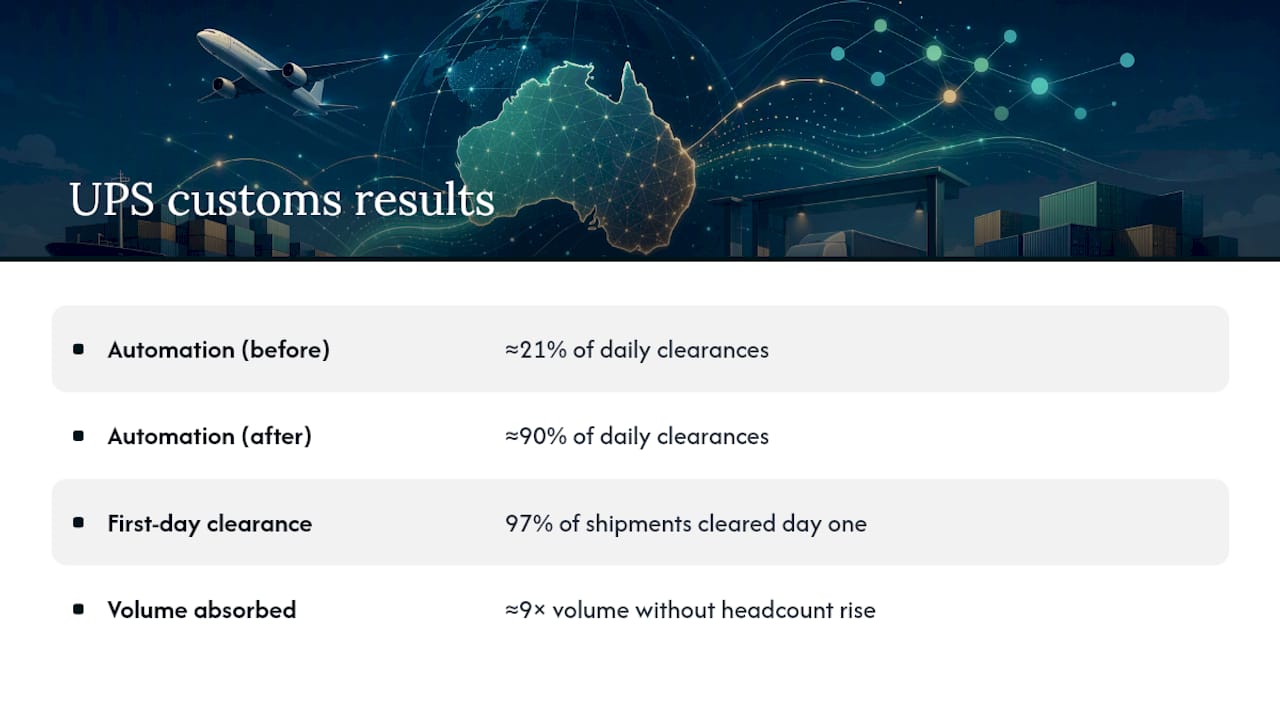
UPS: agentic customs clearance at scale. UPS built agentic AI to handle customs paperwork, a job that used to require armies of specialists reading shipment manifests line by line. The system now automates roughly 90% of daily customs clearances, up from about 21% before the rollout, while 97% of shipments reportedly clear on their first day. The volume the system absorbed grew nearly ninefold without a matching increase in headcount. The lesson: rules-based, high-volume operations are exactly where agentic AI earns its keep, because the logic is consistent even when the paperwork isn’t.
C.H. Robinson: turning inbox chaos into structured orders. Freight brokers spend hours a day reading unstructured customer emails and typing shipment details into order systems. C.H. Robinson replaced much of that work with a LangChain-based agentic workflow that reads incoming emails, extracts shipment data, and places the order automatically. The system now handles about 5,500 orders a day, saving more than 600 hours of manual processing every single day. The team also built in observability and prompt versioning from day one, tracing every agent run so failure modes surface before they scale into a problem.
Spotify: a coding agent that works in the background. Instead of pointing a chatbot at a single coding task, Spotify built a background agent using the Claude Agent SDK that runs migrations and refactors without an engineer babysitting every step. The result: 650 or more agent-generated pull requests merged per month, with engineering time on some migrations cut by as much as 90%. The pattern here isn’t “AI writes code.” It’s “AI handles the repetitive migration work so engineers stay on the harder problems.”
Wayfair: fixing a catalog with millions of broken tags. Product catalogs at that scale rot fast. Wayfair used OpenAI models to build a tag-agnostic correction agent alongside a support-ticket triage system. Early production runs corrected roughly 2.5 million product tags across more than a million products and automated close to 41,000 support tickets a month in some workflows. Wayfair also used a staged rollout tied to a measured alignment rate, moving the system from human-assisted mode to more autonomous operation only once accuracy hit a defined threshold.
Rivian: compressing the month-end finance close. Finance teams live and die by the close calendar, and purchase order accruals are one of the most repetitive parts of it. Rivian built SOP-driven agents on Amazon Bedrock AgentCore that follow documented accounting procedures rather than hardcoded logic, which lets finance staff update the rules themselves instead of filing a ticket with engineering. The result eliminated more than 15 days of manual work per monthly close cycle, while keeping human approvals and audit trails intact at every step.
ABB: reclaiming a full year of engineering capacity. ABB and automation partner Automat deployed agents across four departments, engineering, sales operations, logistics, and billing, to handle document and drawing extraction that used to eat into skilled staff time. The rollout automated more than 16,200 work items and returned roughly one FTE-year of capacity, while drawing-extraction accuracy climbed from 37% to 100% over several months of tuning.
The pattern across all six: none of these companies flipped a switch and walked away. Every one paired the automation with a measurable baseline, a staged rollout, and a way for humans to catch mistakes before they compounded.
Which AI Automation Use Case Fits Your Team?
Case studies are useful only if you can map them to your own operation. Most production deployments fall into one of six categories, and each one has a different metric worth watching.
- Customer support and ticket triage: track first-pass resolution rate and hours saved per week; assistive co-pilot tools work well here before you commit to full autonomy.
- Order processing and logistics: track automation rate (the share of orders handled with zero human touch) and hours saved per day, following the C.H. Robinson model.
- Finance and close automation: track cycle-time reduction and the number of manual adjustment hours eliminated per close, as Rivian did.
- Engineering background coding: track pull requests generated per month and percentage time saved on defined migration tasks, mirroring Spotify’s approach.
- Catalog and data quality: track correction accuracy and volume of items fixed per run, the metric Wayfair leaned on hardest.
- HR and onboarding: track time-to-productivity for new hires and the percentage of onboarding paperwork completed without manual review.
The choice between agentic automation and an assistive co-pilot usually comes down to how forgiving the task is. Rules-based, data-rich workflows with a clear right answer, customs codes, shipment fields, accrual entries, tolerate full autonomy well. Judgment calls, like handling an angry customer or reviewing a legal contract, still benefit from a human staying in the loop for now.
How Production AI Agents Actually Get Built
The architecture behind these case studies looks remarkably similar once you strip away the branding. Four patterns show up again and again.
- Orchestration frameworks do the heavy lifting. LangChain and LangGraph patterns power C.H. Robinson’s order agent, while Rivian built its finance agents on Amazon Bedrock AgentCore. Managed agent frameworks handle memory, tool calls, and retries so engineering teams aren’t reinventing plumbing for every project.
- SOP-driven skills beat hardcoded rules. Rivian’s finance agents follow documented standard operating procedures rather than logic buried in code, which means a finance manager can update the rule directly instead of waiting on a developer sprint.
- Human-in-the-loop gates protect the risky steps. Approval cards, single-click sign-offs, and full audit trails show up across every case here. Wayfair staged its rollout using a measured alignment rate before letting the system run with less oversight, and Rivian kept human approval on every accrual entry even after automation cut the manual workload.
- Integration determines whether an agent survives contact with reality. File ingest pipelines, API-driven ERP connections through standards like SAP’s OData, and email ingestion systems are unglamorous, but they are where most pilots quietly fail.
Continuous evaluation is the piece that separates a demo from a production system. Teams that scale successfully run ongoing evaluation pipelines that check accuracy, latency, and edge-case handling against a human baseline every time the underlying model or data changes. Some organizations go a step further, storing every evaluation trace and using it to propose versioned prompt or configuration changes that get reviewed like a code pull request before they go live. Design matters too: separating what the model reasons about from what code actually executes, an approach used in Intuit’s agentic disaster recovery assistant, makes every action auditable after the fact.
Security deserves its own line item here too. Agentic systems that touch real customer data or financial records need the same risk-mapping discipline you’d apply to any system with write access to production data, not an afterthought bolted on after launch.
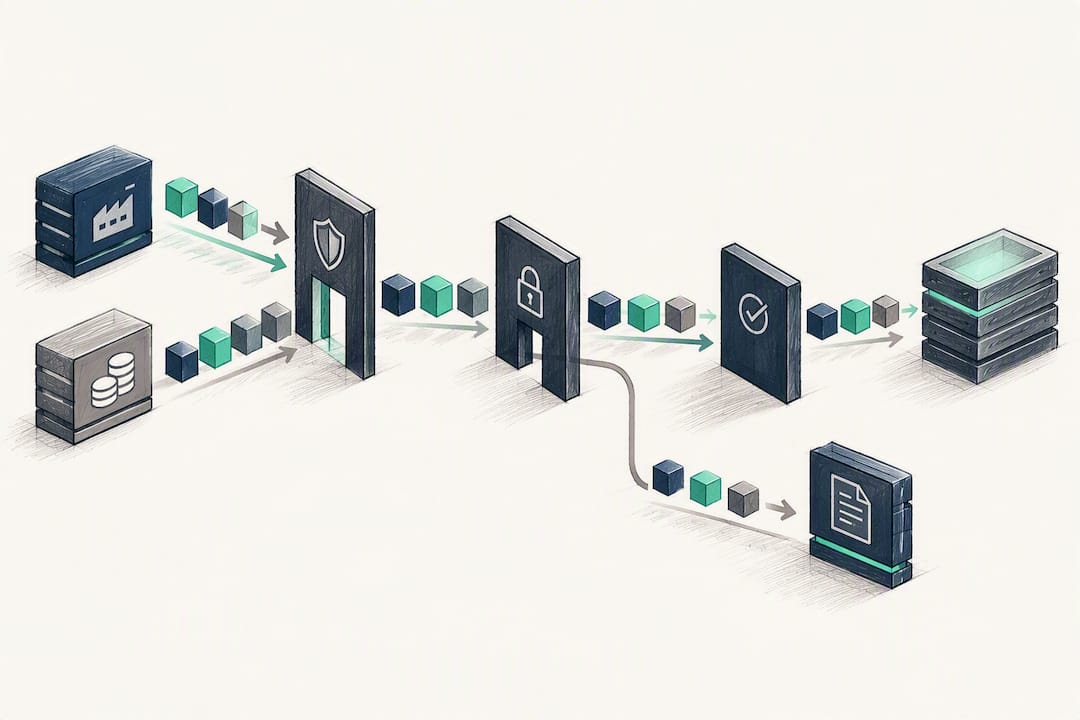
Pro Tip: Push every deterministic decision, tax codes, field formats, approval thresholds, into code rather than model reasoning, and reserve the more expensive model calls for the genuinely ambiguous cases. This alone can cut inference costs dramatically without touching accuracy.
The Metrics That Prove an Automation Actually Worked
Every case study above shares a habit: leaders picked a number before they built anything, not after. That single discipline is what separates a pilot people trust from one that gets quietly abandoned six months later.
The recurring KPIs worth adopting are automation rate (the percentage of cases handled with zero human touch), hours saved per week or month, first-pass accuracy, alignment rate against a human baseline, cycle-time reduction, and, for engineering teams, pull requests generated per month. Continuous evaluation pipelines matter because model behavior drifts.
| Case study | Primary metric | Result |
|---|---|---|
| UPS | Automated customs clearance rate | ~90%, up from ~21% |
| C.H. Robinson | Orders automated per day | ~5,500 orders/day, 600+ hours saved daily |
| Spotify | Migration time saved | Up to 90%, 650+ PRs/month |
| ABB | Capacity returned | ~1 FTE-year, 16,200+ work items automated |
Notice that none of these figures came from a vague estimate. Each one was tracked against a defined baseline before the rollout started, which is the only way to know whether an automation is actually working or just feels like it is.
A Melbourne Example of the Same Playbook
The same measurement-first approach shows up closer to home. A Melbourne trades business reclaimed more than 20 hours a week after an engineering team automated its scheduling and invoicing workflow, the kind of repetitive administrative load that quietly eats a full workday every week without anyone tracking it.
Zatersio’s own build process mirrors the patterns above: rapid MVPs delivered in under two weeks, fixed pricing instead of open-ended hourly billing, Australian data residency for compliance-sensitive work, and both AI agent and workflow automation builds. If you’re weighing your own first pilot, the practical path looks like this:
- Scope one workflow, not five, and pick the one with the highest weekly time cost.
- Define a single success metric before writing a line of code, hours saved, error rate, or turnaround time.
- Run a two-week MVP to prove the concept before committing to a bigger build.
Where Leaders Should Actually Start
The companies above didn’t automate everything at once, and neither should you. Start with the workflow that’s high-frequency, rules-based, and already generating clean data, customs paperwork, order emails, close entries. That’s where agentic AI proves itself fastest and where mistakes are cheapest to catch.
Enforce evaluation pipelines and human approval gates from the first week, not after something breaks. It’s far easier to loosen oversight once a system earns trust than to bolt on governance after a costly error. If you want a one-week starting checklist: pick a single workflow, write down the one metric that proves success, and confirm you actually have clean data to feed it. Everything else follows from getting that first choice right.
— Lakitha
Getting Your Own AI Automation Build Started
This provider builds the same category of automation covered in every case study above, scoped to a single workflow and delivered fast. Instead of a six-month enterprise rollout, clients get a working MVP in under two weeks, fixed pricing agreed upfront, and direct access to the engineers actually writing the code, rather than an account manager relaying updates from an offshore team.
Whether you need a custom AI agent for document processing, an AI phone and enquiry agent to handle customer calls, or a straightforward workflow automation build for your invoicing and scheduling, the process starts the same way: scope one workflow, agree on a fixed price, and see working software within two weeks. If you’re not sure which workflow to start with, request the free AI Automation Blueprint and get a scoped plan before committing to anything.
Sources
- Wayfair boosts catalog accuracy and support speed with OpenAI | OpenAI
- How Rivian accelerated finance operations with AI agents on Amazon Bedrock
FAQ
What Is the 30% Rule in AI?
There’s no single, universally agreed “30% rule” in AI automation. Definitions vary depending on the source, so treat any specific percentage threshold you encounter with caution unless it’s tied to a named study or framework you can verify.
What Are Some Examples of Case Studies About Artificial Intelligence?
Strong examples include Wayfair’s catalog correction and ticket triage system, which corrected roughly 2.5 million product tags, and Rivian’s finance automation, which eliminated more than 15 days of manual work per monthly close cycle. ABB’s four-department rollout, which returned roughly one FTE-year of capacity, is another well-documented case worth studying.
Which Jobs Will Survive AI?
Roles built around judgment calls, relationship management, and physical or highly variable tasks tend to be the hardest to automate fully, think skilled trades, senior client-facing roles, and complex care work. Every case study in this article automated a repetitive task within a job, not the entire role, which is the pattern most AI automation actually follows today.
Does Zatersio Offer AI Automation Case Study Style Builds?
Yes. Zatersio builds single workflow automations, multi-step automations across your existing stack, and custom AI agents, all under fixed pricing listed on its pricing page. Projects typically start as a scoped MVP delivered in under two weeks, the same measurement-first approach used across the case studies in this article.