
Australian Startup Grants: Your 2026 Funding Playbook
Australian Startup Grants: Your 2026 Funding Playbook
Start your search at the Grants and programs finder on business.gov.au, then shortlist five national programs that move the needle for early-stage tech founders: the R&D Tax Incentive, BRII, CSIRO Kick-Start, Export Market Development Grants (EDMG), and NRF-aligned commercialization streams like the Industry Growth Program. Australian startup grants are non-dilutive, which means you keep your equity, but they require co-contribution and disciplined documentation to unlock.
Your next 10 minutes:
- Check your ABN is active and your entity type is eligible (companies and incorporated entities qualify for most programs; sole traders are excluded from several).
- Define your R&D goal in one sentence — what technical hypothesis are you testing, and what does success look like? This single step filters out 80% of irrelevant programs before you even open the Finder.
- Run the Finder now using your state, business structure, and policy area (AI, health tech, renewables) to get a shortlist of live rounds.
Key Takeaways
The most reliable path to Australian startup grant funding combines a correctly structured R&D Tax Incentive claim with one well-matched competitive grant application, backed by documented technical progress at a defined TRL milestone.
| Point | Details |
|---|---|
| Start with the Finder | Use the business.gov.au Grants & Programs Finder, filtered by jurisdiction, business structure, and policy area, to build your shortlist. |
| R&D Tax Incentive first | Structure your MVP build as eligible R&D from day one; eligible startups can access a refundable offset on qualifying spend. |
| BRII for competitive grants | BRII feasibility grants reach up to $100,000 and proof-of-concept grants up to $1 million; apply to a round that matches your project’s challenge. |
| State programs add speed | NSW MVP Ventures ($20,000–$75,000), WA Innovation Booster, and SA Seed-Start offer faster rounds with smaller pools; check priority-group provisions. |
| Zatersio for technical proof | Zatersio builds fixed-price, R&D-ready MVPs with documentation structured for grant applications and R&D Tax Incentive claims. |
Table of Contents
- Which Australian startup grants should you prioritize nationally?
- How do state and territory startup programs differ from national ones?
- How to use the business.gov.au Grants & Programs Finder effectively
- What do assessors actually look for in grant applications?
- How do you prepare a stronger grant application?
- Why an R&D-ready MVP strengthens your grant chances
- What are realistic timelines and costs when applying for grants?
- What’s the honest advice for founders approaching grants?
- Fixed-price MVP builds designed to strengthen your grant narrative
- Sources
Which Australian startup grants should you prioritize nationally?
The five programs below cover the widest range of early-stage tech projects. Each has a distinct purpose, funding range, and timing. Knowing the difference saves you from applying to the wrong one at the wrong time.
R&D Tax Incentive
The R&D Tax Incentive is a tax-based program that reimburses a portion of eligible R&D expenditure. It suits any software or hardware startup running experiments with genuine technical uncertainty. There’s no competitive round to win; you register your activities with AusIndustry and claim through your tax return. The catch is documentation: you need time logs, hypothesis records, and experiment outcomes, not just a summary statement. Structured correctly, it’s frequently the most effective form of non-dilutive capital available to Australian tech founders.
Business Research and Innovation Initiative (BRII)
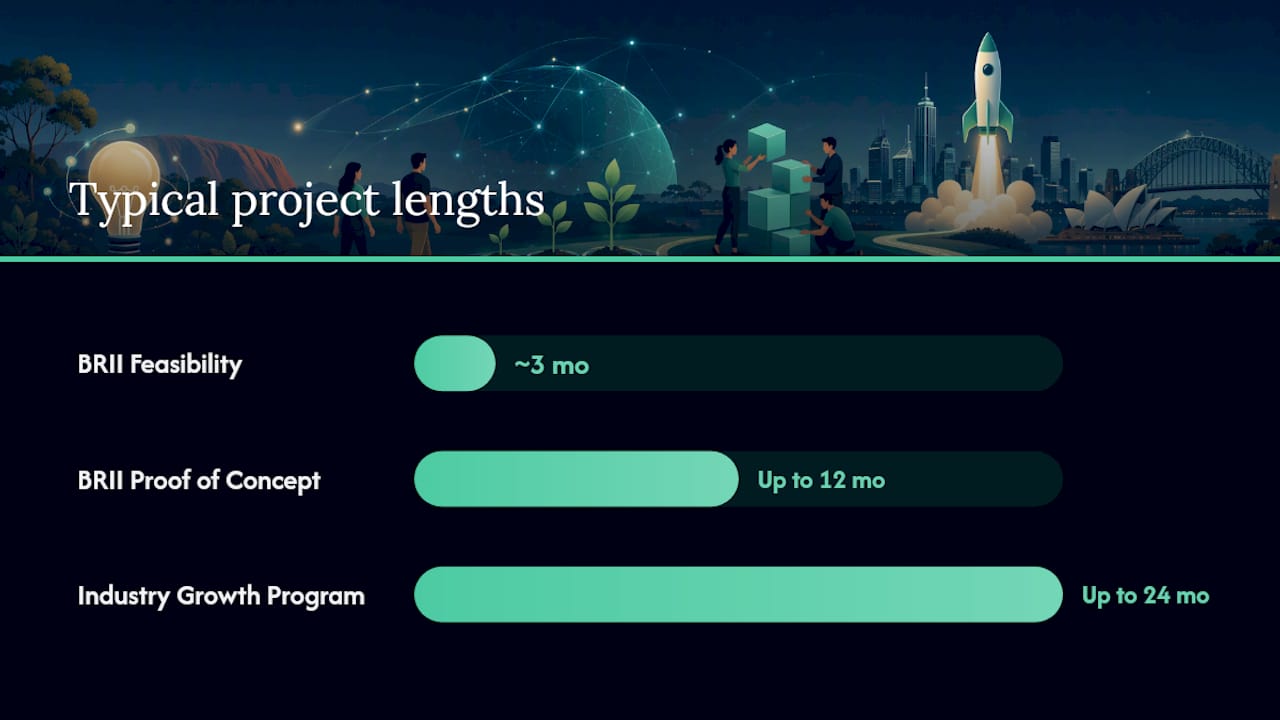
BRII runs challenge-based rounds where the government publishes specific policy or service-delivery problems and invites startups to pitch solutions. Feasibility grants reach up to $100,000 (typically a three-month sprint), and proof-of-concept grants go up to $1 million for projects running up to 12 months. You’re not pitching a generic product; you’re responding to a named government challenge, which means your application needs to map directly to the problem statement. Rounds open periodically, so timing matters.
CSIRO Kick-Start
CSIRO Kick-Start connects startups with CSIRO’s research expertise through matched funding. If your project needs scientific validation, materials testing, or access to specialist research infrastructure, this program pairs you with a CSIRO team and matches your cash contribution. It’s particularly useful for deep-tech and biotech founders who need third-party technical credibility before approaching larger grant programs or investors.
Industry Growth Program and NRF-aligned grants
The Industry Growth Program sits within the National Reconstruction Fund ecosystem and prioritizes projects in robotics, AI, renewables, medical manufacturing, and critical minerals. If your startup operates in one of these sectors, alignment to NRF priority areas materially increases your program fit and assessor interest. Commercialization grants in this stream can be substantial, though specific round amounts vary by cohort and are published on the Department of Industry, Science and Resources portal.
Export Market Development Grants (EDMG)
EDMG reimburses eligible export promotion costs through Austrade, covering activities like overseas trade shows, international marketing, and in-market business development. It’s tiered, so the reimbursement scales with your export spend. For startups with an international go-to-market plan, EDMG is a practical way to offset the cash cost of entering new markets without diluting equity.
Program snapshot:
| Program | Typical grant range | Co-contribution | Typical project length |
|---|---|---|---|
| R&D Tax Incentive | Refundable offset on eligible spend | Your R&D expenditure | Ongoing (annual claim) |
| BRII Feasibility | Up to $100,000 | Varies by round | ~3 months |
| BRII Proof of Concept | Up to $1 million | Varies by round | Up to 12 months |
| CSIRO Kick-Start | Matched funding | Dollar-for-dollar match | Short project sprints |
| EDMG | Tiered reimbursement | Your export spend | Annual claim |
| Industry Growth Program | Varies by round | 25–50% typical | Up to 24 months |
How do state and territory startup programs differ from national ones?
State programs tend to move faster, open in shorter rounds, and target specific regional or demographic priorities. The amounts are smaller, but the competition pool is also smaller, and some states reserve higher match rates or dedicated pools for under-represented founders.
Here’s a representative example from each jurisdiction to check first:
- New South Wales: The MVP Ventures Program offers pre-market development grants from $20,000 up to $75,000, with co-contribution rules that vary by stream and priority group (women founders and regional businesses often qualify for reduced co-contribution).
- South Australia: The Seed-Start stream within the Research and Innovation Fund supports early-stage commercialization; check the SA state development portal for current round details and eligibility.
- Queensland: The Ignite Ideas Fund supports Queensland-based startups with grants for product development and commercialization; check the Business Queensland portal for active rounds.
- Western Australia: The Innovation Booster Grant is part of the $40 million New Industries and Innovation Fund (2025–29) and provides matched funding plus commercialization support for WA-based startups.
- ACT: The ICON program supports Canberra-based startups with grants for early-stage product development; details are published on the ACT Government business portal.
- Tasmania: Smaller programs exist through the Tasmanian Government’s business support portal; amounts are modest but competition is lower, making them worth checking for regional founders.
- Victoria and NT: Check the LaunchVic portal (Victoria) and the NT Government business grants page for current rounds, as programs open and close frequently.
Pro Tip: State programs often have priority-group provisions that reduce your co-contribution requirement or increase your grant percentage. If you’re a woman founder, based in a regional area, or your business is majority Indigenous-owned, check the eligibility notes carefully before assuming the standard co-contribution rate applies to you.
How to use the business.gov.au Grants & Programs Finder effectively
The Finder is comprehensive but noisy. Going in without a clear project definition means you’ll spend an hour scrolling past irrelevant programs. Spend five minutes on this before you open it.
Before you filter, define:
- Your R&D goal in one sentence (what technical problem are you solving?)
- Your Technology Readiness Level (TRL) — are you at concept, prototype, or pilot stage?
- Your project timeline and total budget
- Your preferred funding range (minimum grant size worth your application effort)
Then work through the Finder in this order:
- Go to the Grants and programs finder on business.gov.au.
- Select your jurisdiction — start with “All Australia” to catch national programs, then re-run with your state to catch state-specific rounds.
- Set your business structure (company, partnership, sole trader) — this immediately removes programs you’re ineligible for.
- Select your policy area — AI, advanced manufacturing, health, renewables, or whichever sector your project sits in. This is the highest-signal filter.
- Set a project timeframe and funding range to remove programs that don’t match your stage or budget.
- Save or export the shortlist. Programs open and close; bookmark the ones that are currently closed so you can apply in the next round.
Publication note: When publishing this article, include a screenshot of the Finder UI at step 1 to orient readers who haven’t used the portal before. The exact URL is business.gov.au/grants-and-programs.
What do assessors actually look for in grant applications?
Before you invest 40 hours writing an application, run this self-screen. Most programs share a common eligibility baseline and a consistent set of assessment criteria.
Eligibility essentials
- Active ABN registered to an eligible entity type (companies are the most broadly eligible; sole traders are excluded from most programs).
- Australian headquarters or primary activity in Australia — some programs require a majority of R&D activity to occur onshore.
- IP ownership or rights to commercialize — you need to own or have a clear license to the IP your project will generate.
- Turnover and FTE thresholds — state programs often cap eligibility at a specific annual turnover (commonly under $5 million or $10 million) or headcount. Check each program’s guidelines.
- Additionality — the grant must fund activity you wouldn’t otherwise do, or couldn’t do at the same scale, without the funding. Assessors look for evidence that the grant genuinely accelerates or enables the project.
What assessors score
- Innovation and novelty: Is there genuine technical uncertainty? Can you articulate what’s new about your approach?
- Commercial viability: Is there a credible market, a clear customer, and a path to revenue?
- Deliverability: Are your milestones realistic? Does your team have the capability to execute?
- Value for money: Is the grant amount proportionate to the expected outcome and the co-contribution you’re putting in?
- Alignment to priority areas: For NRF-aligned programs, does your project map to robotics, AI, renewables, or another listed priority?
Vague budget lines are one of the fastest ways to lose points.
How do you prepare a stronger grant application?
The difference between a funded application and a near-miss usually comes down to specificity. Here’s what to do and what to avoid.
Do:
- Map your project to a specific TRL milestone (e.g., “moving from TRL 3 to TRL 5 over 6 months”).
- Write milestones as measurable outcomes, not activities (“prototype validated with 3 pilot customers” beats “complete prototype”).
- Itemize every budget line with a clear rationale — labor hours, contractor rates, materials, and testing costs.
- Include letters of support from industry partners, pilot customers, or research collaborators. A letter from a named organization carries more weight than a general market statement.
- State your IP position clearly: what you own, what you’re creating, and how you’ll protect it.
- Identify your top two risks and describe your mitigation plan. Assessors know projects have risks; pretending otherwise reads as naive.
Don’t:
- Overstate your TRL. Assessors are experienced; claiming TRL 6 when you have a wireframe damages credibility.
- Submit a generic project description that could apply to any startup. Every sentence should be specific to your project.
- Leave co-contribution evidence vague. Show bank statements, signed agreements, or confirmed in-kind commitments.
- Ignore the program’s challenge statement (for BRII) or priority area alignment (for NRF programs). Applications that don’t directly address the stated problem rarely score well.
Pro Tip: If you’re working with an engineering partner to build your MVP, ask them to provide a written technical scope and cost breakdown. This document serves double duty: it’s your matched-funding evidence and your technical validation in one. Assessors respond well to third-party cost confirmation because it removes the “founder optimism” discount from your budget.
Why an R&D-ready MVP strengthens your grant chances
Grant assessors penalize perceived technical risk. An R&D-ready MVP, one built with documented hypotheses, tracked experiments, and TRL-mapped milestones, directly reduces that perceived risk and gives you concrete evidence to cite in your application.
The R&D Tax Incentive works alongside grants rather than competing with them. Structuring your MVP build as eligible R&D activity means you can claim the refundable offset on the same engineering work that your grant application references as technical progress. That’s two funding streams from one body of work, provided the documentation is done correctly from day one.
What “R&D-ready” actually means in practice
- Document your hypothesis before you build: What technical question are you answering? What would a failed experiment look like?
- Log engineering time by activity: Time logs tied to specific R&D activities are the primary evidence for an R&D Tax Incentive claim and strengthen your grant budget justification.
- Define TRL milestones in your project plan: TRL 3 (proof of concept), TRL 4 (lab validation), TRL 5 (relevant environment testing) — map each sprint to a milestone.
- Track experiment outcomes: Positive and negative results both count. Negative results prove you’re doing genuine R&D, not just building a known solution.
- Align budget lines to eligible activities: Separate R&D labor from non-R&D work in your accounting from the start. Mixing them creates a compliance problem later.
Before and after, in practice:
- Before: A founder submits a grant application describing their product as “an AI scheduling tool.” No TRL evidence, no experiment logs, no technical risk articulation. Result: low innovation score, no funding.
- After: The same founder, having built an R&D-ready MVP, submits with TRL 4 evidence, documented hypotheses about their NLP model’s accuracy thresholds, engineering time logs, and a third-party cost breakdown. Result: stronger innovation and deliverability scores, eligible for R&D Tax Incentive claim on the same build.
Pro Tip: Start your R&D documentation on day one of the build, not the day before you file your tax return. Reconstructed records are a red flag for AusIndustry reviewers and reduce the defensibility of your claim. A simple shared doc with dated entries is enough to start.
For a deeper look at structuring MVP work for the R&D Tax Incentive, the Zatersio guide on MVP and R&D Tax Incentive structuring walks through the documentation approach in detail.
What are realistic timelines and costs when applying for grants?
Grants take longer than most founders expect. Building them into your cash flow plan from the start prevents the painful situation of winning a grant and then running out of runway before the first payment arrives.
Typical round timelines:
- Feasibility grants (e.g., BRII feasibility): Assessment and decision typically within 3 months of round close.
- Proof-of-concept grants (e.g., BRII PoC): Project duration up to 12 months; payment is usually milestone-based, not upfront.
- Commercialization grants (e.g., Industry Growth Program streams): Project durations can extend to 24 months, with quarterly or milestone-based reporting and payment.
- R&D Tax Incentive: Annual claim cycle; cash arrives after your tax return is processed, typically 6–12 months after the financial year ends.
Budget considerations:
- Co-contribution ratios of 25–50% are common across most programs. If a grant covers 50% of a $200,000 project, you need $100,000 in confirmed cash or in-kind before you apply.
- Internal staffing time to prepare a competitive application runs 2–6 weeks for a first-time applicant. Factor this into your team’s capacity plan.
- Some founders use R&D financing (short-term loans against expected R&D Tax Incentive refunds) to bridge the gap between engineering spend and the annual cash return. This is worth exploring if your R&D spend is significant and your runway is tight.
A practical schedule for a founder:
- Weeks 1–6: Internal prep — define project scope, gather co-contribution evidence, draft project plan and milestones, confirm team availability.
- Weeks 6–18: Application window open, submit, assessment period (4–12 weeks is typical, longer for larger grants).
- Weeks 18–26: Negotiation and contracting (2–8 weeks after a successful assessment before funds are confirmed).
Grants are patient capital, targeted to discrete R&D milestones rather than day-to-day cash flow. Plan your runway accordingly.
What’s the honest advice for founders approaching grants?
Most founders I work with treat grants as a lottery. They apply to everything, tailor nothing, and then wonder why they’re not getting funded. The founders who consistently win grants do the opposite: they pick one or two programs that genuinely fit their project stage, align their application to the program’s stated priorities, and show up with documented technical progress rather than a slide deck.
The R&D Tax Incentive is the one program I’d tell every eligible software startup to structure for from day one, regardless of whether they’re pursuing competitive grants. It’s not a grant in the traditional sense, but the refundable offset for small claimants makes it the most reliable non-dilutive funding mechanism available in Australia. Getting the documentation right from the start of your MVP build costs almost nothing extra and can return meaningful cash at tax time.
For competitive grants, my honest stance is this: prioritize programs that validate technical risk and commercial demand at your current TRL. A $30,000 state grant that doesn’t move your TRL or strengthen your investor narrative is a distraction. A $100,000 BRII feasibility grant that forces you to articulate your technical hypothesis and test it against a real government challenge is worth ten times that in signal value, even before the cash lands.
Zatersio’s approach of building R&D-ready MVPs with structured documentation exists precisely because we’ve seen how much easier the grant conversation becomes when a founder can point to a working prototype, a TRL milestone, and a clean set of engineering time logs. That’s not just good grant hygiene. It’s good product discipline.
Fixed-price MVP builds designed to strengthen your grant narrative
Getting a grant often comes down to one thing: demonstrable technical progress. Assessors want to see that your project is real, your team can execute, and your budget is grounded in actual engineering costs.
Zatersio builds R&D Tax Incentive-ready MVPs at fixed prices, typically delivered in under two weeks, with the documentation structure assessors expect: hypothesis records, TRL-mapped milestones, engineering time logs, and itemized cost breakdowns. That package gives you the technical validation evidence your grant application needs and a working product your customers can use. For founders building AI agents or automation prototypes that map to NRF priority areas, Zatersio’s builds are structured to align with eligible R&D activities from the first sprint.
Services available: MVP development, R&D documentation support, AI automation prototypes, and workflow automation builds. All projects include Australian data residency and direct access to your engineering team throughout.
To get a fixed-price quote and see how your project maps to R&D Tax Incentive eligibility, visit Zatersio’s MVP development page and submit your project brief.
Sources
Bookmark these directly. Program rules change between rounds, and the official pages are the only reliable source for current eligibility, amounts, and open dates.