
Call Center Automation: A Decision-Maker's Pilot Guide
Call Center Automation: A Decision-Maker’s Pilot Guide
Call center automation is the use of AI-driven software to handle inbound and outbound call intake, route callers intelligently, assist agents in real time, and complete backend workflows without manual effort. The verdict: deploy it now, but start with a time-boxed MVP pilot scoped to your top two or three call drivers.
Quick verdict:
- AHT drops when virtual agents handle routine queries end-to-end and real-time agent assist surfaces answers instantly, cutting the time agents spend searching.
- CSAT improves when callers get faster resolutions, 24/7 coverage, and fewer unnecessary transfers.
- Containment rate is your clearest early signal: if your pilot resolves 40%+ of targeted call types without a live agent, the business case writes itself.
The recommended immediate action is a fixed-price MVP pilot, scoped to your highest-volume, lowest-complexity call driver, with a four-to-six-week build timeline and clear KPI baselines set before day one. Gartner predicted that chatbots would become a primary customer-service channel within five years, and the operational case for moving now is stronger than it has ever been. Zatersio builds these pilots at a fixed price, with working software delivered in under two weeks.
Table of Contents
- The software features vendors actually sell, and what they look like in production
- High-ROI pilot ideas to start with
- The governance and compliance controls you cannot skip
- How to choose the right vendor or solution
- How an MVP-first approach delivers early value, fast
- Key Takeaways
- What actually works in practice
- Zatersio builds your AI voice agent at a fixed price, fast
- Useful sources for further research
The software features vendors actually sell, and what they look like in production
Call center automation platforms bundle capabilities into feature categories that vary significantly in maturity. Knowing what each one does in a real call scenario helps you cut through demo theater.
| Feature Category | What It Does in a Real Call | Maturity Signal to Test |
|---|---|---|
| AI receptionist / virtual agent | Greets caller, classifies intent, resolves or routes | Test with ambiguous phrasing and mid-sentence topic changes |
| Intelligent IVR and predictive routing | Routes based on intent, history, and agent skill, not just key presses | Ask vendor to show routing logic and fallback when no match |
| Real-time agent assist | Surfaces KB articles, scripts, and next-best-action during live calls | Test latency: must surface within 2–3 seconds to be useful |
| Post-call automation | Auto-generates wrap-up notes, updates CRM, queues follow-ups | Verify CRM field mapping in a sandbox before committing |
| Workforce optimization | Forecasts volume, schedules agents, flags adherence gaps | Ask for historical accuracy data on forecasts |
| QA and analytics | Scores calls for sentiment, compliance, and quality automatically | Check whether scoring is rules-based or LLM-driven |
| Orchestration and RPA | Executes backend tasks (lookups, updates) without agent input | Test with your actual legacy systems, not just demo data |
AI receptionists in production handle inbound calls end-to-end: greeting, intent classification, data lookup, and resolution or warm transfer. Modern systems support multiple languages and integrate with calendars and CRMs for live booking. The gap between a polished demo and a production-ready deployment is usually in the edge cases: callers who change their mind mid-sentence, heavy accents, or requests that span two intent categories.

Real-time agent assist is one of the highest-ROI features available, because it reduces AHT on every agent-handled call, not just the ones automation contains. The catch is latency: if the suggestion appears after the agent has already moved on, it adds cognitive load rather than removing it.
Post-call automation removes the wrap-up busywork that can add two to five minutes per call. Automatic CRM updates, disposition tagging, and follow-up task creation are well-proven at this point. The integration work is the variable: a vendor who can connect to your CRM in a sandbox within a week is a different proposition from one who needs a custom connector built over months.
Pro Tip: During vendor demos, ask them to run three failure scenarios: a caller who says something completely off-script, a mid-call transfer that drops context, and a backend lookup that returns an error. How the system fails tells you more than how it succeeds.
Vendor demos almost always show the happy path. Production readiness shows in how the system handles failure, how quickly it escalates, and whether the transfer experience preserves caller context. Insist on a sandbox environment with your own test cases before signing anything.
High-ROI pilot ideas to start with
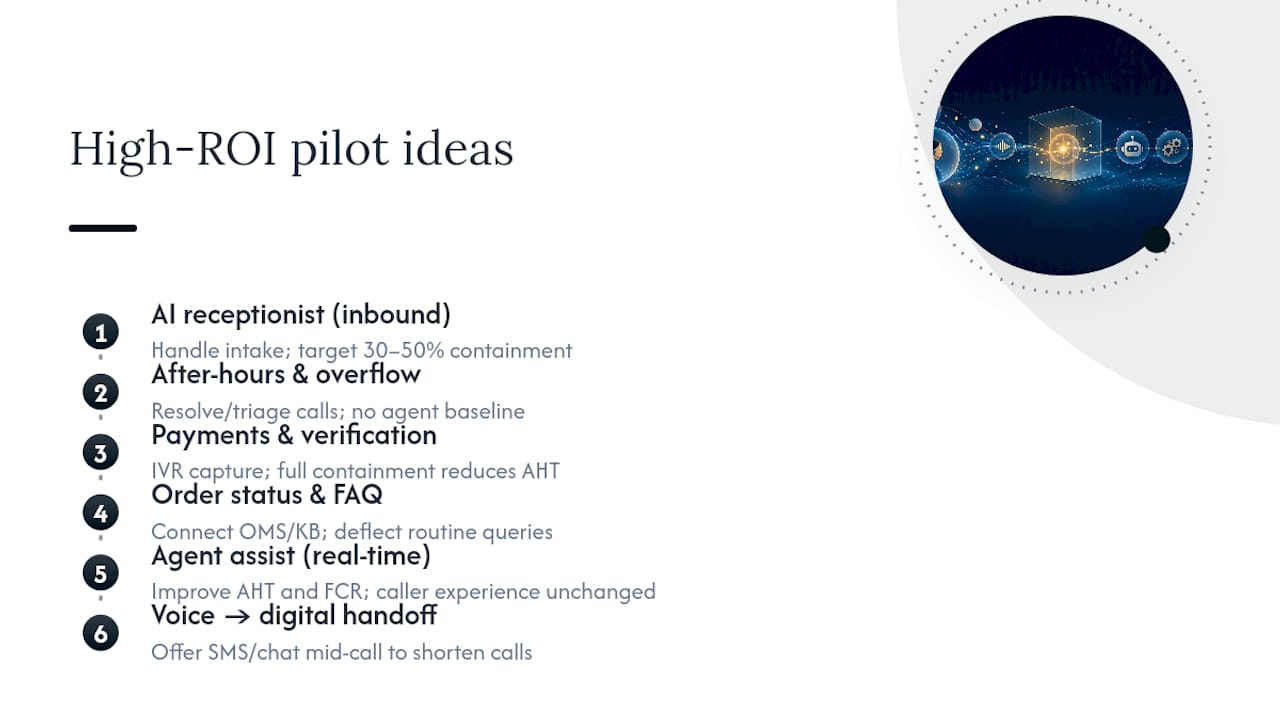
The fastest path to a defensible business case is a pilot scoped to one or two call types that are high in volume, low in complexity, and currently eating agent time. Agentic automation trends for 2026 point to voice AI and RPA as the capabilities with the most immediate operational impact, and the use cases below reflect that.
1. AI receptionist for inbound calls Deploy an AI phone receptionist to handle 100% of inbound call intake: greet, classify, and either resolve or route. Target containment of 30–50% on routine inquiry types. Success criteria include a meaningful containment rate, high transfer accuracy, and comparable CSAT scores on contained calls relative to those handled by live agents. Vendor-reported metrics for AI receptionist deployments—such as Synthflow’s up to 65% routine request automation and 60% scheduling efficiency gain—are achievable in scenarios with deep integration and well-trained NLU models, though typical pilots may target 30–50% containment on routine inquiry types.
2. After-hours and overflow coverage An AI voice agent handles calls when agents are unavailable, capturing intent, answering FAQs, and booking callbacks or appointments. This is one of the safest first pilots because there is no live-agent baseline to displace. A substantial portion of after-hours calls can be resolved or triaged without a missed-call outcome.
3. Automated payment and verification flows IVR-based payment capture and identity verification are well-proven, low-risk automation targets. Callers authenticate, make payments, or verify account details without agent involvement. Expected AHT reduction on these call types: significant, since the entire call is contained.
4. Order status and FAQ deflection Connect the AI agent to your order management system or knowledge base. Callers ask about order status, store hours, or policy questions and get an answer without waiting for an agent. Vendor-reported outcomes for this type of automation vary; Synthflow, for example, reports automation of a high proportion of routine voice requests in large-scale deployments, though individual results depend on integration depth and call mix.
5. Agent-assist for callbacks and escalations Rather than automating the call itself, deploy real-time agent assist on every agent-handled call. This is a lower-risk entry point that improves AHT and FCR without changing the caller experience at all.
6. Blended voice and digital handoffs For callers who prefer to continue on a digital channel, the voice agent offers an SMS or chat handoff mid-call. This reduces call duration and gives the caller a more convenient resolution path.
End-to-end scenario (after-hours booking): A caller rings a healthcare clinic at 9 PM. The AI receptionist greets them, identifies the intent as “book an appointment,” checks the calendar API for available slots, confirms the booking, sends an SMS confirmation, and logs the interaction in the CRM. The caller never waits on hold, and the clinic’s front desk arrives the next morning with the appointment already in the system.
The governance and compliance controls you cannot skip
Deploying AI-driven phone answering automation in the U.S. without a governance framework is how organizations end up with regulatory exposure and broken caller experiences.
U.S. compliance checklist:
- TCPA (Telephone Consumer Protection Act) — governs outbound automated calls and texts. Prior express written consent is required for marketing calls to cell phones using an autodialer or prerecorded voice. Violations carry statutory damages of $500–$1,500 per call.
- CCPA/CPRA — California residents have the right to know what data is collected, to request deletion, and to opt out of sale. Your automation stack must support data-subject request workflows and enforce retention limits.
- Recording consent — federal law requires one-party consent, but California, Florida, Illinois, Pennsylvania, and several other states require all-party consent. Your system must play a recording disclosure before capturing audio in those states.
- Healthcare (HIPAA) — if your contact center handles PHI, your AI vendor must sign a Business Associate Agreement (BAA) and your data flows must be HIPAA-compliant.
- Financial services (GLBA, FDCPA) — debt collection automation has specific restrictions under the FDCPA; financial data handling falls under GLBA safeguards.
Governance controls to build in from day one:
- Full logging and audit trails for every automated interaction
- Model monitoring with regular intent-accuracy reviews (weekly during pilot, monthly in production)
- Warm-transfer policies with clear escalation triggers (caller distress, unrecognized intent, explicit agent request)
- Human-in-the-loop thresholds: define the conditions under which the system must escalate, and never let the AI decide those conditions on its own
- Auto-QA scoring on a sample of contained calls to catch drift in model performance
Operational pitfalls that appear most often in production: over-automating empathy-sensitive call types (complaints, bereavement, medical emergencies) where a human response is the only acceptable one; poor handoff design that drops caller context at transfer; and brittle intent models that degrade when call volume patterns shift seasonally.
Red flags in vendor proposals: No audit log capability, opaque model update schedules (you should know when the model changes), unclear data residency (especially relevant if you operate in California or handle healthcare data), and missing SLAs for transfer latency or system uptime.
This article provides general information about U.S. regulations affecting call center automation. Confirm current rules with a qualified legal or compliance professional for your specific situation.
How to choose the right vendor or solution
Most vendor pitches look similar at the demo stage. The questions below are designed to surface the gaps that only appear in production.
Must-have vs. nice-to-have:
Must-have: REST API or webhook support, pre-built connector to your CRM, sandbox environment for testing, warm-transfer capability with context passing, TCPA/CCPA compliance controls, audit logging, SLA for uptime and transfer latency.
Nice-to-have: multi-language support, sentiment analysis, workforce optimization module, LLM-driven generative responses, predictive routing based on customer history.
Ten vendor questions for RFPs and demos:
- Show me a warm transfer in your sandbox where the receiving agent sees the full call context pre-populated.
- How does your system handle an intent it has never seen before? Walk me through the fallback behavior.
- What is your model update cadence, and how are we notified before a model change goes live?
- Can we export all transcripts, recordings, and intent logs at any time, in a standard format?
- What is your data residency model, and where is our call data stored?
- Show me your TCPA consent management workflow for outbound campaigns.
- What is your SLA for transfer latency, and what happens when you miss it?
- How do we customize intent models for our specific call types, and who does that work?
- Walk me through your pricing at 2x and 5x our current volume.
- If we decide to leave, what does the data portability and exit process look like?
Red flags in vendor answers: pricing that only makes sense at low volume and spikes unpredictably at scale; no sandbox environment before contract signing; intent model customization that requires the vendor’s professional services team for every change; data residency answers that are vague or vary by sales rep.
Scoring guidance: weight technical fit and integration readiness at 40%, time-to-value (how fast can you go live?) at 35%, and total cost of ownership over 24 months at 25%. A vendor who can go live in four weeks with your existing CRM is worth more than one with a richer feature set that needs six months of integration work.
How an MVP-first approach delivers early value, fast
The most common mistake in contact center automation projects is scoping too broadly from the start. A professional services firm recently worked with Zatersio to deploy an AI voice agent scoped to a single, high-volume call type: appointment booking and rescheduling. The MVP was built and live within two weeks. In the first month of operation, the agent handled the majority of after-hours booking requests without human intervention, and the front-desk team reported a measurable reduction in morning callback queues.
The deliverables for that MVP were deliberately narrow: a working voice agent with calendar API integration, a CRM sync for every completed booking, a basic analytics dashboard showing containment rate and transfer frequency, and a documented escalation flow for calls the agent could not resolve. Nothing more. That constraint is what made it fast.
After four weeks of live data, the team identified two additional intent types that appeared frequently in transfer logs: cancellation requests and insurance verification queries. Those became the scope for phase two, funded by the ROI data from phase one.
The lesson is consistent across deployments: prove containment on one call type, measure it rigorously, and use that data to justify the next phase. An MVP that goes live in two weeks and delivers measurable results in four is a stronger business case than a six-month project that promises everything at once.
If you are ready to scope a fixed-price pilot, Zatersio’s AI agents for business page outlines the deployment approach and integration options.
Key Takeaways
Call center automation delivers the fastest ROI when scoped to a single high-volume call type, measured against clear KPI baselines, and built as a fixed-price MVP pilot before any broader rollout.
| Point | Details |
|---|---|
| Start with your top call drivers | Scope your pilot to the one or two call types with the highest volume and lowest complexity for the fastest containment gains. |
| Track five KPIs from day one | AHT, FCR, containment rate, CSAT, and cost per contact are the metrics that build your business case and justify scale. |
| Governance is not optional | TCPA, CCPA, state recording-consent rules, and audit logging must be built into the architecture before go-live, not added later. |
| Vendor selection turns on integration speed | A vendor who can connect to your CRM in a sandbox within a week is worth more than one with a richer feature set that needs months of integration work. |
| Zatersio delivers working MVPs fast | Fixed-price, engineer-built AI voice agents go live in under two weeks, with CRM integration and analytics included from the start. |
What actually works in practice
The gap between what automation vendors promise and what organizations actually achieve in the first six months is almost always an integration and scoping problem, not an AI problem. The technology is capable. The failure mode is deploying it across too many call types at once, with integrations that are not ready, and no clear baseline to measure against.
What works consistently: start with one call type, connect it deeply to the CRM so the agent has real data to work with, set a containment rate target before you go live, and measure weekly for the first month. Organizations that follow that sequence get usable ROI data in four to six weeks. Those that skip the scoping discipline spend months chasing a moving target.
The single most important decision is not which vendor to choose. It is committing to a narrow, well-defined pilot scope and measuring it honestly.
Zatersio builds your AI voice agent at a fixed price, fast
If your contact center is still routing every call to a live agent, you are paying for busywork that AI can handle today. Zatersio builds engineer-designed AI voice agents and custom automation MVPs at a fixed price, with working software delivered in under two weeks. No retainers, no open-ended scopes, no surprise invoices.
The difference from a traditional implementation project: you get a live, integrated voice agent scoped to your top call drivers, with CRM sync and an analytics dashboard, before most vendors have finished their discovery phase. Sectors served include healthcare, legal, financial services, and trades. For eligible projects, Zatersio structures builds to support R&D Tax Incentive readiness, though applicability to U.S. operations varies and should be confirmed with your tax advisor.
Ready to see what a two-week pilot looks like for your call volume? Start the conversation and get a fixed-price scope within 48 hours.
Useful sources for further research
- Gartner press release: Chatbots prediction
- Contact Center Automation Trends for 2026 and Beyond
- Call Center Automation: A Practical Guide | NiCE
- Contact Center Agentic Automation | UiPath
- Contact Center Automation: Benefits, Tools & Best Practices
- Enterprise AI Receptionist: 24/7 Intelligent Call Answering AI