
DevOps: 5 Steps to Choose Australian Cloud Regions and Keep Data Local
DevOps: 5 Steps to Choose Australian Cloud Regions and Keep Data Local
AWS, Google Cloud, and Microsoft Azure each run at least two physical regions inside Australia, and Oracle Cloud maintains a regional footprint here too. AWS covers Sydney and Melbourne, Google Cloud runs australia-southeast1 and australia-southeast2. Azure spans four named regions including two restricted ones. Choosing among them comes down to three things: data residency controls, whether the services you need actually run in that region, and how latency and disaster recovery shape your architecture.
TL;DR:
- Australia has two main AWS regions in Sydney and Melbourne, each with three availability zones, but services can vary between regions and need verification.
- Data residency controls, such as GCP’s resource location policies or Azure’s restricted regions, are essential to prove compliance, not just for onshore hosting.
- Latency is primarily influenced by network infrastructure, making local PoPs and dedicated connections like Direct Connect or Interconnect crucial for performance and cost management.
- Cross-region disaster recovery in Australia often involves layered planning with multi-AZ setups, cross-region replications, and active-active configurations where justified.
- Ensuring compliance requires a combination of resource location enforcement, in-region encryption keys, detailed audit logs, and early infrastructure validation before migration.
Table of Contents
- What Cloud Regions Exist in Australia Right Now?
- How Do Regions, Availability Zones, and PoPs Actually Work?
- What Do AWS, Google Cloud, Azure, and Oracle Each Offer in Australia?
- How Do You Choose the Right Region for an Australian Deployment?
- What Data Residency Controls Actually Protect Your Workload?
- What Networking and DR Patterns Work Best in Australia?
- What Should Your Deployment Checklist Look Like?
- Zatersio’s Take on Fast, Compliant Builds in Australia
- Build Your Next Australian Deployment With a Team That Owns the Whole Stack
- Sources
- FAQ
What Cloud Regions Exist in Australia Right Now?
Before picking a provider, you need a straight answer on what physically exists on Australian soil, how many availability zones back each region, and whether any of them come with access restrictions. The table below is the reference architects keep bookmarked when scoping a new workload.
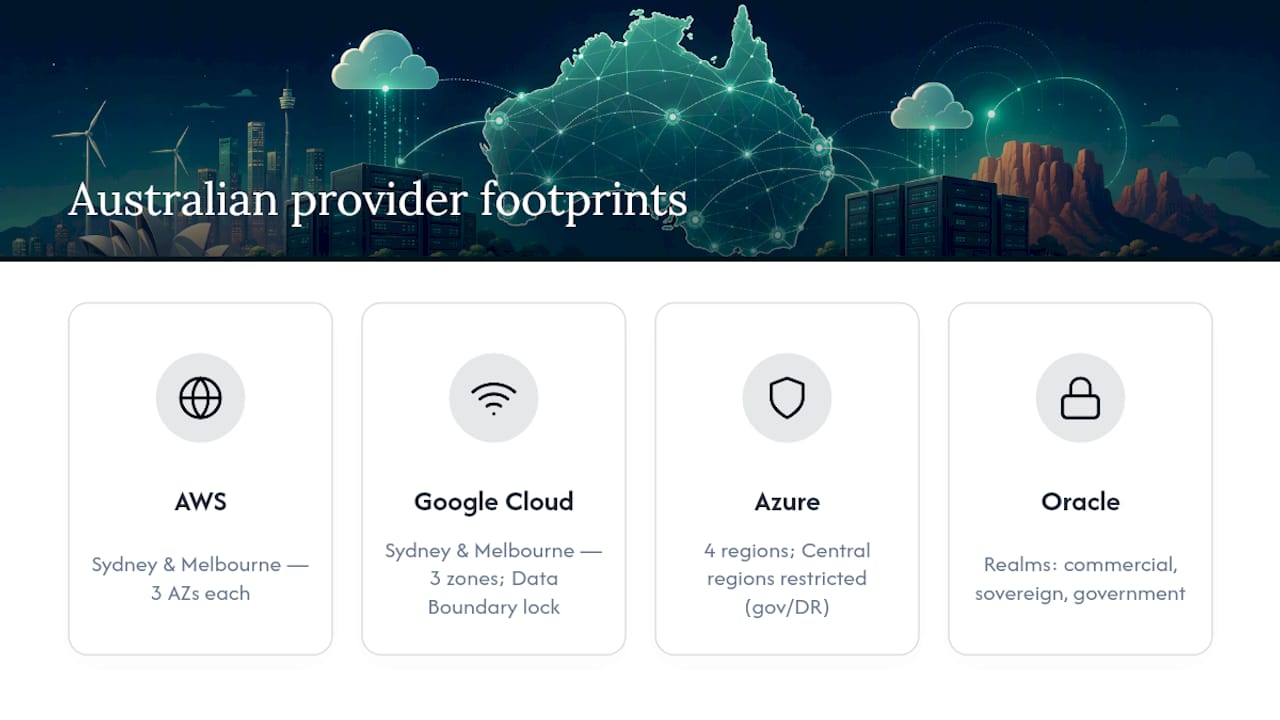
AWS documents three Availability Zones in each of its Australian regions, and Google Cloud publishes the same three zone count for both australia-southeast1 and australia-southeast2. Azure’s region list flags Australia Central and Australia Central 2 as restricted regions, meaning access typically requires a request tied to a specific use case such as government workloads or in-country disaster recovery. Oracle groups its Australian presence under its Australia & New Zealand regions page, which also explains its realm system for commercial, sovereign, and government deployments.
Before committing to any region, cross check the specific services and instance types you plan to use against each provider’s live availability matrix. Region tables go stale fast as providers roll out new services on their own schedule.
How Do Regions, Availability Zones, and PoPs Actually Work?
A region is a geographic area with its own set of data centers. An availability zone (AZ) is an isolated cluster inside that region, usually with independent power and networking. A point of presence (PoP) or edge location is neither. It is a smaller facility that caches content or terminates network traffic closer to users, without hosting your full compute stack.
Confusing these three is the most common mistake teams make when they promise a client “multi-region resilience” and actually deliver multi-AZ resilience within a single geography. Here’s how the three actually differ operationally:
- Region: the top-level container for your resources, tied to a specific city or metro area (Sydney, Melbourne, Canberra).
- Availability zone: a physically separate facility within that region, built to survive a single data center failure without moving your data across the country.
- PoP or edge location: a lightweight node used for content delivery, DNS resolution, or connectivity, not for running your primary databases or application servers.
Spreading a workload across three AZs in Sydney protects you from a fire, a power outage, or a network fault in one building. It does not protect you if an event takes out the entire Sydney metro area, which is why AZ redundancy and cross-region disaster recovery solve different problems. If your recovery point objective (RPO) requires near-zero data loss and your recovery time objective (RTO) is measured in minutes, multi-AZ is often enough. If regulatory or business continuity requirements demand survival of a full regional outage, you need a second Australian region such as Melbourne or Canberra in the mix.
PoPs matter for a different reason entirely: latency to end users. A Perth based customer hitting an application hosted purely in Sydney will see meaningfully higher round trip times than one hitting a local edge cache first. Providers place PoPs and Direct Connect or Interconnect locations in Sydney, Melbourne, Perth, and Canberra specifically to shrink that gap for static content, API responses, and DNS lookups, even when your compute stays centralized in one region.
What Do AWS, Google Cloud, Azure, and Oracle Each Offer in Australia?
Every major provider has invested seriously in Australian infrastructure, but the details that matter for your deployment decision differ enough to warrant a side by side look at each one on its own terms.
AWS runs Asia Pacific (Sydney) and Asia Pacific (Melbourne), each with three Availability Zones. AWS backed the Melbourne build with a planned A$6.8 billion investment through 2037, a scale of commitment that signals the region isn’t a short-term experiment. Direct Connect locations extend into Sydney, Melbourne, Perth, and Canberra, giving teams private, predictable connectivity options outside the public internet. Before locking in a service, check AWS’s regional services list directly, since not every AWS service launches simultaneously in both Australian regions.
Google Cloud operates australia-southeast1 (Sydney) and australia-southeast2 (Melbourne), both with three zones apiece. What sets GCP apart here is its Australia Data Boundary control package, an organization policy constraint (gcp.resourceLocations) that can be locked to those two regions to physically prevent resource creation anywhere else. GCP also runs edge PoPs across major Australian cities for its content delivery and networking products.
Azure lists four regions: Australia East, Australia Southeast, Australia Central, and Australia Central 2. East and Southeast are generally accessible; the two Central regions are restricted regions, reserved for specific customer scenarios like in-country disaster recovery for government or highly regulated entities. Before you design around any Azure region, check the products by region table, because zone redundancy and paired-region behavior differ from region to region.
Oracle Cloud maintains an Australia & New Zealand regional presence and organizes its infrastructure into realms: commercial, sovereign, and government. That realm distinction matters more with Oracle than with the other three providers, since it determines which customers can even provision resources in a given regional footprint. Oracle’s public cloud regions page is the place to confirm which realm applies to your organization before you start a proof of concept.
How Do You Choose the Right Region for an Australian Deployment?
Pick a region using a compliance-first sequence, not a latency-first one. Teams that reverse this order often discover midway through a build that their preferred region can’t legally hold the data they’re storing, forcing a costly re-architecture. Work through these five steps in order.
- Map your compliance and data residency requirements first. Decide whether your workload legally or contractually requires data to stay strictly onshore, or whether occasional cross-border transit (for backups, analytics, or support tooling) is acceptable. Healthcare records, government contracts, and some financial services data typically demand in-country-only handling; a consumer app with no regulated data might not.
- Verify that every required managed service actually runs in your candidate region. A region existing on paper doesn’t mean every database engine, AI service, or managed queue is available there yet. Check each provider’s live region services matrix rather than relying on a general region list, since gaps between Sydney and Melbourne availability are common in newer service categories.
- Measure latency from your actual user population, not from a generic benchmark. If most of your users sit in Melbourne and Sydney, either region performs reasonably well thanks to the fiber backbone connecting Australia’s east coast. If you serve Perth or regional Western Australia heavily, factor in edge PoPs and content delivery layers to offset the extra distance.
- Decide between AZ-only resilience and cross-region replication, and price out both. Multi-AZ within Sydney or Melbourne costs less and covers most operational failures. Cross-region replication between Sydney and Melbourne costs more in data transfer and engineering complexity but protects against a full regional event. Testing recovery times between the two cities as separate geographies, rather than assuming they behave identically, avoids brittle failover assumptions later.
- Confirm your networking path before you migrate a single workload. Check whether Direct Connect, Dedicated Interconnect, or the equivalent exists in your target city, what bandwidth tiers cost, and how egress pricing shifts if you split workloads across two regions. Run a small migration test with representative data volumes before committing production traffic, because theoretical throughput numbers rarely match what you see once real query patterns hit the network.
Pro Tip: Run your region shortlist through the provider’s own services matrix before you write a single line of infrastructure code. It takes twenty minutes and it routinely saves teams from discovering, three sprints in, that a required service doesn’t exist yet in their chosen city.
Enterprises that added a second in-country region gained something specific: the ability to design genuine in-country disaster recovery instead of failing over to an overseas region when Sydney or Melbourne alone won’t satisfy a regulator.
What Data Residency Controls Actually Protect Your Workload?
Selecting an Australian region gets your data onshore. It does not, by itself, prove to a regulator or an auditor that the data stayed onshore, that administrative access was controlled, or that encryption keys never left the country. That gap between “the data center is in Melbourne” and “we can prove compliance” is where most residency projects run into trouble.
Google Cloud’s approach is the most concrete example available today. Its Australia Data Boundary control package uses an organization policy constraint, gcp.resourceLocations, that can be locked to australia-southeast1 and australia-southeast2 specifically. Once that constraint is in place, resource creation outside those two regions is blocked at the platform level rather than relying on team discipline or a written policy nobody enforces.
Azure’s restricted-region model works differently. Australia Central and Australia Central 2 aren’t open by default. Access requires a request tied to a defined scenario, which builds a natural audit trail into the approval process itself. That’s a different mechanism from GCP’s policy constraint, but it accomplishes a similar goal: making it harder to accidentally provision resources somewhere your compliance team hasn’t cleared.
Neither control is sufficient on its own. Regulators and auditors increasingly expect visibility into who accessed your data and why, not just where it physically sat. That’s where Access Transparency and Access Approval, or their equivalents on other platforms, come in. Even fully in-country regions still require these administrative-access logs to satisfy strict sovereignty requirements, because a provider engineer accessing your data for support purposes is a residency event just as much as a cross-border data transfer is.
A practical audit trail for an Australian-resident workload should cover four things:
- Resource location enforcement, using policy constraints like
gcp.resourceLocationsor Azure’s restricted-region request process. - Encryption key locality, keeping KMS keys generated and stored within your chosen Australian region rather than a global default location.
- Administrative access monitoring, capturing every instance a provider engineer or an internal admin touched production data, with a timestamp and justification.
- Continuous audit logging, streamed to a separate, tamper-resistant store so evidence survives even if the production environment is compromised.
Combining a control package with in-country KMS keys and continuous audit streams creates the kind of defensible evidence regulators actually ask for during a review, rather than a policy document nobody can back up with logs. If your organization operates under frameworks that extend beyond Australia, reviewing how broader compliance obligations intersect with data residency is worth doing early, particularly if any part of your customer base or data processing touches jurisdictions with their own rules. For a deeper breakdown of how residency and sovereignty concepts diverge in practice, see this comparison of residency versus sovereignty requirements.
What Networking and DR Patterns Work Best in Australia?
Connectivity choices shape your latency and cost profile just as much as the region you pick, and they deserve the same deliberate attention. Direct Connect (AWS), Dedicated Interconnect (Google Cloud), and ExpressRoute (Azure) all offer private, dedicated links into Australian regions from major cities including Sydney, Melbourne, Perth, and Canberra. These connections matter for two reasons: they bypass the unpredictable latency of public internet routing, and they typically reduce egress costs compared to standard internet-based data transfer, which adds up quickly for data-heavy workloads.
Latency between Sydney and Melbourne over the fiber backbone connecting Australia’s east coast is low, generally in the range that makes synchronous replication feasible for many applications, though it is not zero. That distinction matters for your RTO planning: if you’re relying on cross-region replication between the two cities for disaster recovery, you’re not eliminating latency, you’re managing it. Treating Sydney and Melbourne as genuinely separate geographies with measurable, testable recovery times, rather than assuming near-instant failover, keeps your DR plan honest.
For most workloads, a layered DR approach makes the most sense:
- Start with multi-AZ redundancy within a single region for the majority of your architecture. It handles the most common failure modes at the lowest cost and complexity.
- Add cross-region warm standby for genuinely critical systems, where a secondary environment in the other Australian region stays provisioned and ready but not actively serving traffic until needed.
- Reserve active-active configurations for services that explicitly support it and where the business case justifies the added operational overhead, since running two fully live regions simultaneously roughly doubles your operational surface area.
Pro Tip: Don’t assume your database engine supports active-active replication just because your compute layer does. Check the specific engine’s cross-region replication documentation before you design a DR architecture around it, since this is one of the most common gaps between an architecture diagram and what actually ships.
What Should Your Deployment Checklist Look Like?
A methodical checklist catches the mistakes that architecture diagrams miss, and it gives you something concrete to hand a regulator or an auditor later. Break it into three phases.
Pre-deployment:
- Confirm every required managed service is live in your target region, not just the region itself.
- Lock in resource-location policy controls before any resource gets created, not after.
- Provision encryption keys in-country from day one.
- Confirm your connectivity option (Direct Connect, Interconnect, or ExpressRoute) is available in your target city and model its cost against projected data volumes.
During migration:
- Run staged data synchronization rather than a single cutover, giving you a rollback point if something goes wrong.
- Build verification tests that confirm data integrity at each sync stage, not just at the end.
- Plan your DNS cutover window and communicate it to dependent teams well in advance.
- Configure monitoring and alerting before traffic moves, not after you’ve already gone live.
Post-deployment:
- Turn on audit logging immediately and confirm logs are actually capturing administrative access events.
- Run a real disaster recovery test within the first month, not just a tabletop exercise.
- Document operational runbooks while the migration is still fresh in the team’s memory.
- Capture and store compliance evidence in a format your legal or compliance team can hand to a regulator without translation.
Zatersio’s Take on Fast, Compliant Builds in Australia
Region selection is only half the problem. The other half is building software that actually respects the residency choice you made, and most teams underestimate how much engineering discipline that takes.
Zatersio scopes every MVP with data residency questions answered upfront to address data location concerns. That means picking infrastructure with clear pricing and defined ownership of code and data once the project ships. For clients with regulated workloads, onshore-only hosting from day one is often preferable to retrofitting residency controls later, due to cost and complexity. For workloads with lighter compliance requirements, a hybrid approach can still make sense if it genuinely reduces cost or complexity without compromising the client’s obligations.
— Lakitha
Build Your Next Australian Deployment With a Team That Owns the Whole Stack
Zatersio offers engineer-led software development focused on building infrastructure rapidly with data residency considered from early in the project. Projects are scoped and delivered by engineers based in Melbourne directly, without offshore handoffs or intermediaries between client and coder.
If you’re planning a new build around one of the regions covered in this guide, MVP Development gets you a working product in under two weeks, with data residency options chosen upfront and fixed pricing agreed before work starts. Need to automate the manual work that eats your team’s time instead of building something new? Workflow Automation and AI Agent Development cover single-workflow builds through full custom agents. Every project comes with a fixed quote, and pricing for automation projects starts from $2,000 for a single workflow automation, scaling up based on complexity. Get in touch and describe what you’re building. We’ll tell you what it costs and how fast it ships.
Sources
Region availability, service support, and pricing change often enough that it pays to check the primary source before finalizing an architecture decision. The AWS Melbourne region announcement and AWS’s local Melbourne page cover investment scale and region details. Google Cloud’s Melbourne launch post and regions and zones documentation confirm zone counts and service scope. Microsoft’s regions list and products by region table show current Azure availability, and Oracle’s public cloud regions page lists ANZ region classifications.
- Amazon launches AWS Melbourne region — Invest Victoria
- The Google Cloud region in Melbourne is now open | Google Cloud Blog
- Azure geographies and regions list | Microsoft Learn
- Public Cloud Regions and Data Centers | Oracle
FAQ
What Cloud Regions Exist in Australia?
AWS runs Sydney (ap-southeast-2) and Melbourne (ap-southeast-4), each with three Availability Zones. Google Cloud operates australia-southeast1 (Sydney) and australia-southeast2 (Melbourne), and Microsoft Azure offers four regions: Australia East, Australia Southeast, and two restricted Central regions. Oracle Cloud also maintains an Australia and New Zealand regional presence.
What Are Cloud Regions and Availability Zones?
A region is a specific geographic location, like Sydney or Melbourne, that hosts a provider’s infrastructure. An availability zone is an isolated data center cluster within that region, designed so a failure in one zone doesn’t take down the others.
What Are the AWS Availability Zones for Australia?
AWS provides three Availability Zones in Asia Pacific (Sydney) and three in Asia Pacific (Melbourne), for a total of six across its two Australian regions. Each zone sits in a physically separate facility with independent power and networking within its metro area.
Where Are the AI Data Centers Located in Australia?
Major AI and cloud workloads in Australia run primarily out of Sydney and Melbourne, where AWS, Google Cloud, and Azure all maintain regional infrastructure. Specific data center addresses aren’t publicly listed by providers for security reasons, but the metro locations and regional identifiers are documented on each provider’s own region pages.
How Far Should You Be From a Data Center for Good Latency?
There’s no fixed distance rule, since latency depends more on network routing and peering than straight-line distance. Businesses in Sydney or Melbourne typically see the lowest latency to their local region, while users in Perth or regional areas benefit more from edge PoPs and content delivery layers than from proximity alone.
Can Zatersio Help With Australian Data Residency for a New Build?
Yes. Zatersio scopes MVP Development projects with Australian data residency options selected upfront, at a fixed price agreed before work begins, so compliance isn’t an afterthought bolted onto a finished product.