
Custom Software Cost in Australia: What You'll Actually Pay
Custom Software Cost in Australia: What You’ll Actually Pay
If you’re pricing out a build, here’s the short version. A simple internal tool or pilot runs roughly AUD 4,500–15,000 and takes 2 to 6 weeks. A typical small or medium business build, the kind most Australian companies actually commission, lands in a mid-range cost band over a couple of months or more. A platform-grade or mission-critical system pushes into AUD 150,000–500,000+ and spans multiple quarters.
The fastest way to know which band you’re in? Run a paid, one-week discovery sprint before you ask for a fixed quote.
- Pilot / proof-of-concept: AUD 4.5k–15k, 2–6 weeks
- SME build: AUD 15k–150k, 8–16+ weeks
- Enterprise / platform: AUD 150k–500k+, multi-quarter.
A discovery sprint typically costs AUD 1.5k–3k and forces a vendor to hand you a written scope, wireframes, and a fixed number instead of a guess. If your project involves genuine technical uncertainty or new functionality, it’s also worth checking whether it qualifies for the R&D Tax Incentive, which can offset a meaningful chunk of eligible development spend.
Key Takeaways
Custom software cost in Australia depends far more on workflow count, integrations, and brief clarity than on which vendor you choose.
| Point | Details |
|---|---|
| Know your band | Pilots run AUD 4.5k–15k, SME builds AUD 15k–150k, enterprise systems AUD 150k–500k+. |
| Scope before you quote | A paid discovery sprint (AUD 1.5k–3k) turns vague ideas into fixed, comparable quotes. |
| Budget past launch | Add 15–25% for maintenance and factor in hosting, security, and integration upkeep. |
| Check R&D eligibility | Projects with genuine technical uncertainty may qualify for the R&D Tax Incentive as an offset. |
| Zatersio’s approach | Zatersio delivers fixed-price MVPs in under two weeks, backed by a Melbourne case study showing 20+ hours saved weekly through automation. |
Table of Contents
- How Much Does Custom Software Cost in Australia by Project Type?
- What Actually Drives the Price of Custom Software?
- What Ongoing Costs Should You Budget For After Launch?
- How Do You Get a Tighter, More Accurate Quote?
- Proof This Works in the Australian Market
- What the Cost Data Actually Tells You to Do
- Ready to Turn Your Idea Into a Fixed-Price Build?
- Frequently Asked Questions
- Sources
How Much Does Custom Software Cost in Australia by Project Type?
Most quotes fall into one of three brackets, and matching your idea to the right one before you talk to a developer saves weeks of back-and-forth.
Pilots and single-workflow tools sit at the low end. Think a booking widget for a trades business, a basic client intake form, or a script that pulls job data into a spreadsheet. FindDevs’ Australian market breakdown puts these pilots at roughly $4.5k–$8k, with slightly larger single-feature builds reaching $7k–$28k. Timelines are short: two to six weeks, because there’s one workflow, minimal integration, and no need for user roles or permissions.
Mid-complexity builds are where most Australian SMEs actually spend their money. This covers internal platforms that replace spreadsheets and email chains, or customer-facing tools with logins, dashboards, and a handful of integrations. Expeed Technology’s 2026 Australian pricing guide puts simple internal tools at $15k–$40k, moving to $40k–$150k as complexity grows. A common example: a trades company automating BAS-related admin, syncing job costing data into Xero, and adding a customer portal for quote approvals. Expect 8 to 16-plus weeks depending on how many systems it needs to talk to.

Platform and enterprise-grade systems are a different beast entirely. Multi-tenant architecture, heavy compliance requirements, real-time data processing, or systems that need to survive thousands of concurrent users push costs to $150k–$500k+, per Expeed’s enterprise-tier estimates. Timelines stretch across multiple quarters because testing, security review, and staged rollouts all add real weeks, not just development time.
MVP-specific projects, worth calling out separately, often land at AUD 30k–250k+ depending on how many integrations and user roles are involved. If you’re unsure whether your idea is an MVP, a prototype, or just a proof of concept, that distinction changes your budget significantly, and it’s worth clarifying before you scope anything.
What Actually Drives the Price of Custom Software?
Four levers move a quote more than anything else. Understand these and you can influence your own price before a developer even opens a proposal.
- Workflow and feature count. Each distinct workflow adds screens, database tables, and test cases. Cost doesn’t grow in a straight line once you pass three or four workflows, because they start interacting with each other and multiply the testing surface.
- Integrations. Connecting to Xero, a payment gateway, or an SMS provider each adds setup effort and ongoing maintenance risk, since third-party APIs change without warning and someone has to keep the connection working.
- Who runs it after launch. Client-hosted infrastructure gives you control but means your team owns uptime and patching. Developer-hosted arrangements shift that burden but tie you to the vendor. Hybrid models split the difference and are increasingly common for SMEs that want flexibility without the operational load.
- How complete your brief is. A vague brief forces contingency padding into every quote you get, because the vendor is pricing for unknowns. A tightly written brief with workflows, user roles, and integrations listed can cut quote variance and padding by roughly 20 to 30 percent compared with a loose one.
Pro Tip: Before you request quotes, write a one-page brief listing every user role, every integration, and what “done” looks like for each feature. Vendors price certainty lower than ambiguity, every time.
What Ongoing Costs Should You Budget For After Launch?
The build price is never the whole story. Software that ships and then gets ignored degrades fast, and the recurring costs below are where budgets quietly blow out.
- Hosting: basic setups run $30–$100 a month, VPS or cloud hosting sits at $100–$500, and enterprise-managed infrastructure can reach $500–$2,000+ depending on traffic and redundancy needs.
- Maintenance and retainers: ongoing patching, security updates, and integration upkeep typically cost a percentage of the original build each year, covering the unglamorous work of keeping things running.
- Security and compliance: apps handling personal information often need penetration testing or audits, and compliance work can add 10 to 20 percent of total budget for regulated industries like healthcare or finance.
- The post-launch buffer: build in a maintenance and contingency allowance of 15 to 25 percent of your initial build cost for the first year, since third-party API changes and small fixes always surface once real users touch the product.
How Do You Get a Tighter, More Accurate Quote?
Getting three wildly different quotes for the “same” project usually means three vendors interpreted a vague brief three different ways. Fix the brief and the quotes converge.
- Run a paid discovery sprint first. A week-long sprint costing AUD 1.5k–3k should produce a written scope document, basic wireframes, and clear acceptance criteria, turning guesswork into a real number.
- Write a brief that covers the essentials: every workflow, every integration, your data residency requirements, expected user roles, anticipated traffic, and what success looks like in measurable terms.
- Ask vendors three direct questions: Who owns the code and infrastructure after launch? What does a change request cost once we’re live? What’s the support response time if something breaks?
- Compare quotes phase by phase, not as a single lump sum. Look for a breakdown across discovery, build, testing, and deployment, and read the assumptions and exclusions line by line, not just the bottom number.
- A quote with no phase breakdown is a red flag.
- A quote with no listed assumptions is a red flag.
- A quote that skips testing and deployment as separate line items usually means they’re buried somewhere you can’t see them.
Proof This Works in the Australian Market
Zatersio builds working MVPs in under two weeks for Australian trades, healthcare, and professional services businesses, using fixed pricing so clients know the number before work starts. Every engagement includes a dedicated engineering team, a choice of Australian data residency, and structuring support for the R&D Tax Incentive where a project qualifies.
A Melbourne firm using Zatersio’s automation build saved more than 20 hours a week by replacing manual administrative work with an automated workflow, freeing that time for billable client work instead of data entry.
That result didn’t come from guessing at scope. It came from the same discovery-first approach outlined above: define the workflows, confirm the integrations, price it once, and build to a fixed number. It’s the same playbook Zatersio applies to trades, legal, and healthcare clients across Australia.
What the Cost Data Actually Tells You to Do
Most cost guides hand you a wide range and leave you to figure out where you land. That’s not particularly useful. The real value of these bands is in what they reveal about behavior: businesses that scope loosely consistently pay toward the top of their range, and businesses that scope tightly pay toward the bottom, regardless of how experienced the vendor is.
The conventional advice, get three quotes and pick the middle one, ignores that a vague brief produces three inconsistent guesses, not three comparable prices. You’re not comparing vendors at that point. You’re comparing how each vendor chose to price uncertainty.
If there’s one thing worth prioritizing above everything else in this article, it’s spending the AUD 1.5k–3k on a discovery sprint before you spend anything else. It’s a rounding error against a $40k build, and it’s the difference between a quote built on assumptions and one built on your actual workflows. Businesses that skip this step aren’t saving money. They’re deferring the cost of clarity to a change order six weeks into the build, when it costs far more to fix.
Ready to Turn Your Idea Into a Fixed-Price Build?
Zatersio runs fixed-price MVP development for Australian businesses, with working software delivered in under two weeks for eligible projects and a dedicated engineering team you can actually talk to. Where a discovery sprint reveals genuine R&D activity, Zatersio also helps structure the build to make the most of the R&D Tax Incentive, something most freelance developers won’t touch.
If you’re still mapping out whether your idea needs a full MVP or just a smaller automation, the free AI automation blueprint is a useful starting point that costs nothing to request. For businesses ready to scope a real project, the next step is booking a discovery sprint through Zatersio’s MVP development page, where you’ll get a written scope and a fixed quote instead of another rough estimate.
Frequently Asked Questions
How much does custom software cost in Australia?
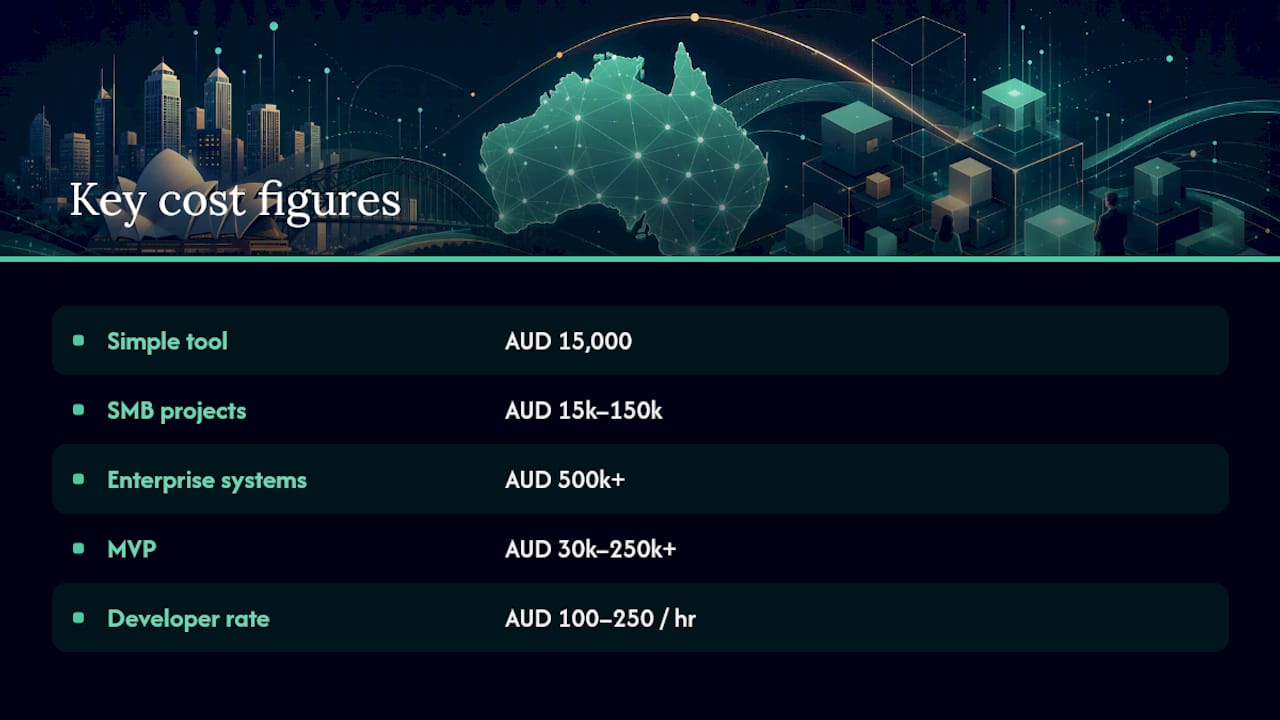
Costs typically range from AUD 15,000 for simple internal tools to AUD 500,000-plus for enterprise systems, with most small and medium business projects landing between $15k and $150k depending on workflows and integrations.
What is the average hourly rate for software developers in Australia?
Local developer rates commonly sit around AUD 100–250 per hour, though fixed-price project quotes are more common for full builds since they remove the risk of scope creep inflating hours.
Is fixed pricing or hourly billing better for a custom software project?
Fixed pricing gives you budget certainty and works best once scope is clearly defined, usually after a discovery sprint. Hourly billing suits ongoing maintenance or exploratory work where requirements are still shifting.
How much does an MVP cost in Australia?
MVP budgets typically fall between AUD 30,000 and AUD 250,000-plus, depending on integrations and regulatory requirements. Zatersio’s rapid MVP model can deliver a working version in under two weeks for many eligible projects.
Can I use the R&D Tax Incentive to offset custom software development costs?
Projects involving genuine technical uncertainty or new experimental functionality may qualify. It’s worth discussing eligibility with your accountant or a specialist before development starts, since documentation requirements begin from day one.
What hidden costs should I budget for after my software launches?
Plan for hosting ($30–$2,000+ monthly depending on scale), ongoing maintenance, security patching, and a 15–25% contingency buffer for the first year to cover integration changes and unexpected fixes.
Sources
- Custom Software Development Cost in Australia (2025) | FindDevs
- MVP Cost Australia (2026) | Founder’s Budget Guide | NYD Systems