
Data Residency vs. Sovereignty: What US Teams Must Know
Data Residency vs. Sovereignty: What US Teams Must Know
Data sovereignty answers whose laws govern your data; data residency answers where that data physically sits. For US organizations, those two questions rarely have the same answer, and the gap between them is where compliance risk lives. The CLOUD Act lets US authorities compel access to data held by US providers even when servers sit in Frankfurt or Dublin, while GDPR can follow EU-resident data into US-owned infrastructure regardless of geography. Vendors like Zatersio build residency options directly into project architecture, but no technical control substitutes for understanding which legal regime actually applies.
Start here before reading further:
- Map your high-risk data now. Identify datasets containing EU, UK, or Swiss subject data and flag them for cross-border transfer rules.
- Check your vendor contracts. Confirm which data center regions your cloud provider actually uses and whether your Data Processing Agreement (DPA) locks those regions in writing.
- Verify CLOUD Act exposure. If your provider is a US-headquartered company, US authorities can reach that data wherever it sits.
- Triage regulated datasets first. HIPAA-covered health data, CCPA/CPRA personal information, and financial records each carry distinct residency and sovereignty obligations that need separate remediation tracks.
Key Takeaways
Data sovereignty and data residency are distinct controls that must be managed together: sovereignty is the legal regime that governs your data, and residency is the physical location where it sits.
| Point | Details |
|---|---|
| Sovereignty is legal, residency is physical | Sovereignty determines which laws apply; residency determines where data is stored. Neither alone is sufficient. |
| CLOUD Act creates outbound reach | US authorities can compel US providers to produce data stored anywhere, regardless of the host country’s laws. |
| GDPR follows the data subject | EU resident data triggers GDPR obligations even when stored in US infrastructure, requiring valid transfer mechanisms. |
| Residency alone is not compliance | Pinning data to a region satisfies localization requirements but does not resolve sovereignty conflicts or extraterritorial rules. |
| Zatersio builds in residency options | Zatersio delivers MVPs and automations with data residency configured from the start, reducing retrofit compliance risk. |
Table of Contents
- What is data sovereignty, and why does US law make it complicated?
- What is data residency, and how does it relate to localization?
- How do sovereignty and residency actually differ?
- Why does this distinction matter specifically for US organizations?
- When does sovereignty outrank residency as a priority?
- Your compliance checklist for this quarter
- Three scenarios US teams encounter in practice
- How to choose the right technical and contractual controls
- The part most compliance programs get wrong
- Zatersio builds residency-aware software so your team can focus on the main event
- Sources
What is data sovereignty, and why does US law make it complicated?
Data sovereignty is the principle that data is subject to the laws and regulatory frameworks of the country or region where it originates or where the data subjects reside. It is a legal concept, not a technical one. Sovereignty determines who can access data, under what legal authority, and what enforcement mechanisms apply.
For US organizations, sovereignty is complicated by two forces pulling in opposite directions. Domestically, the CLOUD Act grants US law enforcement the power to compel US-based cloud providers to produce data stored anywhere in the world, which can directly conflict with foreign data-protection regimes. Internationally, GDPR extends EU regulatory authority to any organization that processes EU residents’ personal data, regardless of where that organization is incorporated or where its servers sit. A US company storing EU customer records in an Oregon data center is still subject to GDPR’s transfer restrictions, breach notification timelines, and data subject rights.
Other US-specific touchpoints compound the picture:
- CCPA/CPRA grants California residents rights over their personal data and imposes obligations on businesses that collect it, regardless of where the data is stored.
- HIPAA governs protected health information (PHI) and requires covered entities and business associates to implement specific safeguards, with penalties that do not disappear because data moved to a cloud region.
- Sector rules in finance (GLBA, SEC recordkeeping), defense (ITAR/EAR), and federal contracting (FedRAMP, CMMC) add additional sovereignty-adjacent obligations that tie data handling to specific legal regimes.
More than 100 countries now have some form of legislation touching data sovereignty, which means a US organization operating globally is almost certainly subject to multiple, sometimes conflicting, legal regimes simultaneously. That is not a theoretical risk. It is the default state for any SaaS company with international users or any enterprise using a global cloud provider.
What is data residency, and how does it relate to localization?
Data residency is the physical or geographic location where an organization’s data is stored and processed. It is a technical and operational concept. You choose residency when you select an AWS region, configure a database cluster to a specific availability zone, or deploy on-premises hardware in a particular facility.
Common deployment models include:
- On-premises: Data stays in hardware the organization owns and operates, giving maximum physical control but requiring significant infrastructure investment.
- Single-region cloud: Data is pinned to one cloud provider region (e.g., us-east-1), which is straightforward to verify and audit.
- Multi-region cloud with region controls: Data replicates across regions for availability, but policy controls restrict which regions are permitted, often enforced through provider-level configuration.
- Sovereign cloud: A dedicated cloud environment operated under specific legal and contractual constraints, often with in-country staff and government-audited controls. Sovereign cloud offerings have grown precisely because standard regional selection does not satisfy all sovereignty requirements.
- Hybrid models: On-premises for the most sensitive data, cloud for everything else, with strict data classification driving which tier a dataset lands in.
Residency and localization are related but not the same thing. As Alation frames it, residency tells you where data lives, sovereignty tells you whose laws govern it, and localization is the policy or regulatory requirement that may mandate keeping data within a specific territory. Residency is a configuration state. Localization is a legal obligation. Achieving residency in a given country can satisfy a localization requirement, but it does not automatically do so, and it says nothing about which legal regime governs that data once it is there.
Residency decisions are often driven by latency and performance as much as compliance. A US healthcare provider might pin patient records to a US-East region primarily for application performance, and that choice happens to satisfy HIPAA’s domestic-processing expectations. The compliance benefit is real, but it was not the only reason the architecture was built that way.

How do sovereignty and residency actually differ?
Sovereignty is a legal concept; residency is a geographic one. They interact constantly, but they are not interchangeable. The table below maps the key dimensions decision-makers and engineers need to track.
| Dimension | Data Sovereignty | Data Residency |
|---|---|---|
| Nature | Legal/jurisdictional | Physical/geographic |
| Who has authority | Nation-state, regulator, or court | Organization or cloud provider |
| Primary driver | Legal compliance, enforcement, national security | Performance, latency, contractual obligation, compliance |
| Typical controls | Legal agreements, DPAs, transfer mechanisms (SCCs, BCRs), access restrictions | Region selection, on-prem deployment, sovereign cloud, encryption with local key custody |
| Common triggers | Cross-border data transfers, law enforcement requests, regulated-sector processing, EU/UK subject data | Cloud provider selection, backup configuration, DR site location, vendor SLA requirements |
Two consequences follow from this matrix that engineers often underestimate. First, residency alone is insufficient when extraterritorial rules apply. IBM’s analysis makes this explicit: residency often determines sovereignty, but rules like GDPR can apply to data even when it is stored outside the regulator’s territory. Storing EU subject data in a US data center does not remove GDPR obligations. Second, sovereignty can impose additional contractual and technical controls beyond what a standard cloud region selection provides. A DPA with Standard Contractual Clauses (SCCs), encryption with customer-managed keys, and explicit law-enforcement notice provisions are sovereignty controls, not residency controls, and they need to be negotiated separately from where the data center sits.
Why does this distinction matter specifically for US organizations?
The core risk for US organizations is jurisdictional collision. US law can reach outward through the CLOUD Act; foreign law can reach inward through GDPR and equivalent regimes. Both can apply to the same dataset at the same time, and they can require contradictory actions.
Consider the practical legal risks:
- Conflicting access orders. A US court order under the CLOUD Act and an EU blocking statute or GDPR restriction can simultaneously apply to the same data. Complying with one may mean violating the other.
- Extraterritorial enforcement. GDPR fines apply to US companies processing EU resident data regardless of server location. CCPA/CPRA obligations follow California resident data regardless of where it is processed.
- Data subject rights. EU residents can exercise rights to erasure, portability, and access under GDPR. If your architecture does not support locating and deleting all copies of a record across regions and backups, you have a sovereignty gap, not just a residency gap.
Cloud architecture choices amplify these risks in specific ways. Backups replicated automatically to a secondary region may cross a border without any deliberate decision by your team. Multi-tenant cloud control planes can give provider staff visibility into data that your DPA does not adequately restrict. Sovereign cloud or on-premises deployments change the exposure profile significantly, but they also change cost, availability, and incident response complexity.
McKinsey’s analysis of fragmented localization rules makes a point worth internalizing: compliance costs are real, but organizations that treat regional rules as product constraints rather than pure overhead can turn them into competitive advantages. A US SaaS company that builds GDPR-compliant data handling into its architecture from the start can sell into EU enterprise accounts that competitors cannot touch.
For legal ops and security teams, the operational impact is concrete: incident response playbooks must account for multi-jurisdictional notification timelines (GDPR’s 72-hour window versus HIPAA’s 60-day window), litigation holds become more complex when data spans jurisdictions, and contractual obligations to customers may require residency commitments the current architecture cannot support.
When does sovereignty outrank residency as a priority?
Physical location is the easier problem to solve. You pick a region, configure your cloud provider, and the data stays there. Sovereignty is harder because the law does not always care where data sits.
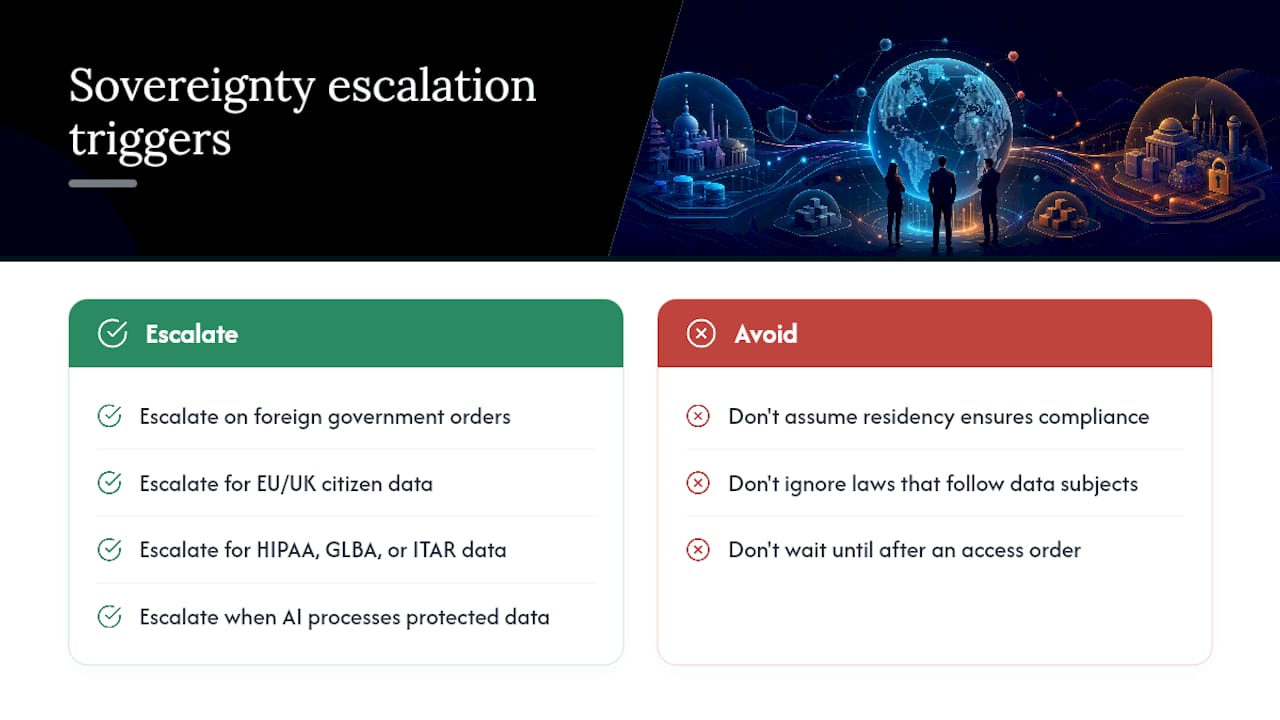
Several scenarios should trigger an immediate escalation to legal review:
Foreign government access orders. If your US cloud provider receives a preservation or production order for data stored in an EU region, the CLOUD Act may require compliance even if GDPR prohibits it. Your legal team needs to know this scenario is possible before it happens, not after.
Datasets tied to EU or UK citizens. GDPR follows the data subject, not the server. A US company processing EU employee records, EU customer purchase histories, or EU patient data is subject to GDPR transfer restrictions the moment that data moves outside the EU/EEA, regardless of where the company is headquartered.
Regulated-sector processing. Healthcare data under HIPAA, financial data under GLBA or SEC rules, and defense-related data under ITAR each carry sovereignty-adjacent obligations that go beyond physical location. A HIPAA Business Associate Agreement (BAA) is a sovereignty control, not just a residency one.
AI processing of protected datasets. When AI models train on or process personal data, the data flows involved can be complex and cross-border by default. Sector-specific guidance on healthcare AI illustrates how sovereignty considerations must be built into AI architecture from the start, not retrofitted.
The underlying pattern: residency gives you a false sense of safety when laws follow the data subject or give jurisdictional reach based on who the data relates to rather than where it sits. TechTarget’s governance guidance frames this well: a single dataset can fall under multiple, sometimes conflicting, sovereign jurisdictions simultaneously, which is why static physical controls are never sufficient on their own.
Your compliance checklist for this quarter
Run through these steps in order. Triage by regulator exposure first: EU subject data and HIPAA PHI carry the highest penalty risk and should move to the front of the queue.
-
Inventory and classify sensitive data. Identify every dataset containing personal information, PHI, financial records, or regulated content. Tag each by data type, data subject geography, and applicable regulation.
-
Map data flows and residency. Document where each classified dataset is stored, processed, and backed up. Include cloud regions, third-party processors, and any cross-border transfers. Automated data discovery tools can accelerate this step significantly.
-
Identify sovereignty exposures. For each dataset, ask: which legal regimes apply based on data subject location, collection location, and processor location? Flag any dataset where the answer involves more than one jurisdiction.
-
Fix quick wins. Reconfigure cloud regions to pin sensitive data to compliant locations. Enable encryption at rest and in transit with customer-managed keys where possible. Verify that backup and DR configurations respect the same regional constraints as primary storage.
-
Update contracts and DPA clauses. Review vendor agreements for data locality commitments, law-enforcement notice provisions, audit rights, and sub-processor restrictions. Negotiate SCCs or equivalent transfer mechanisms for any cross-border processing of EU/UK subject data.
-
Build ongoing monitoring and update your breach playbook. Set alerts for configuration drift (e.g., a new backup job that routes to an out-of-scope region). Update incident response procedures to reflect multi-jurisdictional notification timelines.
Prioritization questions to ask your legal and engineering teams:
- Which datasets contain EU or UK resident personal data, and do we have valid transfer mechanisms in place?
- Does our primary cloud provider have CLOUD Act exposure, and have we assessed what that means for our most sensitive data?
- Are our DPAs with cloud providers and sub-processors current, and do they include explicit region-lock and law-enforcement notice provisions?
Pro Tip: Implement a governance “knowledge layer” — a metadata index that tracks, for each dataset, the applicable jurisdictions, data subject geographies, transfer mechanisms in place, and the date of last legal review. TechTarget’s sovereignty guidance identifies this kind of dynamic governance index as the operational best practice precisely because datasets can fall under multiple, shifting jurisdictions. A spreadsheet works to start; a proper data catalog tool scales it.
Three scenarios US teams encounter in practice
Scenario A: US SaaS platform with EU customers
A US-based SaaS company signs its first enterprise contracts in Germany and France. Customer data, including names, email addresses, and usage logs, flows into the company’s AWS us-east-1 environment. The company has no EU data center and no DPA with its cloud provider.
The problem: GDPR applies the moment EU resident personal data is processed, regardless of server location. Transferring that data to the US without a valid transfer mechanism (SCCs or an adequacy decision) violates GDPR’s Chapter V restrictions.
Recommended next steps:
- Execute SCCs with AWS and any sub-processors immediately.
- Evaluate whether EU customers contractually require data to remain in the EU; if so, provision an EU region and update the architecture.
- Add a GDPR-compliant privacy notice and data subject rights workflow before the next customer onboarding.
Scenario B: Healthcare provider using cloud AI
A regional hospital network deploys a cloud-based AI tool to analyze patient intake forms and flag high-risk cases. The AI vendor’s processing infrastructure spans multiple US regions and one Canadian availability zone.
The problem: PHI processed by the AI vendor is subject to HIPAA. The Canadian availability zone creates a cross-border transfer that the existing BAA may not cover. If the AI model retains training data derived from patient records, there may be additional de-identification and data minimization obligations.
Recommended next steps:
- Audit the BAA to confirm it covers all processing locations, including the Canadian zone; amend or replace it if not.
- Require the vendor to restrict processing to US regions only, or obtain legal review of the Canadian transfer.
- Implement data minimization: pass only the fields the AI model needs, not full patient records.
Scenario C: Backups and analytics crossing borders inadvertently
A US financial services firm discovers that its cloud provider’s default backup configuration replicates snapshots to an EU region for redundancy. The firm’s compliance team was unaware because the configuration was set by a cloud engineer during initial setup and never reviewed.
The problem: Financial records subject to SEC and GLBA rules are now sitting in an EU jurisdiction, potentially triggering GDPR obligations the firm did not intend to assume. The firm also cannot confirm whether the EU region is covered by its existing vendor DPA.
Recommended next steps:
- Immediately audit all backup and replication configurations against the firm’s approved-region list.
- Update the cloud provider DPA to explicitly cover or exclude the EU region, depending on business intent.
- Add region configuration to the change-management process so future infrastructure changes require compliance sign-off before deployment.
How to choose the right technical and contractual controls
The choice between on-premises, regional cloud, and sovereign cloud is not purely a compliance decision. It involves real engineering trade-offs.
Decision rules by control type:
- On-premises gives maximum physical and legal control but requires capital investment, dedicated security operations, and longer incident response cycles. Use it for the most sensitive regulated data where no cloud option satisfies the legal requirement.
- Regional cloud is the right default for most US organizations. Pin sensitive data to specific regions, use customer-managed encryption keys, and negotiate explicit region-lock clauses in your DPA. This satisfies most HIPAA, CCPA/CPRA, and standard contractual residency requirements.
- Sovereign cloud is appropriate when a customer contract, government requirement, or sector regulation demands both physical controls and legal/contractual assurances that a standard cloud region cannot provide. Sovereign cloud offerings are a practical compromise for organizations that need both.
- Encryption with local key custody can substitute for physical residency in some legal frameworks, but not all. GDPR’s transfer restrictions are not satisfied by encryption alone; a valid transfer mechanism is still required.
Engineering trade-offs to budget for:
- Sovereign cloud and on-premises options typically carry higher latency for globally distributed users.
- Multi-region availability architectures conflict with strict residency requirements; you usually have to choose one.
- Customer-managed key management adds operational complexity and a new failure mode (key loss = data loss).
- Incident response is slower when data spans jurisdictions and law enforcement requests require legal review before disclosure.
Contractual controls to negotiate with every cloud provider:
- Explicit data locality commitments naming permitted regions and prohibiting replication outside them
- Sub-processor restrictions requiring written approval before adding new processors
- Law-enforcement notice provisions requiring the provider to notify you before complying with a government access request, to the extent legally permitted
- Audit rights allowing you or a third party to verify compliance with residency and access commitments
- Key custody language specifying who holds encryption keys and under what conditions the provider can access plaintext data
Vendor due diligence checklist:
- Is the provider subject to the CLOUD Act? (Any US-headquartered provider is.)
- Does the provider offer a DPA that covers your specific regions and data types?
- Can the provider demonstrate SOC 2 Type II, ISO 27001, or equivalent certification for the regions you are using?
- Does the provider have a documented process for handling law-enforcement requests, and will they notify you?
- Are sub-processors listed, and can you restrict or approve them?
For on-premises vs. cloud trade-offs in legally sensitive environments, the architecture decision often comes down to whether the legal risk of a cloud provider’s jurisdictional exposure outweighs the operational cost of running your own infrastructure.
The part most compliance programs get wrong
Most organizations treat data residency as the compliance destination. They pick a region, check a box, and move on. That is the wrong frame.
Residency is a lever you can pull quickly. Sovereignty requires ongoing legal governance, and the two need to be managed as separate but coupled controls. A dataset pinned to us-east-1 is still subject to GDPR if it contains EU resident data. A dataset stored on-premises in New York is still reachable by US law enforcement under the CLOUD Act. Physical location is necessary but not sufficient.
The organizations that get this right treat sovereignty as a dynamic property of each dataset, not a static attribute of their infrastructure. They maintain a governance index that tracks which jurisdictions apply to each dataset, when that assessment was last reviewed, and what transfer mechanisms are currently in place. They update that index when they add new customer geographies, change cloud providers, or modify data flows. That is not a one-time project. It is an operational discipline.
For CISOs and General Counsels, the prioritization is straightforward: start with the datasets that carry the highest penalty exposure (EU subject data, HIPAA PHI, financial records), fix the quick engineering wins (region locks, encryption, backup configuration), and then negotiate the contractual controls that protect you when a law enforcement request arrives. The order matters because engineering fixes are faster than contract renegotiations, and you want the technical controls in place before you need them.
Zatersio builds residency-aware software so your team can focus on the main event
Sorting out data residency and sovereignty obligations while also shipping product is a lot to carry. Zatersio builds rapid MVPs and custom AI automations with data residency options built into the architecture from day one, so you are not retrofitting compliance after the fact. Fixed pricing, direct access to your engineering team, and a two-week delivery window mean you get working, compliant software without a long procurement cycle.
For teams that want a structured starting point, the free AI Automation Blueprint maps your current data flows, flags residency and sovereignty gaps, and outlines the engineering steps to close them. It is a practical first move for any organization that knows it has exposure but is not sure where to start.
Sources
- Data Sovereignty vs. Data Residency | IBM
- Data Sovereignty vs. Data Residency: What’s The Difference? | Splunk
- Data Residency Vs. Sovereignty Vs. Localization: A Buyer’s Guide | Alation
- What Is Data Residency? | MongoDB
- What is data sovereignty? | Cloudflare
- What is data sovereignty? | TechTarget
This article is general information, not a substitute for advice from a qualified lawyer. Consult a qualified legal professional about your own circumstances before acting on anything here.