
Pilot in 2–6 Weeks: Engineering Team as a Service for Product Leaders
Pilot in 2–6 Weeks: Engineering Team as a Service for Product Leaders
Engineering team as a service is a dedicated external engineering team, complete with a tech lead, that plugs into your product roadmap and ships against outcomes instead of billing you for hours. It fits companies that need production-ready software fast but can’t (or don’t want to) run a six-month hiring cycle. If you need specialist skills for a defined stretch of work, this model beats a slow internal build every time.
TL;DR:
- The embedded tech lead is crucial for accountability, managing sprint commitments, and ensuring quality within the engineering team as a service model.
- Short pilots with clear deliverables and artifacts are essential in the first six weeks to evaluate vendor fit before larger commitments.
- Due diligence should focus on technical fit, governance, communication, IP ownership, security, and the provider’s ability to replace key personnel rapidly.
- The model is most suitable for fast MVP development, scaling temporarily, or filling niche skills, rather than long-term strategic work.
- Vague promises and lack of transparency on scope, pricing, and data residency are red flags that warrant ending negotiations early.
Table of Contents
- What Engineering Team as a Service Actually Looks Like
- When to Choose an Engineering Team as a Service
- EaaS vs. In-House Teams vs. Staff Augmentation vs. Outsourcing
- What Onboarding and the First 90 Days Look Like
- How to Evaluate and Hire an Engineering Team as a Service Provider
- Why the Embedded Tech Lead Model Beats the Alternatives Most Buyers Consider
- How Zatersio Fits the Checklist You Just Built
- Sources
What Engineering Team as a Service Actually Looks Like
Strip away the marketing language and the model is straightforward: you get a small, embedded unit that behaves like your own team, not a ticket queue. Most providers structure it around a tech lead, two to four engineers, a QA function, and light product owner support depending on scope.
The tech lead is the linchpin. They run standups, own the sprint commitments, and act as the single point of accountability, so you’re not chasing five different engineers for status updates. That structure is exactly what dedicated pod providers promise when they ship features as a single accountable unit.
Day-to-day mechanics matter more than most buyers expect going in:
- Communication runs on a hybrid model: synchronous inside the team, asynchronous across time zones, a practice Shopify’s engineering group has documented as the difference between a team that collaborates and one that just messages.
- Documentation isn’t optional. Decision logs, architecture notes, and runbooks need to exist from week one, not retrofitted at handover.
- IP and tooling integration should be settled before code gets written, not negotiated after the first sprint ships.
When to Choose an Engineering Team as a Service
This model earns its cost when speed and flexibility matter more than building permanent headcount. Four situations make the case clearly:
- You need an MVP validated fast. Hiring a team to build one product, then figuring out what to do with them after launch, rarely makes financial sense.
- You’re scaling velocity temporarily. A backlog spike or a major feature push doesn’t justify four new full-time hires.
- You need a skill you don’t have in-house. Specialist work like AI integration or legacy system migration often shows up once and disappears.
- You’re hitting a hiring bottleneck. If recruiting takes three months and your runway doesn’t, outsourced engineering services close the gap.
EaaS is a poor fit in the reverse cases: when the work is core to your long-term competitive advantage, when you need engineers who will still be there in five years shaping architecture decisions, or when the domain knowledge is so specific that ramp time would eat any speed advantage. Outsourcing broadly brings cost reduction and specialist access, but that same source is blunt that outcomes hinge on due diligence, not the model alone.
EaaS vs. In-House Teams vs. Staff Augmentation vs. Outsourcing
Four models solve the same problem. They don’t solve it the same way.
- In-house hiring gives you full ownership and the deepest institutional knowledge, but ramp time runs three to six months and costs are fixed whether or not the workload justifies them.
- Staff augmentation fills specific skill gaps fast, but you inherit the management overhead. There’s no embedded tech lead absorbing accountability. You’re still the delivery owner.
- Traditional outsourcing often optimizes for cost over communication, and knowledge retention suffers when the vendor relationship ends.
- Engineering team as a service sits between staff augmentation and outsourcing: you get a pre-built pod with an embedded tech lead who owns delivery, and providers commonly promise onboarding in two to four weeks rather than months.
The pod model matters here because it changes who is accountable when something breaks. A single embedded tech lead, rather than a rotating cast of contractors, keeps quality consistent and simplifies escalation when priorities shift.
As a rule of thumb: choose in-house when the work is permanent and strategic, staff augmentation when you need one or two specific skills inside a team you already manage, outsourcing when cost is the primary driver and the scope is well defined, and engineering team as a service when you need dedicated engineering staff fast, with delivery ownership baked in.
What Onboarding and the First 90 Days Look Like
Most providers follow a similar rhythm, and knowing it in advance lets you set real success criteria instead of vague hopes.
- Weeks 1 to 2: Team assembly and first stand-up. This is when the tech lead is assigned and the pod starts running sprint rituals.
- Weeks 2 to 6: A scoped pilot deliverable, typically a working feature or MVP slice, not a slide deck. Short pilots with a defined deliverable are the cleanest way to test vendor fit before signing anything longer.
- Weeks 4 to 12: Deeper integration into your existing workflows, ticketing system, and release process.
Demand real artifacts early: a decision log, a runbook, and acceptance tests tied to the pilot’s success criteria. If a provider can’t produce those by week six, that’s information worth having before you commit further budget.
How to Evaluate and Hire an Engineering Team as a Service Provider
Treat this like hiring a senior team member, not procuring a subscription. Cover five areas in discovery calls: technical fit, delivery governance, communication style, security and data residency, and commercial terms including IP ownership.
Fifteen questions worth asking directly:
- Who is our embedded tech lead, and what’s their track record?
- What does a typical sprint cadence look like, and who runs it?
- How do you handle time zone overlap for daily communication?
- What’s your onboarding timeline to a working pilot?
- What happens if a key engineer leaves mid-project?
- Do you offer a personnel replacement SLA, and how fast?
- Where is our data and code stored, and who has access?
- Who owns the IP on code written during the engagement?
- What’s included in your fixed price, and what triggers a change order?
- How do you document architecture decisions?
- What’s your defect rate on comparable projects?
- Can we speak with a past client in our industry?
- What’s your knowledge-transfer process if we end the contract?
- How do you handle scope changes mid-sprint?
- What tools and platforms do you require access to?
Pro Tip: Ask for a 30-day knowledge-transfer window written into the contract, not promised verbally. Providers who structure managed teams properly treat handover documentation as a deliverable, not an afterthought.
Red flags that should end a conversation quickly: no named tech lead before signing, reluctance to discuss data residency, vague pricing that shifts after discovery, and no willingness to start with a scoped pilot instead of a long-term contract.
Build your SLA around measurable items: time-to-first-ship, sprint commitment reliability, defect rates on delivered features, and a defined knowledge-transfer window. Vague promises about “quality” and “communication” aren’t KPIs. Numbers and deadlines are.
Why the Embedded Tech Lead Model Beats the Alternatives Most Buyers Consider
Most comparisons of outsourced engineering focus on cost per hour, which misses what actually breaks these engagements: accountability drift. When five contractors report loosely to a project manager who isn’t technical, decisions stall and quality slips through the cracks nobody owns.
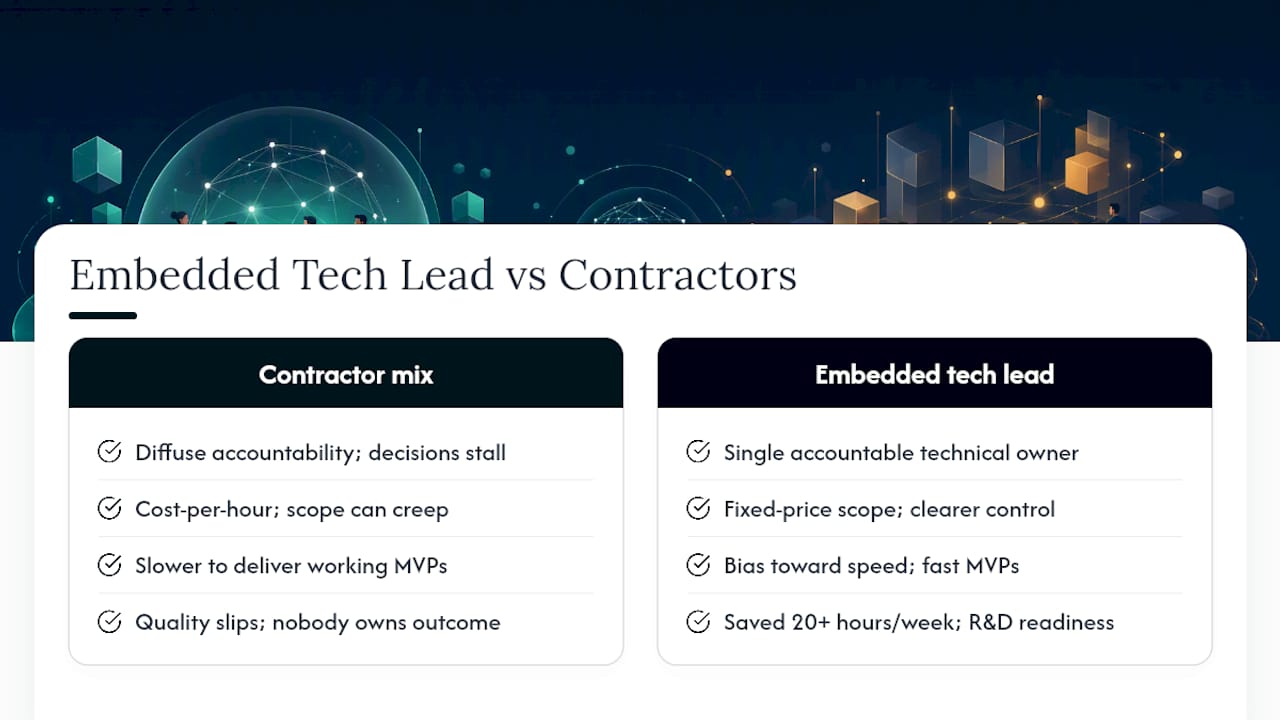
The embedded tech lead model solves a problem most buyers don’t realize they have until they’ve lived through its absence. A pod with one accountable technical owner, running against a fixed-price scope, removes the ambiguity that kills most vendor relationships in month three.
Certain providers build on that model with a bias toward speed, offering working MVPs quickly, fixed pricing so scope changes don’t quietly become invoice changes, and data residency options for teams that need to keep compliance simple. One Melbourne business saved more than 20 hours a week after automating manual workflows this way, which is the kind of result that matters more than any feature list. Combine that with structured R&D Tax Incentive readiness for eligible builds, and the pilot-first approach this guide recommends stops being theoretical.
— Lakitha
How Zatersio Fits the Checklist You Just Built
Every criterion in this guide, fixed pricing, a named accountable lead, a fast pilot, clear data residency, maps directly onto how some providers run engagements. There’s no ambiguity about who owns delivery and no surprise invoices when scope shifts mid-sprint.
Some providers build working MVPs quickly, structure eligible projects for R&D Tax Incentive support, and offer choices of data residency without adding cost tiers or contract lock-in. If you’re weighing a hiring cycle against a scoped pilot, start with the pilot. Book an MVP development consultation and see a working build before you commit to anything larger.
Sources
- Three essential remote‑work practices for engineering
- Team as a Service | Dedicated Engineering Teams | Softensity
- Dedicated Teams (PODS) — Pre‑Built Engineering Squads | RemoteEngine
- Complete guide to engineering services outsourcing