
MVP Development Timeline: Realistic Weeks and a Solid Plan
MVP Development Timeline: Realistic Weeks and a Solid Plan
A production-ready MVP takes 8 to 16 weeks of build time, and you should budget 10 to 24 weeks of calendar runway once sprint zero and post-launch stabilization are factored in. That gap between “build time” and “runway” trips up more founders than any coding problem ever does.
Here’s the quick reference:
- Lean MVP (single flow, one user type): 4 to 8 weeks build, 6 to 10 weeks runway
- Standard MVP (SaaS with a few roles, payments): 8 to 16 weeks build, 10 to 18 weeks runway
- Complex MVP (multi-role, regulated, or heavy integrations): 16 to 24 weeks build, 20 to 28 weeks runway
A well-scoped MVP typically lands in the 8 to 16 week range from kickoff to a paying-user launch, with simple single-flow products at the low end and regulated builds pushing past 20 weeks. The rest of this guide breaks down why, and what you can actually control.
Key Takeaways
A realistic MVP development timeline runs 8 to 16 weeks of build time and 10 to 24 weeks of calendar runway, with scope discipline as the biggest lever founders control.
| Point | Details |
|---|---|
| Budget runway, not just build time | Add sprint zero and stabilization buffers; an 8-week build often needs 10 to 12 weeks of calendar time. |
| Scope drives the schedule | Fewer user flows and a hard scope freeze at kickoff beat any amount of extra developer speed. |
| Match your tier to your product | Lean builds run 4 to 8 weeks, standard SaaS 2 to 4 months, complex or regulated builds 4 to 8 months. |
| Parallel tracks save real weeks | Running design and backend scaffolding together, behind a frozen API contract, compresses the calendar. |
| Zatersio delivers fixed-price, R&D-ready builds | Zatersio runs discovery, sprint zero, and build in parallel with embedded QA and R&D-ready documentation included. |
Table of Contents
- Why Your MVP Development Timeline Matters More Than You Think
- What Actually Changes Your MVP Timeline
- MVP Development Phases and How Long Each One Takes
- Sample MVP Timelines by Complexity Tier
- How Product Type Shifts Your MVP Timeline
- How to Shave Weeks Off Your MVP Timeline Without Adding Risk
- Common Pitfalls That Stall an MVP Schedule
- What Happens After You Ship Your MVP
- How Zatersio Builds Rapid, R&D-Ready MVPs
- The One Rule That Actually Keeps a Timeline Honest
- Get a Fixed-Price, R&D-Ready MVP Built in Weeks, Not Months
- Frequently Asked Questions
- Sources
Why Your MVP Development Timeline Matters More Than You Think
Your timeline isn’t a scheduling exercise. It’s the backbone of your cash runway, your investor pitch, and your product’s odds of survival.
- A wrong estimate means you either raise too little or burn cash waiting on a launch that keeps slipping.
- Rushed schedules create technical debt that costs more to unwind later than it saved up front.
- Missed timelines erode confidence with investors and early customers who were promised a date.
- Most MVPs cluster in the 2 to 4 month range, and budget tracks scope almost one-for-one, so a fuzzy timeline usually means a fuzzy budget too.
If you can’t state your MVP timeline with confidence, you probably can’t state your burn rate with confidence either.
What Actually Changes Your MVP Timeline
Five variables push a project toward the fast end or the slow end of any range, and scope clarity beats all of them combined.
- Scope clarity: the number of distinct user flows you’re building drives time more than any other factor. Three flows take roughly three times longer than one, not because the code is harder, but because each flow needs its own edge cases, tests, and design states.
- Team makeup: a dedicated team of two senior engineers will outpace a part-time team of five, every time. Coordination overhead eats hours that never show up on a burndown chart.
- Tech choices: leaning on managed providers for auth, payments, and hosting saves weeks compared to custom-built infrastructure.
- Integrations: every third-party API you depend on, especially legacy systems or unstable payment gateways, adds testing and contingency time that’s easy to underestimate.
- Compliance and regulation: healthcare, finance, and legal builds need documentation, audit trails, and extra QA passes that simple consumer apps skip entirely.
Pro Tip: List every external dependency your MVP touches before you write a single line of code. Each one is a potential two-week delay hiding in plain sight.
MVP Development Phases and How Long Each One Takes
Five phases make up almost every MVP build, and they overlap more than most founders expect. Treating them as strictly sequential is one of the fastest ways to add weeks you didn’t need to spend.
| Phase | Typical Duration | Core Deliverable |
|---|---|---|
| Discovery | 1–2 weeks | Locked user stories, success metrics, prioritized flows |
| Design | 1–3 weeks | Wireframes, clickable prototype, signed-off UI kit |
| Sprint zero | 1 week | CI/CD pipeline, staging environment, architecture decisions |
| Build (sprints) | 4–12+ weeks | Working software, feature-complete core flow |
| QA and launch | 1–2 weeks | Tested release, monitoring live, stabilization plan |
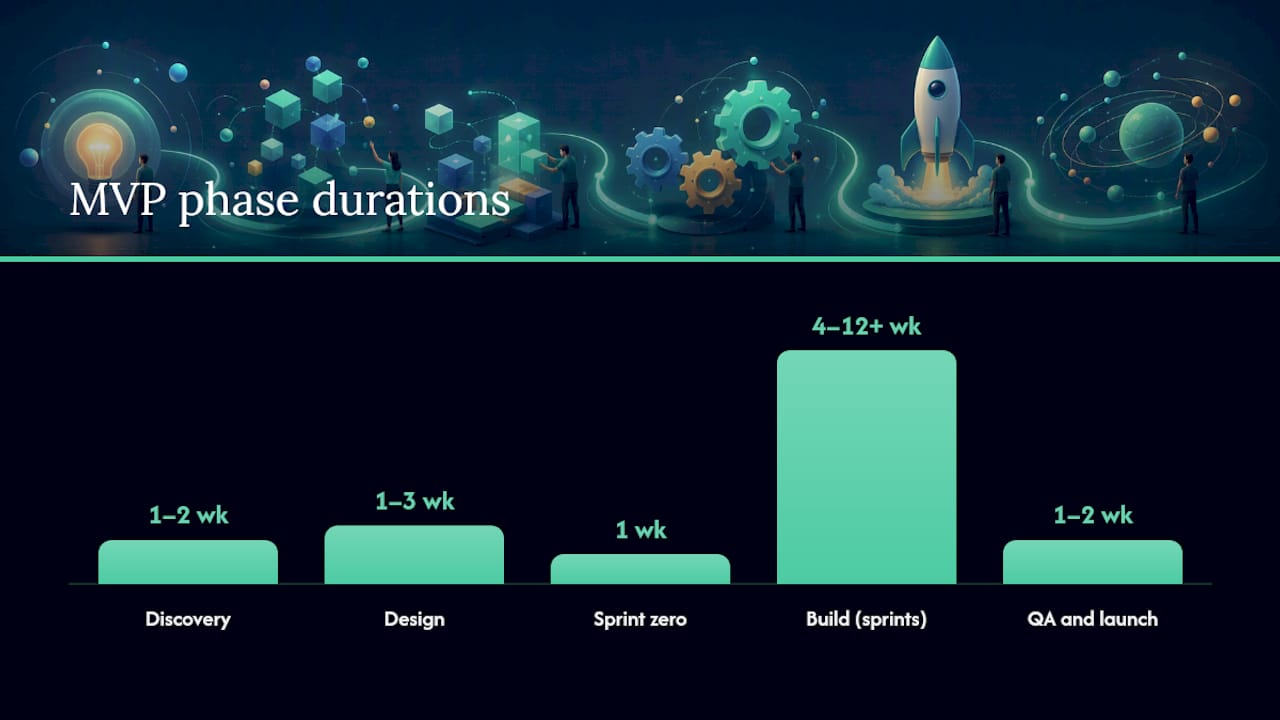
Phase templates from recent MVP guides show discovery running 1 to 2 weeks, design 1 to 3 weeks, and the build phase stretching from 4 weeks for lean products to 12 or more for complex ones. Design and sprint zero can run in parallel with early backend scaffolding, which is where experienced teams claw back real time.
Calendar runway isn’t the same as build time. An 8-week build often needs 10 to 12 weeks of actual calendar time once you account for sprint zero setup at the front and a stabilization window at the back. Skip either buffer and you’ll ship on schedule with a broken staging environment or a week of frantic bug triage nobody planned for.
Lock these before development starts, or you’ll pay for it in rework:
- Signed user stories with clear acceptance criteria for every flow
- A finalized tech stack and hosting decision
- An API contract freeze between frontend and backend teams
- A defined “done” for QA, not just “it works on my machine”
Pro Tip: Write acceptance criteria as if a stranger will build the feature without ever talking to you. If the criteria leave room for interpretation, they’ll get interpreted the expensive way.
Sample MVP Timelines by Complexity Tier
Three tiers cover almost every MVP a founder will plan.
- Lean (one user type, single core flow, no payments): 4 to 8 weeks. Week 1 discovery and design overlap, weeks 2 through 6 are build, week 7 to 8 is QA and launch.
- Standard (multiple user roles, payments, basic admin panel): 2 to 4 months. Two to three weeks of discovery and design, six to ten weeks of sprint-based build, two weeks of hardening.
- Complex (multi-tenant, compliance requirements, several integrations): 4 to 8 months. Discovery alone can take three weeks when compliance mapping is involved.
A senior two-person team running parallel design and infrastructure tracks routinely beats a five-person team working sequentially. Parallelization, not headcount, is what actually compresses these tiers.
How Product Type Shifts Your MVP Timeline
Web apps iterate fastest since there’s no app-store review and no device fragmentation, though a web app with heavy real-time features or complex permissions can still stretch into complex-tier territory.

Native mobile apps add store submission and review cycles on top of the build, typically another 1 to 2 weeks per platform, plus device-specific QA that web builds skip entirely.
SaaS platforms with multiple user roles carry the most hidden time. Admin tooling, billing logic, and multi-tenant data isolation aren’t optional extras. They’re core infrastructure that has to exist before the “main event” features even matter.
How to Shave Weeks Off Your MVP Timeline Without Adding Risk
Speed and risk aren’t the same trade-off, if you pick the right tactics.
- Freeze scope at kickoff and route every new idea to a post-launch backlog instead of the current sprint.
- Use managed providers for auth, payments, and hosted infrastructure instead of building that plumbing yourself.
- Run design and backend scaffolding in parallel, locked behind a frozen API contract so neither team blocks the other.
- Work in two-week sprints with embedded QA rather than QA as a final gate, and automate your CI/CD pipeline from day one.
- AI-assisted coding, templates, and no-code tools compress build work for standard flows, but they don’t shorten discovery, compliance mapping, or stakeholder decision cycles. Those still take exactly as long as they take.
Pro Tip: Ask “build now or defer to post-launch?” for every feature request during the build phase. A stage-by-stage build-versus-defer framework keeps that decision consistent instead of ad hoc.
Common Pitfalls That Stall an MVP Schedule
Most delayed MVPs fail for the same handful of reasons, not because the code was hard.
- Scope creep: new features sneak in mid-sprint. Fix it with a hard scope freeze and a formal change-order process for anything added after kickoff.
- Vague acceptance criteria: “make it work well” isn’t a spec. Require signed user stories with a definition of done before sprint one starts.
- Late integrations: discovering a third-party API is unreliable in week 10 is a disaster. Surface every integration risk during discovery, not during the build.
- QA as an afterthought: bolting testing onto the end of a project guarantees a scramble. Build QA into every sprint instead.
- Slow stakeholder decisions: a founder who takes five days to approve a design choice adds five days to the schedule. Protect a recurring sprint-review slot and hold to it.
What Happens After You Ship Your MVP
Launch day isn’t the finish line. It’s the start of your data collection.
Track activation rate, retention, error rates, and any early revenue signal in the first 30 days. That’s the actual test of whether your MVP validated anything.
Keep a 72-hour on-call window after release for incident response, and set up basic monitoring before launch, not after something breaks. Sort every post-launch request into three buckets: hot fixes that block usage, high-priority changes that inform your next sprint, and deferred features that go straight to the roadmap backlog.
How Zatersio Builds Rapid, R&D-Ready MVPs
Zatersio runs discovery, sprint zero, and a locked-scope build in parallel tracks with embedded QA at every stage, which is how a working MVP ships in under two weeks for well-scoped projects and within the standard 8 to 16 week range for larger builds.
Every engagement includes deliverables built for more than just launch day:
- Locked user stories and technical specs from discovery
- A staging environment and CI/CD pipeline from sprint zero onward
- Documentation structured for R&D Tax Incentive eligibility, since structured tracking of development activity supports incentive claims rather than being an afterthought
- Direct access to the engineering team building your product, not an account manager relaying messages
If your product idea is still closer to a proof of concept than a production build, it’s worth understanding how an MVP differs from a prototype before you commit to a timeline.
The One Rule That Actually Keeps a Timeline Honest
Ship one end-to-end flow, then stop adding to it. Every founder who blew a timeline did it by widening scope mid-build, not by writing slow code. Discipline about what’s “in” beats any amount of extra velocity, because a predictable calendar comes from a fixed target, not a faster team.
Get a Fixed-Price, R&D-Ready MVP Built in Weeks, Not Months
Zatersio builds working MVPs with engineer-built code, fixed pricing, and documentation structured for R&D Tax Incentive claims from day one, so you’re not paying an agency retainer to find out later whether your project even qualifies. Unlike open-ended agency engagements billed by the hour, you know the price and the delivery week before the contract is signed.
Bring three things to a discovery call: your single most critical user flow, who your target users actually are, and what success looks like in the first 30 days. That’s enough for Zatersio’s team to scope a fixed-price estimate and a real delivery date. If you’re weighing automation alongside the build, a service-oriented MVP approach to documenting technical decisions pairs well with what Zatersio delivers on the engineering side.
Book a discovery call and get a scoped timeline back before you commit to anything.
Frequently Asked Questions
How long does it take to build an MVP from scratch? A production-quality MVP typically takes 8 to 16 weeks of build time, with simple single-flow products landing closer to 6 to 8 weeks and complex or regulated builds running 16 to 24 weeks.
What’s the difference between MVP build time and total project timeline? Build time covers only active development. Total calendar runway also includes sprint zero setup at the start and a stabilization buffer after launch, which typically adds 2 to 4 extra weeks on top of an 8-week build.
Can you really build an MVP in two weeks? A working prototype can happen in days, but a production MVP with real authentication, a proper database, and CI/CD in place generally needs several weeks even with senior engineers and heavy reuse of existing components. Rapid two-week deliveries are possible for tightly scoped, single-flow projects with experienced teams and pre-built infrastructure.
What phase of MVP development usually takes the longest? The build phase, typically 4 to 12 or more weeks depending on complexity. Discovery and design combined usually run 2 to 5 weeks, so the sprint-based build phase is where most of your calendar time gets spent.
How do I keep my MVP timeline from slipping? Freeze scope at kickoff, require signed acceptance criteria for every user story, and route new feature ideas to a post-launch backlog instead of adding them mid-sprint. Late-stage scope changes are the single most common cause of blown timelines.
Sources
- How Long Does It Take to Build an MVP? The Real Numbers | Upsilon IT
- MVP Development Timeline: A Realistic Week-by-Week Plan for 2026 — Schedars
- OECD STIP interactive dashboard — policy initiatives (2025/3036)