
AI Privacy Compliance: A U.S. Practitioner's Playbook
AI Privacy Compliance: A U.S. Practitioner’s Playbook
Start with an AI-specific Data Protection Impact Assessment and hard vendor controls — that single sequence removes the majority of regulatory risk for U.S. AI deployments faster than any other intervention. Here is what your team can assign today:
- Run an AI-specific DPIA now. Map every point where personal data enters, moves through, or exits your AI system. The EDPB’s LLM-specific risk methodology provides the lifecycle structure; adapt it to U.S. regulatory expectations.
- Freeze PII inputs to public-facing generative AI tools. The OAIC’s guidance on commercial AI products is direct: avoid entering personal or sensitive information into public generative tools. Issue a policy memo today.
- Audit your vendor contracts. Confirm your model provider and cloud vendor agreements include data processing addenda, subprocessor controls, deletion rights, and audit access. If they do not, you are exposed.
- Classify your AI use cases by risk tier. High-risk uses (healthcare, credit, biometrics, HR decisions) need immediate legal review under HIPAA, CCPA/CPRA, and Illinois BIPA before another inference call runs.
- Assign a named AI privacy owner. Someone on your team must own the DPIA, the vendor register, and the incident response trigger. Diffuse ownership is how incidents become breaches.
Risk/benefit statement for your next briefing: Documented AI privacy controls reduce regulatory enforcement exposure and build the audit trail regulators now expect — without blocking product delivery.
Pro Tip: Schedule a 90-minute cross-functional triage with legal, security, and product this week. Walk the AI data flow on a whiteboard. You will find gaps in 20 minutes that would take months to discover in a formal audit.
Key Takeaways
Documented AI privacy controls — built on a DPIA, vendor contracts with audit rights, and continuous output monitoring — are the foundation of a defensible U.S. AI compliance program.
| Point | Details |
|---|---|
| Start with the DPIA | Run an AI-specific DPIA before deployment; it is the document regulators ask for first. |
| Freeze public PII inputs immediately | Issue a policy memo today prohibiting personal data entry into public generative AI tools. |
| Lock down vendor contracts | Require data processing agreements with deletion rights, subprocessor controls, and audit access. |
| Log everything searchably | Searchable inference logs are the operational backbone for DSAR responses and incident investigations. |
| Treat the DPIA as a living document | Rerun it after every material model change; regulators want to see the decision history, not just the current state. |
Table of Contents
- Why does AI create a different privacy risk than traditional data processing?
- Which U.S. laws and regulators govern AI privacy right now?
- What does a prioritized AI privacy compliance checklist look like?
- How do you run an AI-specific DPIA step by step?
- Which technical controls materially reduce AI privacy risk?
- What should your vendor contracts and procurement checklist require?
- How do you operationalize DSARs, monitoring, and AI incident response?
- What documentation do regulators and auditors actually ask for?
- Which standards and frameworks should you build your program on?
- The compliance gap most teams underestimate
- Ready to build a compliant AI system from the ground up?
- Sources
Why does AI create a different privacy risk than traditional data processing?
Standard data-processing playbooks assume you know what data you hold, where it goes, and what it outputs. AI breaks all three assumptions at once.
Foundation models trained on vast, heterogeneous datasets introduce privacy risks that span the entire lifecycle — from the moment training data is scraped to the moment a model generates a response years later. A peer-reviewed review of AI’s privacy impact confirms that as models grow more agentic, new failure modes emerge that traditional governance frameworks were never designed to catch.
Here are the six failure modes your team needs to understand and document:
- Memorization and regurgitation. Large language models can reproduce verbatim training data, including names, addresses, medical records, or proprietary text. This is not a theoretical edge case — it is a documented attack vector that regulators now expect you to test for.
- RAG and context leakage. Retrieval-Augmented Generation systems pull live documents into the model’s context window. If access controls on the document store are misconfigured, one user’s query can surface another user’s private records.
- Prompt injection. Malicious input in a user prompt or retrieved document can override system instructions, causing the model to exfiltrate data, bypass filters, or take unauthorized actions.
- Model inversion. An attacker queries a model repeatedly and reconstructs approximate training records from the outputs. Healthcare and financial datasets are the highest-value targets.
- Membership inference. An attacker determines whether a specific individual’s data was in the training set — a direct privacy harm even without reconstructing the record itself.
- Agent exfiltration. Autonomous AI agents with access to email, calendars, databases, or APIs can be manipulated into sending data to unauthorized destinations. The AI agents architecture matters enormously here; containment must be built in, not bolted on.
The EDPB’s opinion on AI models states plainly that AI models are unlikely to be anonymous by default, and that supervisory authorities should expect thorough documentation — including DPIAs, threat models, and test logs — to assess any anonymity claims. Regulators are not taking vendors’ word for it.
Each of these failure modes maps directly to a regulator’s concern. Memorization and regurgitation trigger transparency and accuracy obligations. Model inversion and membership inference implicate data minimization and security requirements. Agent exfiltration raises questions about lawful purpose and access controls. Your DPIA must address all of them by name.
Pro Tip: When briefing a non-technical executive, describe memorization risk as “the model may quote someone’s private record back to a stranger.” That framing lands faster than any technical definition.
Which U.S. laws and regulators govern AI privacy right now?
The most material authorities for U.S. AI privacy compliance are the FTC, state attorneys general enforcing CCPA/CPRA and emerging AI statutes, OCR under HIPAA, CFPB under GLBA, and Illinois under BIPA. No single federal AI privacy law exists yet, so your compliance map is a patchwork — and enforcement is already active.
- FTC. The FTC’s unfair and deceptive practices authority under Section 5 of the FTC Act is the broadest enforcement lever in U.S. AI privacy. The FTC has signaled it will pursue AI companies that make false privacy claims, use training data without adequate disclosure, or deploy models that produce discriminatory outputs. Its Blueprint for an AI Bill of Rights — though non-binding — frames the transparency and human-oversight expectations regulators will reference in enforcement.
- CCPA / CPRA (California). California’s Consumer Privacy Rights Act extends to automated decision-making. Businesses subject to CCPA/CPRA must disclose AI-driven profiling, honor opt-out rights for automated decisions, and conduct risk assessments for high-risk processing. The California Privacy Protection Agency is actively developing AI-specific regulations.
- HIPAA (OCR). Any AI system that processes protected health information must satisfy HIPAA’s Security Rule and Privacy Rule. That includes model training on patient records, AI-assisted diagnostics, and any inference pipeline that touches PHI. OCR has made clear that de-identification standards apply to training datasets, not just outputs.
- GLBA (CFPB). Financial institutions using AI for credit decisions, fraud detection, or customer profiling must satisfy GLBA’s safeguards rule and the CFPB’s fair lending expectations. AI-generated adverse action notices require explainability.
- Illinois BIPA. The Biometric Information Privacy Act covers facial recognition, voiceprints, and other biometric identifiers. Any AI system that processes biometrics of Illinois residents — even incidentally — requires written consent, a public retention policy, and strict deletion timelines. BIPA litigation is among the most active privacy enforcement in the country.
- State biometric and AI statutes. Texas, Washington, and a growing number of states have enacted biometric or AI-specific laws. Colorado’s AI Act, effective 2026, imposes risk management and impact assessment requirements on consequential AI decisions.
Regulatory watchlist: The FTC’s rulemaking on commercial surveillance, state AG enforcement coalitions, and the CFPB’s AI explainability guidance are the three developments most likely to create new compliance obligations in the next 12 months.
Cross-border angle — when GDPR matters for U.S. deployments: If your AI system processes data of EU residents, GDPR applies regardless of where your servers sit. The EDPB’s opinion on AI models references GDPR Articles 5, 24, 25, 30, and 35 as directly applicable to model development and deployment. U.S. teams with any EU data exposure need a GDPR legal basis, a DPIA, and Article 30 records of processing. The OECD’s mapping of privacy guidelines to AI principles provides a useful framework for teams managing multi-jurisdictional deployments.
Statistic to use in your next briefing: The California Privacy Protection Agency’s draft automated decision-making regulations, if finalized as written, would require opt-out rights and impact assessments for any business using AI to make consequential decisions about California residents — covering the majority of U.S. enterprise AI deployments.
What does a prioritized AI privacy compliance checklist look like?
The three priority workstreams are: (1) triage and freeze high-risk inputs, (2) run your DPIA and map data flows, and (3) lock down vendor contracts. Everything else builds on those three.
Within 24–72 hours:
- Issue a policy memo prohibiting entry of personal, sensitive, or privileged data into public-facing generative AI tools. This is the single fastest risk reduction available and costs nothing to implement.
- Identify every AI system in production or active development that touches personal data. Build a one-page inventory: system name, data types processed, vendor, legal basis claimed, and current DPIA status.
- Assign a named AI privacy owner for each system. That person is responsible for the DPIA, the vendor register, and incident escalation.
Within 30 days:
- Complete an AI-specific DPIA for every high-risk system (see Section 5 for the full workflow). High-risk means: consequential decisions, sensitive data categories, biometrics, health, or financial data.
- Audit all vendor and model-provider contracts. Flag any agreement missing a data processing addendum, subprocessor list, deletion rights, or audit clause.
- Update your privacy notices to disclose AI use, automated decision-making, and any profiling. CCPA/CPRA and the FTC’s transparency expectations both require this.
- Implement access controls on RAG document stores. Confirm that retrieval is scoped to the requesting user’s authorization level.
Within 90–180 days:
- Deploy output monitoring and logging for all production AI systems. You need searchable logs to respond to DSARs and to detect regurgitation or exfiltration events.
- Conduct your first round of adversarial testing: membership inference probes, regurgitation tests, and prompt injection attempts against each production system.
- Train legal, product, and engineering teams on AI-specific privacy obligations. Governance without training is a policy document, not a program.
- Establish a quarterly AI privacy review cadence. Regulatory requirements are moving fast — what is compliant today may not be in six months.
Pro Tip: Gate your 30-day checklist on the DPIA. Teams that skip the DPIA and go straight to technical controls often fix the wrong things. The DPIA tells you where the actual risk is.
How do you run an AI-specific DPIA step by step?
The DPIA is the backbone of your AI privacy program. Run one before deploying any AI system that processes personal data at scale, makes consequential decisions, or uses sensitive data categories. For systems already in production, run it now and document the gap analysis.
Step 1: Define scope and system description. Document the AI system’s purpose, the data types it processes, the population affected, and the decision or output it produces. Include the model architecture (LLM, classifier, agent), the inference environment, and the feedback loop if one exists.
Step 2: Map the data flow across the AI lifecycle. Trace personal data from collection through preparation, training or fine-tuning, inference, and any feedback loop back into training. The EDPB’s LLM lifecycle framework covers data flows, risk identification, estimation, evaluation, risk control, and residual risk — use it as your organizing structure.
Step 3: Identify and score risks. For each lifecycle stage, identify the privacy risk, estimate likelihood and impact, and document the proposed mitigation. A working risk register looks like this:
Step 4: Document technical and organizational measures. For each risk, record the specific control implemented, the team responsible, and the test evidence that confirms the control works.
Step 5: Assess residual risk and obtain sign-off. If residual risk remains high after mitigations, escalate to your DPO or legal counsel before deployment. Document the decision and who approved it.
Step 6: Maintain and update. Rerun the DPIA when the model changes materially, when new data sources are added, or when the system’s purpose expands.
Required deliverables for auditors and regulators:
- Completed DPIA report with risk register and sign-off
- Data flow diagram covering the full AI lifecycle
- Dataset provenance documentation (sources, consent basis, scraping history)
- Model card describing architecture, training data, known limitations, and test results
- Adversarial test logs (membership inference, regurgitation, prompt injection)
- Vendor attestations and data processing agreements
- Change history for model versions and data sources
Stakeholder roles: Legal owns the legal basis and DPIA sign-off. Security owns adversarial testing. Engineering owns data flow documentation and technical controls. Product owns the system description and purpose statement. The AI privacy owner coordinates all four.
Which technical controls materially reduce AI privacy risk?
The most effective controls are differential privacy during training, pseudonymization of training datasets, synthetic data substitution, output filtering, per-user access scoping for RAG, and comprehensive logging. Each addresses a different failure mode, and none is a substitute for the others.
- Differential privacy. Adds calibrated noise to training gradients, reducing the model’s ability to memorize individual records. The IBM analysis of AI privacy risks lists differential privacy alongside federated learning and synthetic data as the primary privacy-enhancing technologies for AI. Tradeoff: model accuracy degrades at high privacy budgets — calibrate the epsilon parameter against your risk tolerance and document the choice.
- Pseudonymization of training data. Replace direct identifiers with tokens before data enters the training pipeline. This reduces reidentification risk without eliminating the dataset’s utility. It does not constitute anonymization — the Stanford HAI brief is clear that removing personal data from training pipelines where feasible is the stronger recommendation.
- Synthetic data substitution. Generate statistically representative synthetic records to replace real personal data in training and testing. Useful for healthcare and financial datasets where real data is high-risk. Validate that synthetic data does not inadvertently encode real individuals through membership inference testing.
- Output filtering and content classifiers. Deploy a post-generation filter that detects and blocks outputs containing PII patterns (names, SSNs, account numbers, medical record numbers). Set alert thresholds and log every filter trigger for audit purposes. Success metric: zero unfiltered PII outputs in production sampling.
- Per-user retrieval scoping for RAG. Every document retrieval in a RAG pipeline must be bounded by the requesting user’s authorization level. Implement attribute-based access control on the vector store and test it with cross-user queries before deployment.
- Agent containment. For autonomous AI agents, apply least-privilege principles to every external integration. Agents should have read-only access by default, with write or send permissions requiring explicit human approval. Zatersio’s AI agent architecture guidance covers containment patterns for enterprise deployments.
- Comprehensive logging. Log every inference call: timestamp, user ID, input hash, output hash, and any filter triggers. Logs must be searchable by data subject identifier to support DSAR responses. Retain logs for the period your legal team specifies — typically aligned with your incident response and litigation hold policies.
For high-sensitivity workloads — healthcare, legal, financial — consider on-premises or isolated inference rather than shared cloud endpoints. Local inference architectures eliminate a class of third-party data exposure risk entirely.
Tradeoff note: Privacy-enhancing technologies add engineering complexity and, in some cases, latency. The right framing for your product team is not “privacy vs. speed” but “documented risk vs. undocumented liability.” A system with a 10% accuracy reduction and a clean DPIA is far easier to defend than a high-accuracy system with no audit trail.
What should your vendor contracts and procurement checklist require?
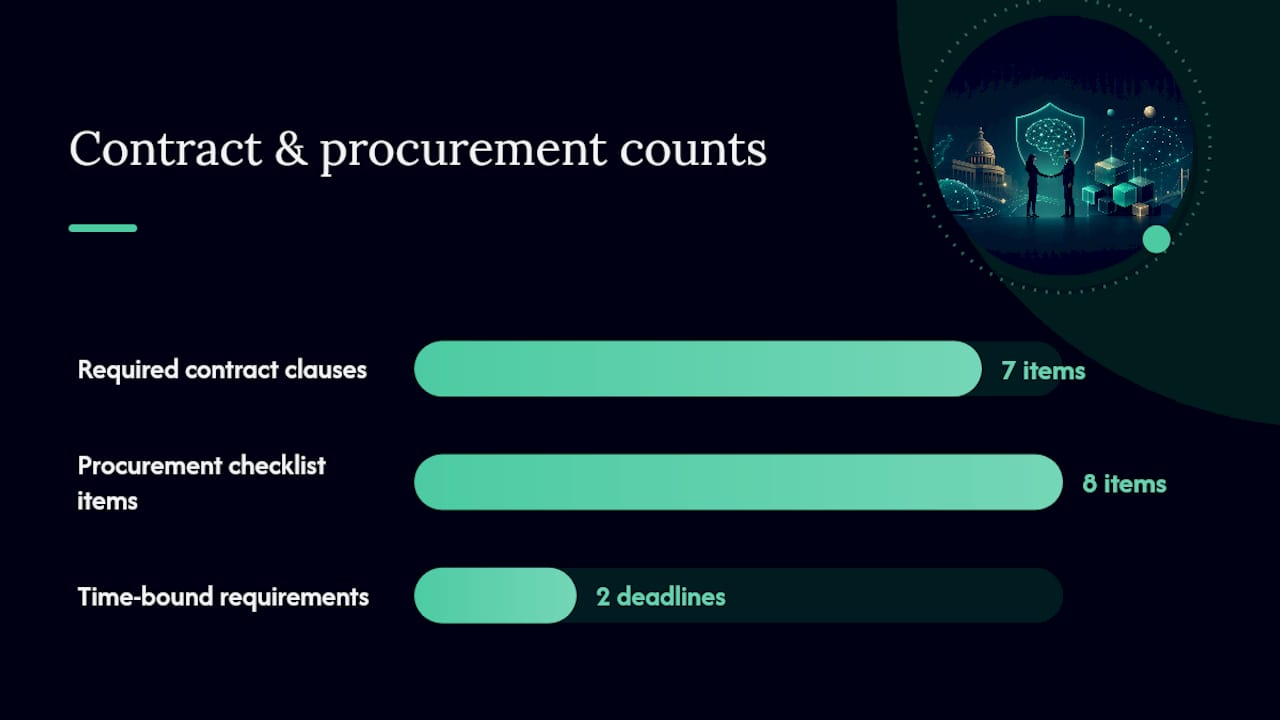
The single must-have contractual requirement is a data processing agreement that includes audit rights, subprocessor controls, data deletion obligations, and a prohibition on using your data to retrain the vendor’s shared model. Without that, you have no enforceable privacy posture regardless of what your internal controls say.
Required contract clauses:
- Data access and purpose limitation. The vendor may process your data only for the services described in the agreement, not for model improvement, benchmarking, or any other purpose.
- Subprocessor list and approval rights. The vendor must disclose all subprocessors, notify you before adding new ones, and give you the right to object.
- Data deletion and return. On termination, the vendor must delete all your data — including any copies in training pipelines — within a specified timeframe and provide written confirmation.
- Model retraining restrictions. Explicitly prohibit the vendor from using your inputs or outputs to fine-tune or retrain any model, including shared or foundational models.
- Audit rights. You must have the right to audit the vendor’s privacy controls, or to receive third-party audit reports (SOC 2 Type II, ISO 27001) on a defined schedule.
- Incident notification. The vendor must notify you within 72 hours of any security incident that may affect your data — matching GDPR’s notification window even for U.S.-only deployments, since it sets the practical industry standard.
- Data residency. For sensitive workloads, specify the geographic region where data may be stored and processed. For U.S. healthcare data, this typically means U.S.-only regions. Zatersio’s data sovereignty guidance covers residency options for teams with strict jurisdictional requirements.
Procurement due-diligence checklist — request these before signing:
- Current SOC 2 Type II report (issued within the last 12 months)
- ISO 27001 or ISO 27701 certification
- Data processing agreement template (review against the clause list above)
- Subprocessor list with geographic locations
- Model card or equivalent documentation for any foundation model used
- Incident response SLA and notification procedures
- Evidence of adversarial testing (penetration test summary, red team report)
- Data deletion procedures and confirmation process
When to insist on on-premises or isolated inference: Any system processing PHI, biometric data, attorney-client privileged material, or financial account data warrants isolated inference. The risk of a shared cloud endpoint — where your data may transit infrastructure also serving other tenants — is difficult to fully mitigate contractually. On-prem or dedicated inference eliminates that exposure class.
How do you operationalize DSARs, monitoring, and AI incident response?
The most important operational control is a logging architecture that produces searchable, timestamped artifacts and a defined human review path for every AI output that may contain personal data. Without searchable logs, you cannot respond to a DSAR or investigate an incident in any reasonable timeframe.
AI incident response playbook:
- Detection. Output monitoring alerts fire when PII patterns appear in model outputs, when filter trigger rates spike, or when anomalous query volumes suggest a membership inference or exfiltration attempt.
- Containment. Suspend the affected model endpoint or restrict access while the scope of the incident is assessed. Do not wait for root-cause confirmation before containing.
- Root-cause analysis. Determine whether the incident stems from a training data issue (memorization), a RAG misconfiguration (context leakage), a prompt injection, or an agent action. Each has a different remediation path.
- Notification assessment. Apply your breach notification decision tree. HIPAA requires OCR notification within 60 days of discovery for breaches affecting 500 or more individuals. CCPA/CPRA requires notification to affected consumers without unreasonable delay. State breach notification laws vary — confirm the applicable threshold for your jurisdiction.
- Regulator reporting. If the incident meets reporting thresholds, notify the relevant regulator (OCR, state AG, FTC) with a factual incident summary, the scope of affected individuals, and your remediation steps.
- Post-incident review. Update your DPIA risk register, retrain or fine-tune the model with the problematic data removed, and retest before redeployment.
DSAR operationalization for AI outputs:
- Maintain a data subject index that maps individual identifiers to training dataset sources and to inference logs.
- When a DSAR arrives, search inference logs by the data subject’s identifier to identify any outputs that may contain their data.
- If the model was trained on data that includes the subject’s records, document the dataset provenance and assess whether the model can reproduce that data.
- For deletion requests, assess whether model unlearning or full retraining is technically feasible. Document your assessment and the action taken.
- Provide the data subject with a plain-language summary of what AI processing occurred, what outputs were generated, and what action you took.
What to log and how:
- Every inference call: timestamp, user ID (hashed), input hash, output hash, model version, filter triggers
- Every RAG retrieval: document ID, user authorization level, retrieval timestamp
- Every agent action: action type, target system, data accessed, approval status
- Alert thresholds: PII filter trigger rate above baseline, query volume spikes, repeated identical queries (potential membership inference probing)
- Sampling strategy: review a random sample of 1–5% of daily outputs for PII leakage on a weekly basis, and 100% of flagged outputs within 24 hours
What documentation do regulators and auditors actually ask for?
The document regulators ask for first is the DPIA with a technical appendix covering dataset provenance and model test logs. Everything else supports and expands on that core document.
Audit-ready document checklist:
| Document | Purpose | Retention guidance |
|---|---|---|
| DPIA report with risk register | Primary evidence of privacy-by-design and risk management | Retain for the life of the system plus 3 years |
| Data flow diagram (AI lifecycle) | Shows where personal data enters, moves, and exits | Update on every material system change |
| Dataset provenance record | Documents training data sources, consent basis, and scraping history | Retain for the life of the model plus 3 years |
| Model card | Describes architecture, training data, known limitations, and test results | Version-controlled; retain all versions |
| Adversarial test logs | Evidence of regurgitation, membership inference, and prompt injection testing | Retain for 3 years or per litigation hold |
| Vendor attestations and DPAs | Contractual evidence of third-party controls | Retain for contract term plus 3 years |
| Change history / model version log | Tracks material changes to model, data, or purpose | Retain for the life of the system |
| Incident response records | Documents detection, containment, notification, and remediation | Retain for 5 years or per applicable law |
Presentation tips for regulator briefings:
- Lead with a one-page executive summary: system purpose, data types, risk tier, DPIA status, and current control posture.
- Follow with a risk heatmap that maps each failure mode to its likelihood, impact, and mitigation status. Regulators respond well to visual risk summaries.
- Attach the full DPIA, test logs, and vendor attestations as a numbered appendix. Reference appendix items by number in the executive summary.
- Use plain language in the executive summary. Technical detail belongs in the appendix, not the briefing document.
Retention and versioning: Version-control every document with a date stamp and a named owner. When a model changes materially, create a new DPIA version rather than amending the original. Regulators want to see the decision history, not just the current state. The EDPB’s opinion on AI models specifically identifies the documentation elements supervisory authorities will inspect — use that list as your audit-readiness checklist.
Which standards and frameworks should you build your program on?
The two most actionable frameworks for U.S. privacy teams are the NIST AI Risk Management Framework and the EDPB’s LLM-specific guidance. Together they give you a risk-scoring methodology, a lifecycle map, and a documentation standard that satisfies both U.S. regulators and EU supervisory authorities for cross-border deployments.
Standards and regulator guidance to bookmark:
- NIST AI RMF (AI 100-1). The NIST AI Risk Management Framework provides a govern-map-measure-manage structure that aligns well with DPIA methodology. It is the closest thing the U.S. has to a binding AI governance standard and is already referenced in federal procurement requirements.
- ISO/IEC 22989. The AI vocabulary standard. Use it to ensure your DPIA and model documentation use consistent, internationally recognized terminology — particularly important when briefing regulators or external auditors.
- ISO/IEC 27701. The privacy information management extension to ISO 27001. If your organization holds ISO 27001, adding 27701 gives you a certifiable privacy management framework that covers AI processing activities.
- EDPB LLM guidance. The EDPB’s LLM risk methodology is the most detailed regulator-authored lifecycle framework available. Even for U.S.-only deployments, it is the best available template for structuring a DPIA.
- OECD AI and privacy mapping. The OECD’s alignment of privacy guidelines with AI principles is useful for multinational teams and for justifying international cooperation approaches in your governance documentation.
- OSTP AI Bill of Rights. Non-binding but widely cited by U.S. regulators. Use its transparency, notice, and human-alternative principles to shape your privacy notices and governance policies.
- Stanford HAI foundation model brief. The Stanford HAI brief on data privacy and foundation models is the clearest policy-level summary of training-phase risks and recommended mitigations.
Tool categories for operationalizing compliance:
- Privacy test suites. Tools that probe models for memorization, regurgitation, and membership inference. Evaluate options against your model architecture — API-based models and self-hosted models require different testing approaches.
- Synthetic data generators. Platforms that produce statistically representative synthetic datasets for training and testing. Validate outputs with membership inference tests before treating synthetic data as safe.
- PETs vendors. Vendors offering differential privacy libraries, federated learning infrastructure, and secure multi-party computation. Evaluate against your engineering stack and your epsilon budget.
- Output monitoring and PII detection. Production monitoring tools that scan model outputs for PII patterns in real time. Integrate with your SIEM for alert correlation.
Model documentation formats: Request model cards from every vendor before deployment. For internally developed models, publish model cards internally and share them with auditors. Zatersio’s Australian AI Transparency Index 2026 benchmarks transparency practices across AI deployments — a useful reference for setting your own documentation standards.
The compliance gap most teams underestimate
Privacy teams tend to focus on the controls they can see — the contract clause, the DPIA checkbox, the consent banner. The harder problem is the one you cannot fully observe: algorithmic opacity. You cannot predict with certainty what a large language model will output for every possible input. That unpredictability is not a bug you can patch; it is a structural property of how these models work.
The practical implication is that documented governance and continuous testing are not optional extras. They are the only way to demonstrate to a regulator that you took the risk seriously, even when an incident occurs. Regulators do not expect perfection. They expect evidence that you identified the risks, implemented controls, tested them, and updated your approach when you found gaps.
The teams that get this right are the ones that treat the DPIA as a living document rather than a one-time filing. They rerun adversarial tests after every model update. They log everything. They brief executives quarterly, not annually. And they build the evidence pack before they need it — not in the 72 hours after a regulator inquiry lands.
One more thing worth saying plainly: the speed pressure to ship AI features is real, and it will not go away. The answer is not to slow down. It is to build privacy controls into the engineering sprint from day one, so the DPIA and the test logs exist by the time the feature ships. Privacy-by-design is faster than privacy-by-remediation, every time.
Ready to build a compliant AI system from the ground up?
If your team needs to move from compliance planning to a working, privacy-respecting AI system quickly, Zatersio builds engineer-grade AI automations and MVPs with data residency options, fixed pricing, and contractual controls built in from day one. Whether you need an isolated inference environment, a documented automation workflow, or a proof-of-concept that satisfies your legal team, the Zatersio AI automation blueprint is the fastest way to scope it.
For teams commissioning a new AI build, Zatersio’s MVP development service delivers working software in under two weeks, structured for R&D Tax Incentive eligibility where applicable.
Sources
These are the primary documents your team should cite in DPIAs, regulator responses, and governance policies:
- AI privacy risks and mitigations in LLMs (EDPB)
- Data privacy and foundation models: can we have both? (Stanford HAI)
- Guidance on privacy and the use of commercially available AI products (OAIC)
- Data Privacy Guide to AI and Machine Learning (IBM)
- AI, data governance and privacy (OECD)
This article provides general information for educational purposes and does not constitute legal advice. Confirm current regulatory requirements with qualified legal counsel and the relevant primary sources before making compliance decisions.
This article is general information, not a substitute for advice from a qualified lawyer. Consult a qualified legal professional about your own circumstances before acting on anything here.