
Quote Request Automation for Businesses to Cut Admin Time
Quote Request Automation for Businesses to Cut Admin Time
Build an MVP that automates inbound RFQs and pulls live pricing from your ERP. That is the fastest, lowest-risk way to cut quote turnaround and stop losing bids to slower competitors. Skip the year-long platform rollout. Start narrow.
That’s the ASC 606-adjacent discipline finance teams already apply to revenue recognition, applied instead to how quotes get built.
- Pick one intake channel (email is usually easiest) and one product line.
- Map your current pricing rules exactly as they exist in your ERP today.
- Set a target: quotes out in a much shorter time than usual.
Statistic to know: research on AI citation patterns found that 44.2% of AI-generated answers pull from the first 30% of an article covering a topic, which is exactly why this piece leads with the verdict instead of burying it.
Pro Tip: Don’t try to automate every product line on day one. Pick the RFQ pattern that repeats most often, prove it works, then expand.
| Point | Details |
|---|---|
| Start small | A two-week pilot on your top RFQ pattern beats a year-long full rollout. |
| Integrate, don’t replace | Connect to your existing ERP and CRM instead of ripping them out. |
| Zatersio builds fast | Fixed-price MVPs, often delivered in under two weeks for a focused scope. |
Key Takeaways
The fastest path to reliable quote request automation is a fixed-price MVP that ingests unstructured RFQs, applies your existing pricing rules, and routes exceptions to a human reviewer.
| Point | Details |
|---|---|
| Start with an MVP | Target the most frequent RFQ patterns before automating everything. |
| Integrate, don’t rebuild | Connect to your existing ERP, CRM, and contract data instead of replacing them. |
| Guardrails prevent errors | Route pricing outliers to a human rather than automating 100% of requests. |
| Track the right KPIs | Time-to-quote, exception rate, and win rate reveal whether the pilot is working. |
| Zatersio delivers fast | Fixed-price MVPs with Australian data residency, often live in under two weeks. |
Further Reading and Zatersio Resources
- Workflow Automation Services: integration-first automation approach explained.
- AI Agents for Australian Business: agentic automation connected to core systems.
Table of Contents
- Why Quote Request Automation Matters for Your Bottom Line
- How Does Inbound Quote Request Automation Actually Work?
- Is CPQ the Same as Quote Request Automation?
- Which Systems and Data Feed an Automated Quote?
- What Does an MVP-First Rollout Actually Look Like?
- Which KPIs Prove Quote Automation Is Working?
- What Security Risks Come With Automated Quoting?
- How Do You Keep Pricing Rules Accurate Over Time?
- What Does Successful Quote Automation Look Like in Practice?
- How Do You Align Sales, Finance, and Operations Around Automated Pricing?
- What Data Residency and Compliance Rules Apply?
- How Does AI Improve Quote Accuracy and Speed?
- Zatersio’s Take on MVP-First Automation
- How Zatersio Builds Your Quote Automation MVP
- Frequently Asked Questions
Why Quote Request Automation Matters for Your Bottom Line
A slow quote is a lost quote. Buyers requesting quotes from multiple vendors typically go with whoever responds first with an accurate number, not whoever eventually sends the most polished PDF. Quote automation shrinks that response window from days to hours or minutes, which directly moves your win rate.
The businesses that gain the most are the ones drowning in repetitive RFQs: distributors juggling hundreds of SKUs, manufacturers with tiered contract pricing, contractors quoting similar jobs on repeat, and services firms with rate cards that rarely change but get manually reapplied every single time.
- Faster response time means you’re first in the buyer’s inbox, not third.
- Fewer manual entry errors means fewer embarrassing pricing corrections after the fact.
- Lower cost per quote frees up staff for the deals that actually need a human touch.
Quote-to-cash platforms that connect quoting, billing, and revenue recognition consistently report fewer reconciliation headaches downstream. A trades business we’ve studied went from a two-day average quote turnaround to same-day delivery once pricing rules were codified into a system instead of living in someone’s head.
How Does Inbound Quote Request Automation Actually Work?
The technical flow is more straightforward than most vendors make it sound. An RFQ comes in as an email, a PDF attachment, or an EDI feed. The system needs to read it, understand it, price it, and get it back out the door.
Here’s the sequence:
- Ingest the request from whatever channel it arrives on.
- Parse and extract the requirements. This is where an intelligence layer, built on natural language processing and product matching, converts a messy paragraph or spreadsheet into structured line items.
- Match products against your catalog, resolving customer shorthand or part numbers to actual SKUs.
- Pull pricing from the ERP or contract store. This has to reflect the actual negotiated rate for that customer, not a list price.
- Apply approval rules, checking margin floors and any contract-specific constraints.
- Draft the quote document in your standard format.
- Send and track the response, logging it against the CRM record.
Autonomous RFQ response systems can complete this entire loop in under a minute for a standard request, with exceptions flagged for a human rather than pushed through blind.
| Flow stage | What it does | Human involvement |
|---|---|---|
| Ingest & parse | Reads email/PDF/EDI, extracts structured data | None, unless format is unreadable |
| Match & price | Maps to SKUs, pulls contract pricing | None for standard requests |
| Approval & send | Checks margin floors, drafts and sends | Only for flagged exceptions |
| Approach | Best for | Weak point |
|---|---|---|
| Rules-only automation | Simple, stable pricing structures | Breaks on unstructured or unusual requests |
| AI-driven intelligence layer | Messy, varied inbound formats | Needs guardrails to avoid bad outliers |
Pro Tip: Set hard guardrails, like margin floors and contract exception limits, so anything outside normal bounds automatically routes to a person instead of going out the door on autopilot.

Is CPQ the Same as Quote Request Automation?
No, and mixing these up leads to buying the wrong tool. CPQ (configure, price, quote) is built for outbound, rep-driven selling: a salesperson configures a complex product and generates a proposal. It assumes a human starts the process.
Inbound quote request automation solves a different problem entirely. It handles RFQs that arrive unprompted, by email, PDF, or spreadsheet, without a rep initiating anything.
| Factor | CPQ | Inbound quote automation |
|---|---|---|
| Trigger | Rep starts the process | Customer sends an unsolicited RFQ |
| Best fit | Complex, configurable products | High volume or ad hoc requests |
| Typical channel | Sales conversation | Email, PDF, portal upload |
Quick check: if most of your quotes start with a customer emailing you a spec sheet, you need inbound automation, not a CPQ extension.
Pro Tip: If you already run CPQ for outbound deals, don’t force it to handle inbound RFQs. Layer a separate intake system on top instead of bending CPQ into a shape it wasn’t built for.
Which Systems and Data Feed an Automated Quote?
Accuracy lives or dies on integration quality. Skimp here and you’ll automate the wrong number faster than a person ever could.
Five systems need to talk to each other:
- ERP for live pricing, inventory levels, and contract terms.
- CRM for the customer record and deal context.
- Product catalog or SKU master so requests map to real items.
- Contract repository for negotiated rates and discount tiers.
- Invoicing and billing so the quote matches what eventually gets billed.
Before any of this goes live, run a data quality check against this list:
- SKU mapping is complete and current.
- Contract terms and discount rules are documented, not just remembered.
- Margin floors are defined per product line.
- Tax rules, including ASC 606 or IFRS 15 revenue recognition considerations, are mapped.
- Account credit flags are visible before a quote goes out.
| Data type | Read frequency | Why |
|---|---|---|
| Inventory levels | Real-time | Quoting stock you don’t have kills trust fast |
| Customer-specific pricing | Real-time | Wrong tier pricing is the most common quoting error |
| Product catalog | Batch (daily) | Changes infrequently enough to sync overnight |
Without clean underlying data, automation just amplifies existing errors faster than a person could make them manually.
What Does an MVP-First Rollout Actually Look Like?
Forget the twelve-month platform migration. The smarter path is a fixed-scope MVP that proves value before you touch a single legacy system.
Typical timeline:
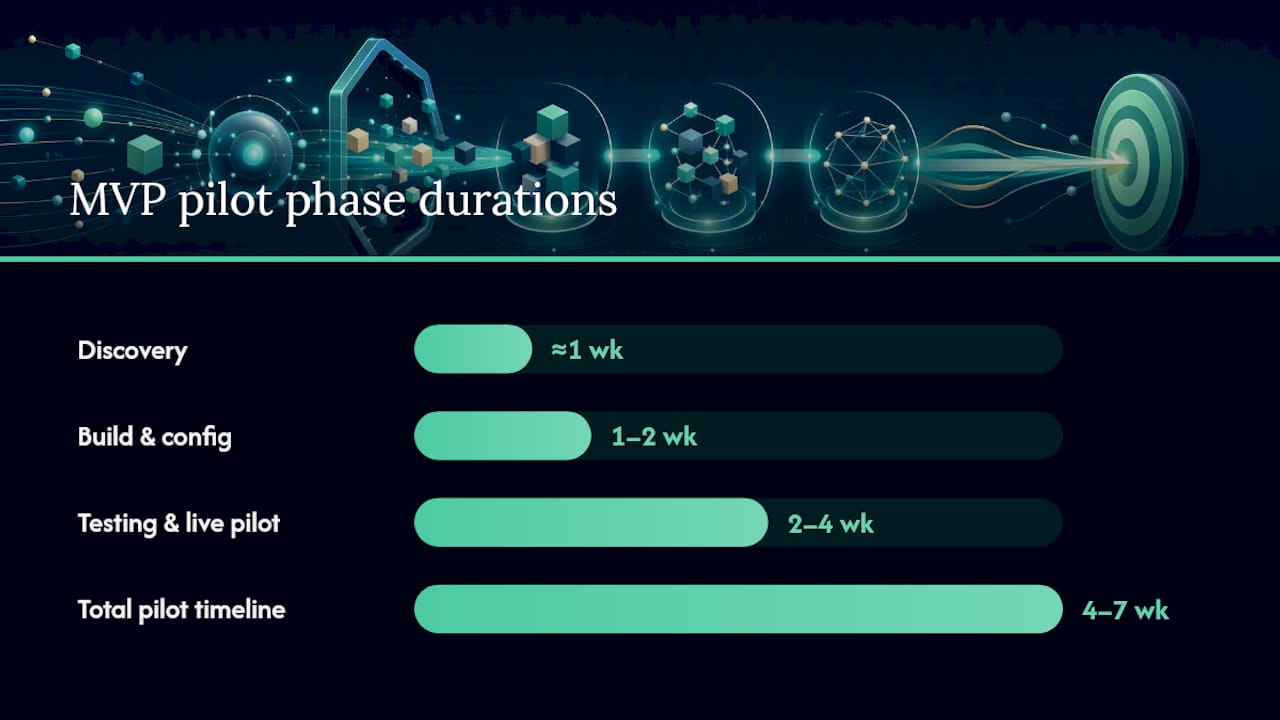
- Discovery: about one week to map pricing rules and integration points.
- Build and configuration: one to two weeks for the core automation logic.
- Testing and live pilot: two to four weeks running alongside your current process.
A focused MVP scope can produce working software in under two weeks, which is a different proposition than a drawn-out enterprise CPQ deployment.
Cost drivers worth budgeting for:
- Integration complexity with your ERP and CRM.
- Data cleansing, especially if your SKU master or contract data is scattered across spreadsheets.
- NLP configuration for matching unstructured product requests to catalog items.
- Approval workflow complexity, particularly with multiple sign-off tiers.
- Security and compliance requirements specific to your industry.
| Pilot acceptance criteria | Target |
|---|---|
| Quote accuracy | High enough that exceptions are rare, not routine |
| Time-to-quote | Hours instead of days |
| Exception rate | Low enough that human review stays manageable |
| Order-matching reliability | Quoted terms match what finance eventually invoices |
Pro Tip: Treat the pilot as a decision gate, not a soft launch. If accuracy or exception rate misses target after two weeks, fix the data problem before scaling the automation wider.
| Point | Details |
|---|---|
| Scope tight | Target the RFQ patterns responsible for most of your volume first. |
| Timeline is short | Discovery to live pilot can run four to seven weeks total. |
| Cost tracks integration | ERP/CRM connections and data cleanup drive most of the budget. |
Which KPIs Prove Quote Automation Is Working?
Track these from day one of the pilot, not after full rollout:
- Time-to-first-quote, from RFQ receipt to quote sent.
- Quotes per day, per person or per system.
- Quote accuracy or error rate, tracked against corrections issued after send.
- Win rate, to confirm faster quotes are actually converting.
- Average deal velocity, from quote to closed order.
- Cost per quote, factoring in labor time saved.
- Exception rate, the share of RFQs still needing human intervention.
A simple ROI model: multiply labor hours saved by hourly rate, then add any revenue uplift from a higher win rate. Zatersio’s ROI breakdown on manual quoting versus automation walks through a payback example that many pilots hit within six weeks.
Three pitfalls show up constantly:
- Poor data quality. Fix it by auditing SKU mapping and contract terms before automating, not after.
- Trying to automate 100% of RFQs. Automating every edge case rarely works well; route the unusual 10 to 15% to a human instead.
- Siloed pricing rules between sales and finance. Mirror one single source of pricing truth across both teams before go-live.
What Security Risks Come With Automated Quoting?
Automated quotes carry real data exposure risk because they touch customer pricing, contract terms, and sometimes credit information in one automated pipeline. A breach here isn’t just embarrassing, it can leak negotiated rates to competitors or violate contract confidentiality clauses.
Lock down access at the integration layer first. Every connection between your quoting system and ERP or CRM should use scoped API credentials, not a shared admin login that can touch everything. If your automation vendor can’t explain exactly what data each integration point can read and write, that’s a red flag worth pausing on.
Encrypt data in transit and at rest, particularly for contract repositories holding customer-specific discount structures. Quotes often reveal margin information indirectly, so treat outbound quote documents with the same care as an invoice.
Audit logging matters more here than in most business systems. You need a record of who approved which exception, what pricing rule fired, and when a quote actually went out, both for internal accountability and in case a customer disputes a quoted price months later.
Watch for one specific risk unique to inbound automation: RFQ intake channels, especially email, are a common phishing vector. A parsing system that blindly trusts inbound content without validation could be manipulated into generating fraudulent quotes or leaking pricing data to a spoofed request. Build validation checks before the parsing stage, not after.
How Do You Keep Pricing Rules Accurate Over Time?
Pricing rules rot faster than most businesses expect. A contract renegotiated in March and a margin floor updated in June can both silently drift out of sync with what your automation system is actually applying, and nobody notices until a customer flags an underpriced quote.
Assign clear ownership. One person or team, usually finance or a pricing lead, should own the master pricing ruleset, with sales and operations able to flag issues but not edit rules directly. Without single ownership, you end up with the exact siloed-pricing problem that undermines automation credibility.
Schedule a recurring review, monthly at minimum for fast-moving product lines, quarterly for stable ones. Treat it like a financial close process: confirm contract terms match what’s live in the system, check that discontinued products are pulled from the catalog, and verify margin floors still reflect current cost structures.
Version your pricing rules the way you’d version software. When a rule changes, log what changed, why, and who approved it. This matters twice: it protects you if a customer disputes a quote, and it gives you a rollback path if a new rule accidentally breaks pricing for an entire product line.
Build a lightweight approval workflow for rule changes themselves, separate from the approval workflow for individual quotes. A single unreviewed pricing rule change can generate hundreds of wrong quotes before anyone catches it, which is a far bigger problem than one bad quote slipping through.
What Does Successful Quote Automation Look Like in Practice?
A mechanical trades workshop juggling walk-in and phone-based RFQs for parts and labor is a common candidate, since automation tailored to workshop workflows can turn a same-day scramble into a structured, trackable process instead of sticky notes and memory.
Distributors with tiered contract pricing tend to see the clearest wins. When a customer’s negotiated discount lives in the ERP and the automation pulls it directly rather than a rep guessing or checking a spreadsheet, pricing errors that used to slip through manual review simply stop happening.
Professional services firms with standardized rate cards show a different pattern. A financial planning practice fielding repetitive quote requests for similar service packages can automate the intake and drafting step while keeping a human firmly in the loop for anything involving custom scope, which is exactly the kind of guardrail that keeps automation trustworthy rather than reckless.
The common thread across working deployments isn’t the industry. It’s scope discipline: start with the RFQ pattern that repeats most, prove the pricing logic holds up under real volume, then expand one product line or channel at a time. Businesses that try to automate everything on day one tend to hit the same wall, unstructured edge cases that the intelligence layer wasn’t trained to handle, and lose confidence in the whole system before it’s had a fair test.
How Do You Align Sales, Finance, and Operations Around Automated Pricing?
Pricing mismatches almost never come from bad technology. They come from three teams operating off three different versions of the truth. Sales quotes off memory or an outdated spreadsheet, finance bills off the contract system, and operations fulfills based on whatever inventory shows available. Automation doesn’t fix that gap on its own, it just executes whichever version of pricing you feed it, faster.
Before automating anything, get sales, finance, and operations in a room to agree on a single source of pricing truth. This sounds obvious and almost never happens without deliberate effort. Successful programs mirror the same pricing rules used in quoting downstream in billing and invoicing, so what a customer is quoted matches exactly what they’re eventually billed.
Assign a change owner for pricing rules, as covered earlier, but also assign a communication protocol. When a rule changes, who gets notified? If finance updates a margin floor and sales doesn’t know, reps will keep quoting the old number until a customer complaint forces a correction.
Run a short parallel period where automated quotes get reviewed against what a human would have quoted, before fully cutting over. This catches misalignment early, while it’s a training issue rather than a customer-facing incident. Most teams underestimate how much implicit pricing knowledge lives in a senior rep’s head rather than in any documented system.
What Data Residency and Compliance Rules Apply?
Where your quote data physically sits matters more than most businesses realize until a customer or regulator asks. Pricing data, contract terms, and customer records often carry contractual confidentiality obligations, and some industries layer statutory requirements on top.
Ask any automation vendor directly where data is hosted and processed, not just where the company is headquartered. Data residency options, keeping data within Australia specifically, matter for businesses handling government contracts, health sector pricing, or any client relationship with a data sovereignty clause written into the agreement.
Revenue recognition standards add another compliance layer. Quotes that eventually convert to invoices need to reflect ASC 606 or IFRS 15 principles around performance obligations and transaction pricing, particularly for businesses with bundled products, subscriptions, or multi-year contracts. Get finance involved in reviewing how the automation handles these cases before go-live, not after your accountant flags a discrepancy at year-end.
Document your data handling practices clearly enough that you can answer a customer’s security questionnaire without scrambling. Enterprise buyers increasingly ask vendors, including their suppliers using automation internally, for details on how quote and pricing data is stored, encrypted, and who can access it. Treat this documentation as part of the build, not an afterthought bolted on when the first questionnaire lands.
How Does AI Improve Quote Accuracy and Speed?
The biggest single bottleneck in quote automation is unstructured input. Most RFQs don’t arrive as clean, structured data. They arrive as a rambling email, a scanned PDF, or a spreadsheet with inconsistent formatting, and an intelligence layer that extracts and normalizes this data is what makes automation viable at all. Systems that only handle structured inputs tend to fail the moment a real customer sends a messy request.
Natural language processing does the heavy lifting here, reading a paragraph of prose and pulling out quantities, specifications, and part references, then matching them against your product catalog even when the customer used shorthand or an old part number. This is different from rules-based matching, which breaks the moment a request doesn’t match an exact pre-programmed pattern.
Machine learning improves over time in a way static rule sets can’t. As more quotes get processed and corrected, the matching accuracy for ambiguous product descriptions improves, and the system gets better at recognizing which requests are standard versus which genuinely need human judgment. AI agents can also collect missing details by prompting for clarification before drafting an estimate, rather than guessing and sending an inaccurate quote.
The turnaround improvement is the practical payoff. What used to take a person half a day, reading the request, checking pricing, drafting the document, can compress to minutes for standard requests, with the AI layer holding a request for human review only when it falls outside defined guardrails.
Zatersio’s Take on MVP-First Automation
We build fixed-price MVPs that connect to your existing ERP rather than replacing it, because ripping out systems that already hold years of pricing history is the riskiest possible starting point. Measure pilot success against a tight metric, time-to-quote and exception rate, then let engineering iterate weekly based on what the data actually shows.
Clients working with our MVP builds have seen measurable time savings within the first pilot cycle, backed by Australian data residency options and R&D Tax Incentive structuring for eligible projects.
How Zatersio Builds Your Quote Automation MVP
Zatersio delivers fixed-price MVPs that connect your existing ERP and CRM to an AI-driven quoting layer, often producing working software in under two weeks for a focused scope, with Australian data residency and R&D Tax Incentive structuring built in from the start.
You’ve seen the technical flow, the integration requirements, and the pilot criteria that separate a working automation project from an expensive stalled one. The next step is putting a real number on your own RFQ volume and pricing complexity, not guessing at scope from a generic vendor pitch. A free automation blueprint gives you that scoped starting point before you commit to a build. If you already know the shape of the project, you can go straight to requesting a fixed-price MVP quote and get a working pilot in front of your team inside two weeks.
Frequently Asked Questions
What is quote request automation? Quote request automation is the process of using software, often paired with AI, to receive an inbound RFQ, match it against your product catalog and pricing rules, and generate an accurate quote with minimal manual entry.
How is quote automation different from CPQ? CPQ handles outbound, rep-initiated proposals for configurable products, while quote request automation handles inbound RFQs that arrive unprompted by email, PDF, or portal, without a rep starting the process.
How long does it take to implement quote request automation? A focused MVP covering your top RFQ patterns typically runs four to seven weeks from discovery to live pilot, with a working prototype often ready in under two weeks for a tightly scoped project.
What systems need to integrate with a quote automation platform? At minimum, your ERP for pricing and inventory, your CRM for customer context, a product catalog or SKU master, and your contract repository for negotiated rates and discount tiers.
Can quote automation handle complex, custom pricing? Yes, provided your margin floors, contract terms, and approval rules are clearly documented before the build starts. Complex or unusual requests should route to a human reviewer rather than being forced through automation blindly.