
Referral Management Automation: What It Does, When to Adopt It
Referral Management Automation: What It Does, When to Adopt It
Referral management automation centralizes intake, routes referrals to the right provider automatically, and closes the loop so no patient falls through the cracks. Adopt it when referral leakage, long wait times, or manual intake and scheduling work are eating into staff hours and patient access. If your coordinators are still faxing referrals and chasing status updates by phone, you’re paying twice: once in wasted labor, once in patients who give up and go elsewhere.

The case for automating gets stronger as your referral volume gets bigger. A practice handling a few dozen referrals a month can survive on spreadsheets and sticky notes. A multi-site clinic or specialist network processing hundreds weekly cannot do so without losing patients in the gaps between fax machines, inboxes, and phone tag. Vendors like Zatersio build automation specifically for this kind of operational strain, and standards bodies like ISO/IEC 27001 give administrators a benchmark for judging whether a system handles patient data responsibly. Austrade also tracks how Australian health services are adopting these tools as part of broader technology uptake.
Three operational wins matter most once a health service automates referrals:
- Faster time-to-book — referrals move from intake to scheduled appointment in days, not weeks.
- Closed-loop tracking — every referral shows a status, so nobody has to guess whether a patient was seen.
- Lower admin hours — staff stop re-keying data across fax, email, and portal systems.
The gap between a referral being sent and a referral being acted on is where most patients get lost. Automation exists to close that gap, not to replace clinical judgment.
Key Takeaways
Referral management automation works because it replaces manual referral handoffs with centralized intake, automated matching, and closed-loop tracking that together cut leakage and booking delays.
| Point | Details |
|---|---|
| Adopt when leakage is measurable | If you can’t state your current referral-to-appointment conversion rate, that gap alone justifies a pilot. |
| Prioritize integration first | Confirm EHR/PMS connectivity and request a sandbox test before evaluating any other feature. |
| Track four core KPIs | Measure time-to-book, closed-loop rate, referral-to-appointment conversion, and admin hours per referral. |
| Scope pilots narrow | Test one referral type and one clear KPI rather than automating every pathway at once. |
| Consider a bespoke build for complex workflows | Zatersio delivers a working MVP in under two weeks with fixed pricing for services whose referral logic doesn’t fit generic software. |
Table of Contents
- What Is Referral Management Automation? The End-to-End Referral Lifecycle
- Key Benefits for Health Services and Measurable Outcomes to Expect
- Core Features to Expect From an Automated Referral Management System
- Integration, Interoperability, and Privacy: What to Check Before You Commit
- How Implementation Typically Works: Timeline and KPIs
- Vendor Selection Checklist and What to Ask During Demos
- When to Choose a Bespoke Automation Build
- A Tailored Pilot for Fast Proof-of-Value
- Sources
What Is Referral Management Automation? The End-to-End Referral Lifecycle
Referral management automation is software that handles the administrative mechanics of a referral: capturing it, sorting it, matching it to the right provider, booking it, checking eligibility, and reporting back on the outcome. It doesn’t replace the clinical decision to refer. It replaces the manual busywork that happens after that decision, which is usually where referrals stall.
The referral lifecycle breaks into four stages, and knowing where automation fits at each one helps you scope a pilot correctly.
- Intake — a referral arrives by fax, email, portal submission, or direct EHR order. Automation software captures this data automatically instead of requiring a staff member to transcribe it.
- Triage and matching — the system classifies the referral by specialty, urgency, and insurance, then matches it to an available in-network provider. This is where AI matching tools add the most value, since manual matching depends on one coordinator’s memory of who has openings.
- Scheduling and authorization — the platform checks eligibility, confirms prior authorization requirements, and books the appointment, often through direct calendar integration.
- Consult and loop closure — once the patient is seen, the system logs the outcome and reports it back to the referring provider, closing the loop that too many manual processes leave open indefinitely.
Humans still own the clinical decisions: which specialist is appropriate, whether urgency should override a standard queue, how to handle an edge case the software flags. Automation owns the repetitive mechanics around those decisions. That division of labor is the whole point of automating a medical intake process instead of trying to remove people from it entirely.
Key Benefits for Health Services and Measurable Outcomes to Expect
The business case for referral process optimization comes down to five things: less leakage, faster booking, lower admin cost, better patient experience, and better data for managing your referral network.
Referral leakage, patients who are referred out and never actually get seen, is the single biggest hidden cost in most health services. Every leaked referral is a patient who may return sicker, plus a wasted clinical assessment that led nowhere. Automated tracking flags referrals that stall past a set number of days so staff can intervene before the patient disappears from the system entirely.
- Reduced referral leakage through automatic follow-up nudges and stalled-referral alerts.
- Faster time-to-book, since matching and scheduling happen without a coordinator manually calling around.
- Decreased admin cost, because staff stop re-entering the same referral data across multiple systems.
- Better patient experience, with fewer delays and clearer communication about next steps.
- Better network data, giving administrators visibility into which specialists have capacity and which referral sources send the most volume.
Statistic Callout: Vendors like Phreesia build dashboards specifically to track referral-to-appointment conversion rates and referral source analytics, treating that conversion number as the primary health metric for a referral program. If you can’t currently answer “what percentage of our referrals actually convert to a booked visit,” that gap alone justifies a pilot.
Translate this into staff hours and the case gets more concrete. One Zatersio workflow automation case study documented a Melbourne business recovering more than 20 hours of staff time a month after automating repetitive administrative workflows. Even a fraction of that recovered time, applied to referral coordination, changes how many referrals a small team can handle without adding headcount.
Core Features to Expect From an Automated Referral Management System
Before you evaluate vendors, know what a functioning system actually needs to do. A feature checklist keeps procurement conversations grounded instead of drifting into vague promises about “smart” software.
- Centralized intake across fax, email, and portal submissions, so nothing lands in three different inboxes.
- Intelligent triage and matching, sorting referrals by urgency and specialty and suggesting an appropriate provider.
- Appointment coordination, syncing with scheduling systems to book directly instead of generating a task for someone to call the patient.
- Eligibility and prior authorization checks, run automatically before the appointment is confirmed.
- EHR or PMS integration, so referral data writes back into the patient’s existing record without manual re-entry.
- Dashboards and closed-loop tracking, giving administrators a live view of referral status and outcomes.
Each feature solves a different operational headache. Centralized intake matters most for front-desk staff drowning in fax pages. Triage and matching save the referral coordinator who used to keep a mental list of which specialists had openings. Dashboards matter to the network manager who needs to report leakage rates to a board or funder.
Some platforms go further with AI-driven matching, patient self-scheduling, and automated outreach campaigns for referrals that go quiet. Products like skyReferral market this kind of automatic classification and nudging as their core value proposition, and MantraEHR bundles similar matching and eligibility features into a single referral workflow. These extras aren’t essential for every service, but they’re worth asking about if your volume is high enough that manual matching has become a bottleneck.
A referral system that can’t tell you where a referral currently sits, intake, waiting on authorization, booked, seen, isn’t really managing referrals. It’s just storing them.
Integration, Interoperability, and Privacy: What to Check Before You Commit
No referral automation platform operates in isolation. It has to talk to your existing EHR or PMS, your scheduling system, and often a secure messaging layer connecting you to referring providers and specialists. Get this wrong and you end up with two disconnected systems that each require manual updates, which defeats the purpose of automating in the first place.
Run through this integration checklist before signing anything:
- EHR/PMS connectivity using recognized standards like HL7 or FHIR, or a documented proprietary API if the vendor doesn’t support open standards.
- Scheduling system sync, so bookings write directly into existing calendars instead of creating a parallel schedule.
- Secure messaging for provider-to-provider communication that meets clinical correspondence requirements.
- Payer directory access, so eligibility checks pull from current insurance data rather than static lists.
On the compliance side, ask about data residency options, encryption standards, audit trails showing who accessed what and when, and role-based access controls that limit staff visibility to what their job actually requires. ISO/IEC 27001 certification is a recognized benchmark here. It signals that a vendor has a formal information security management system in place rather than ad hoc security practices bolted on after the fact.
Pro Tip: Don’t take integration claims at face value during a sales demo. Ask the vendor for an integration runbook or a sandbox connection to your actual EHR test environment before you sign. A vendor confident in their interoperability will have this ready; one that stalls on the request is telling you something.
How Implementation Typically Works: Timeline and KPIs
A realistic rollout moves through four phases, and knowing the expected duration of each helps you set internal expectations and avoid a project that drags on indefinitely.
| Phase | Typical Duration | Primary Owner |
|---|---|---|
| Pilot / proof-of-concept | 2 to 4 weeks | Vendor engineering team with clinical lead input |
| Integration with EHR/PMS | 3 weeks | Vendor technical team plus IT liaison |
| Go-live with limited referral volume | 2 to 4 weeks | Referral coordinators and administrators |
| Full-scale rollout | 4 to 8 weeks | Administrators with ongoing vendor support |
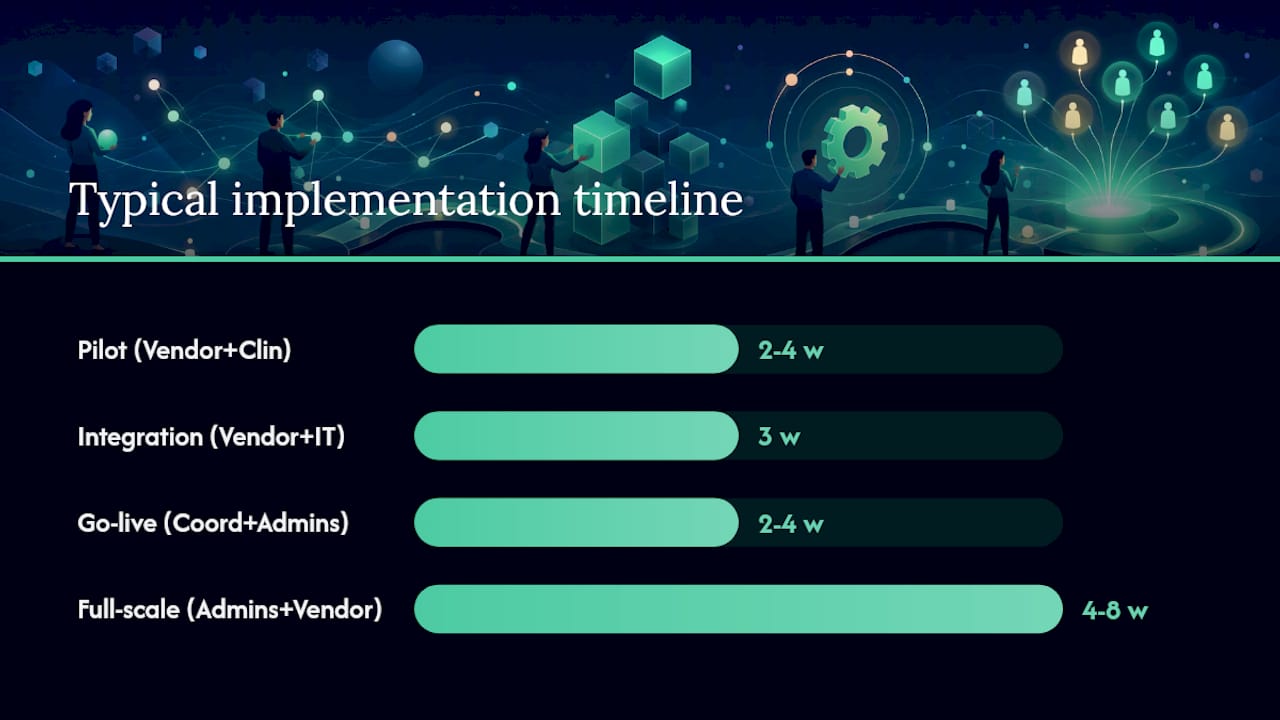
Vendors that specialize in rapid builds, Zatersio among them, compress the pilot phase significantly by delivering a working version of the automation in under two weeks rather than months, which shortens the entire timeline for a health service trying to prove value before committing to a full build.
Track these KPIs before and after deployment so the pilot actually proves something:
- Time-to-book, from referral receipt to scheduled appointment.
- Referral closed-loop rate, the percentage of referrals with a documented outcome.
- Referral-to-appointment conversion, how many referrals actually result in a completed visit.
- Admin hours per referral, tracked before and after automation to quantify labor savings.
The most common rollout pitfalls are predictable. Data quality issues surface when historical referral records are incomplete or inconsistently formatted, so budget time for cleanup before go-live. Staff training gets rushed when a go-live date is treated as fixed regardless of readiness. And intake formats that don’t match your EHR’s field structure cause silent data loss unless someone maps the fields carefully during integration testing.
Vendor Selection Checklist and What to Ask During Demos
Choosing between an off-the-shelf platform and a custom build comes down to how well a vendor answers a specific set of questions, not how polished their sales deck looks.
Ask every vendor these questions during a demo:
- How does your system integrate with our specific EHR or PMS, and can you show a live sandbox connection?
- What security certifications do you hold, and can we see an audit trail sample?
- What’s your uptime SLA, and what happens if the system goes down during business hours?
- What training and change management support is included, and for how long after go-live?
- Is your pricing model per-referral, per-user, fixed-tier, or custom, and how does that scale as our volume grows?
For a 4 to 8 week pilot, judge success against a short numbered checklist:
- Did time-to-book improve measurably compared to your baseline?
- Did the closed-loop rate increase, meaning fewer referrals disappeared without a documented outcome?
- Did staff report the system as easier to use than the manual process it replaced?
- Did integration hold up under real referral volume without manual workarounds?
Pricing models vary widely across the market. Per-referral pricing scales with volume but can get expensive fast for high-volume services. Per-user licensing is predictable but penalizes services that need broad staff access. Fixed-tier subscriptions offer budget certainty but may include features you don’t need. Custom-build pricing, the model Zatersio uses, gives you a fixed cost tied to the specific workflow you’re automating rather than a generic feature bundle you’re paying for regardless of use.
When to Choose a Bespoke Automation Build
An off-the-shelf platform works fine for standard referral workflows. But bespoke automation makes more sense once your service has complex routing rules, a proprietary data model, or compliance requirements that generic software wasn’t built to handle. If your referral process depends on logic specific to your network, say, a multi-site triage rule that routes based on a combination of specialty, urgency, and a specific funding stream, a generic platform will force you to work around its limitations instead of the other way around.
This is the scenario Zatersio was built for. Their model delivers a working MVP in under two weeks, structures eligible projects so clients can access the R&D Tax Incentive, and offers Australian data residency options for services that need to keep patient data within specific jurisdictional boundaries. Projects run on fixed pricing with direct access to the engineering team building the system, not a support ticket queue.
- Complex workflows that don’t fit a generic referral template.
- Proprietary data models, such as a specialty network with non-standard classification rules.
- Specific compliance or integration needs, including a legacy PMS with no modern API.
Off-the-shelf software solves the referral problem every health service shares. A bespoke build solves the referral problem specific to yours.
Pro Tip: If you’re unsure whether your workflow is standard enough for existing software or unusual enough to need a custom build, ask a prospective vendor to map your current referral process step by step during the first conversation. If they can’t find a clean fit within their existing product in that conversation, that’s your answer.
Zatersio’s AI Booking & Intake solution for clinics is built around exactly this kind of workflow automation, and their broader workflow automation case studies show the kind of measurable time savings a tailored build can produce. A discreet pilot is an effective way to find out if that fit is real for your service.

Author perspective: practical priorities when automating referrals
Most conversations about referral automation start with software features and end there. That’s backwards. The systems that actually work start with data quality, not feature lists. If your current referral records are inconsistent, missing fields, duplicate entries, referral reasons buried in free text, no automation platform fixes that on day one. It just automates the mess faster. Clean the data model before you pick a vendor, not after.
Clinician buy-in matters more than the interface. A referral coordinator who trusts the new system will flag its errors early; one who resents it will quietly route around it, and you’ll never know the automation isn’t working until the leakage numbers don’t move. Scope the initial pilot narrow. One referral type, one specialty, one clear KPI. A pilot trying to prove value across every referral pathway in the organization at once usually proves nothing, because there’s no clean baseline to measure against.
After go-live, adoption doesn’t sustain itself. Build a recurring cadence, monthly at minimum, where someone actually looks at the dashboards instead of assuming the system is working because nobody’s complained. Keep a light governance process for updating routing rules as your provider network changes. And hold onto one principle through all of it: the goal isn’t throughput. A system that books referrals faster but doesn’t improve whether patients actually get seen has automated the wrong thing.
A Tailored Pilot for Fast Proof-of-Value
Zatersio is the faster path to proving referral automation works for your service, without committing to a year-long enterprise contract before you’ve seen a single result. Where off-the-shelf platforms lock you into their existing feature set, Zatersio builds around your actual referral workflow and delivers a working version in under two weeks, so you’re testing something real against your own data instead of a generic demo environment.
A pilot typically includes a sandbox integration with your EHR or PMS, a live trial run against a defined referral pathway, and a fixed price estimate before any work begins, so there are no surprises partway through. Projects can also be structured for R&D Tax Incentive eligibility where applicable, and Australian data residency options are available for services with jurisdictional requirements. If a broader automation need comes up alongside referrals, Zatersio’s workflow automation services cover adjacent administrative tasks too.
If referral leakage, slow booking, or admin overload are costing your service real hours every week, the next step is straightforward: reach out and scope a pilot against one specific referral pathway, with a clear KPI attached before the build even starts.
Sources
For readers who want to verify the standards and support programs referenced throughout this guide, these resources go deeper on the underlying frameworks.
- ISO/IEC 27001 — Information security management
- Austrade — Australian Trade and Investment Commission
Requesting a sandbox environment or live demo remains the most reliable way to confirm any integration or security claim holds up against your specific systems before you commit to a full rollout.