
2–6 Weeks vs 3–6 Months: Choosing RPA or API for Tech Leaders
2–6 Weeks vs 3–6 Months: Choosing RPA or API for Tech Leaders
Use APIs where stable backend access exists; use RPA only for gaps or urgent, short-lived tasks. Deployment time and long-term maintenance are the deciding factors: RPA often ships in weeks but degrades whenever a screen changes, while API integration takes longer to build but keeps running quietly once it’s live. Most enterprise stacks end up hybrid anyway.
TL;DR:
- API integrations are more suitable for long-term, high-volume processes with stable, documented endpoints, and support strict SLAs and audit requirements.
- RPA is ideal for legacy systems without APIs, urgent tasks, or short-lived projects where quick deployment and flexibility outweigh maintenance costs.
- Hybrid automation combining API stability and RPA flexibility tends to be more durable, with orchestration tools passing data smoothly between both methods.
- Deployment timelines differ significantly, with RPA taking weeks to implement, while API integrations can take several months, but APIs require less ongoing maintenance over time.
- Security and governance differ; APIs offer structured logs and scoped credentials, whereas RPA needs careful management of credentials, monitoring, and handling personal data.
Table of Contents
- RPA vs API Integration: The Technical Trade-offs That Change Your Architecture
- When Does API Integration Make Sense for Enterprise Automation?
- When Does RPA Beat API Integration?
- How Do RPA and API Integration Work Together in Hybrid Automation?
- What Should Be on Your RPA vs API Decision Checklist?
- What Do Deployment Timelines and Total Cost of Ownership Actually Look Like?
- What Security and Governance Controls Belong in Either Approach?
- When Should You Bring In an Engineering-Led Automation Partner?
- Zatersio Builds the Hybrid Automation Your Legacy Systems Actually Need
- What This Comes Down To
- Sources
RPA vs API Integration: The Technical Trade-offs That Change Your Architecture
The two approaches solve the same problem, “get System A talking to System B,” through fundamentally different mechanics, and that difference cascades into everything downstream.
API integration calls a backend directly, so latency is measured in milliseconds and throughput scales with your infrastructure, not with how fast a screen can redraw. RPA drives a user interface the way a person would, clicking, typing, waiting for pages to load, which caps its speed at whatever the slowest application in the chain can tolerate.
That speed gap turns into a reliability gap. APIs are resilient to backend changes and log every call in a structured, auditable format. A robotic process automation bot has no such protection. Move a button three pixels or rename a form field, and the bot breaks until someone rebuilds the click path.
The practical differences that matter for architecture reviews:
- Latency and scale: APIs handle thousands of concurrent transactions; RPA bots typically process one screen sequence at a time.
- Fragility: UI-driven automation breaks on interface updates; API calls only break on version deprecation, which vendors usually announce in advance.
- Auditability: Server-side API logs give you a clean transaction trail; RPA audit trails often rely on session recordings and screenshots.
- Cost shape: APIs carry higher upfront integration cost and lower ongoing spend; RPA is cheap to start and expensive to keep patched.
- SLA impact: API integrations support tight, measurable SLAs; RPA introduces variability that makes strict SLAs harder to guarantee.
None of this makes one approach universally better. It just means the decision has to be made deliberately, not by default.
When Does API Integration Make Sense for Enterprise Automation?
API integration wins whenever the target system exposes stable, documented endpoints and the process needs to run for years, not months. Choosing APIs is the right call for high-volume or real-time processes with long operational lifespans, because the integration effort pays for itself many times over once maintenance costs are compared against RPA’s ongoing UI babysitting.
Five conditions signal you should reach for an API first:
- The API is documented and the credentials are reachable. If your team can get a sandbox key without a six-week procurement fight, that’s a strong signal.
- Throughput requirements are high or near-real-time. Order processing, payment reconciliation, and inventory sync all punish anything slower than an API call.
- The process is permanent, not a one-off migration. Long-lived workflows justify the heavier upfront build because maintenance stays low afterward.
- Compliance or audit rules favor server-side logging. Financial services and healthcare regulators generally want structured logs, not screenshots.
- API access is priced reasonably relative to the automation’s value. Gated enterprise tiers can flip the math, which is worth checking before committing engineering time.
Pro Tip: Before scoping any integration, ask the vendor for their rate limits in writing. A generous free tier that throttles hard at production volume will quietly force you into RPA later, after you’ve already built around the API.
When Does RPA Beat API Integration?
RPA earns its place when there is no API to call, or the API exists but sits behind a paywall or approval process that kills your timeline. RPA is the pragmatic choice for systems without accessible APIs, temporary projects, or urgent automation needs, which describes a huge share of legacy enterprise software still running on-premise today.
Realistic scenarios where RPA is the right tool:
- A 20-year-old ERP system with no exposed endpoints and no vendor roadmap to add one.
- A one-off data migration from a system you’re decommissioning in six months, where building an API integration would outlive its own usefulness.
- A government or supplier portal that only offers a browser interface, with zero appetite from that third party to build you an API.
- An urgent compliance deadline where a working bot in three weeks beats a correct integration in four months.
Because RPA is inherently fragile, treat governance as part of the build, not an afterthought. Monitor the target UI for layout changes, enforce a strict credentials rotation policy for the service accounts your bots use, and write a runbook so someone other than the original developer can fix a broken bot at 2 a.m.
Pro Tip: Every RPA deployment should ship with an exit plan. Document which parts of the workflow would become obsolete the day an API becomes available, so migrating off the bot later is a scoped project instead of a rebuild.
How Do RPA and API Integration Work Together in Hybrid Automation?
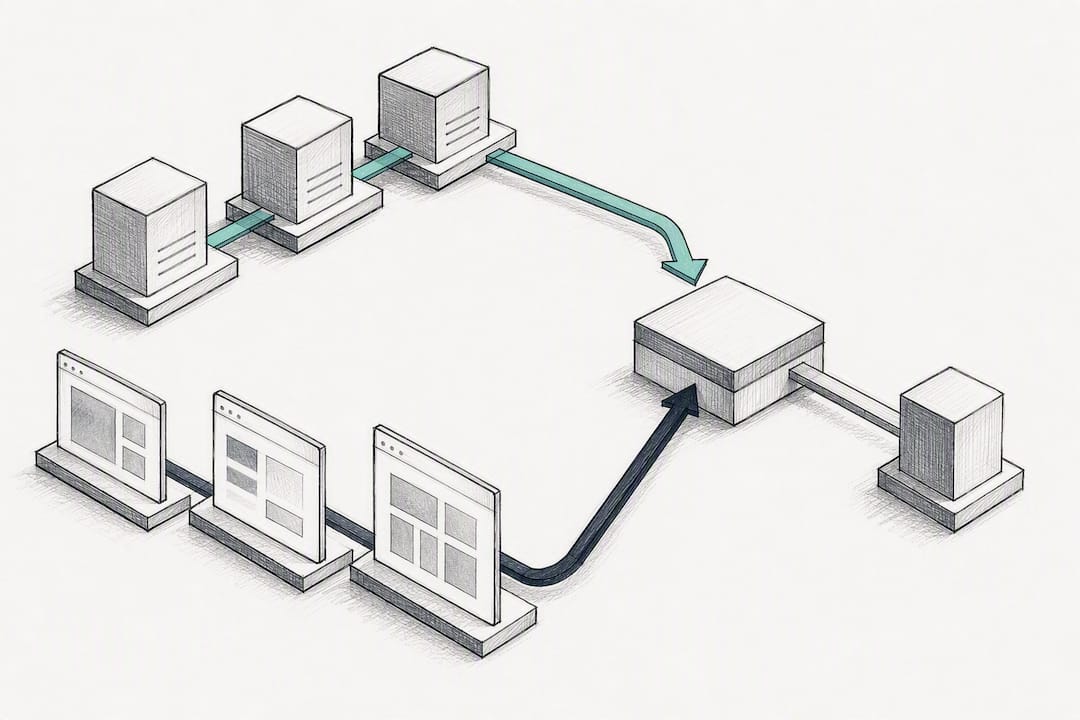
Most mature automation stacks don’t pick a side. A hybrid strategy that combines API stability for the core with RPA flexibility for the legacy edges tends to age better than a purist commitment to either approach. Modern RPA platforms already ship with API connectors, letting a single workflow mix backend calls and UI automation, so the “either/or” framing is increasingly artificial.
A working hybrid pattern looks like this:
- APIs handle the foundation. Order creation, authentication, and data retrieval run through documented endpoints wherever they exist.
- RPA covers the last mile. A bot picks up only where no API exists, such as entering data into a legacy claims system or a supplier’s browser-only portal.
- Orchestration ties the two together. Event-driven triggers, status polling, or callback webhooks pass state between the API layer and the bot layer without manual handoff.
- Reconciliation catches drift. A nightly job compares what the API recorded against what the bot completed, flagging mismatches before they become customer-facing problems.
- Centralized logging with correlation IDs makes debugging possible. Centralized logging and reconciliation across the hybrid stack meaningfully cuts operational risk, which matters once you have five or six of these mixed flows running in parallel.
A concrete example: an API creates a job record and pulls customer data, an RPA bot completes entry into a legacy system with no endpoint, and the API receives a confirmation webhook to close the loop. Zoho documents this exact pattern across use cases where a modern backend has to talk to a system nobody has modernized yet.
What Should Be on Your RPA vs API Decision Checklist?
Before committing budget to either path, or briefing a vendor, run the decision through a short checklist rather than a gut call.
- API availability and access level. Does a documented API exist, and can you get production credentials without a lengthy sales cycle?
- Rate limits and licensing cost. Does the pricing tier that gives you the access you need still make financial sense at your projected volume?
- Volume and SLA needs. Is this a nightly batch job or a real-time customer-facing process? The answer usually settles the RPA-versus-API question on its own.
- Maintenance ownership. Who fixes it when it breaks, and does your team have the bandwidth for UI-monitoring work if you go the RPA route?
- Compliance and data residency requirements. Does the process touch regulated data that needs to stay logged in a specific jurisdiction or format?
- Monitoring and rollback plan. What triggers a rollback, and who’s paged when the bot or the integration fails at 3 a.m.?
Pro Tip: Score each workflow candidate against this checklist before scoping, not after. A five-minute exercise up front routinely saves teams from discovering, three months into a bot build, that the vendor shipped an API two years ago and nobody checked.
What Do Deployment Timelines and Total Cost of Ownership Actually Look Like?
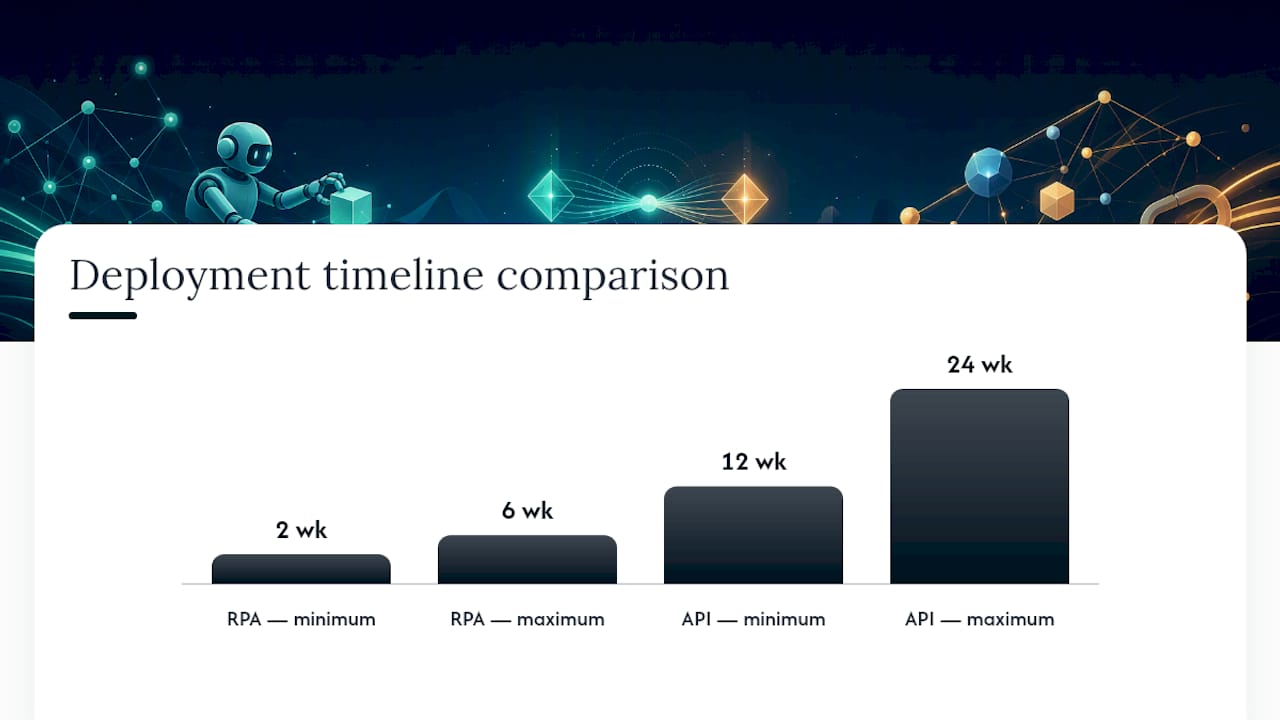
The timeline gap is the first thing that surprises technology decision-makers. RPA typically deploys in two to six weeks, while API integrations run three to six months, because a bot only needs to mimic clicks a human already makes, while an integration needs contract design, authentication setup, and testing against edge cases the UI never exposes.
That speed advantage flips once you zoom out to a one to three year window:
- RPA maintenance scales with UI churn. Every vendor update to the target application is a potential break, and someone has to catch it fast.
- API maintenance scales with version deprecation. This happens on a published schedule, giving your team weeks or months of warning instead of a surprise outage.
- Hidden RPA costs stack up quietly. Bot licensing tiers, monitoring tooling, and the consulting hours needed for constant small fixes rarely show up in the initial pitch.
- The migration trigger is measurable. Legacy, unintegrated systems compound friction over time; once a bot’s monthly fix rate crosses a threshold your team can name, that’s your signal to migrate the flow to an API.
Plan the budget for both years, not just the launch month.
What Security and Governance Controls Belong in Either Approach?
Security expectations differ sharply between the two models, and a project spec that treats them the same will leave gaps.
- Authentication: APIs typically use OAuth with scoped tokens limiting exactly what a call can touch; RPA usually runs under a shared service account with broader access than any single task needs.
- Audit trails: API server logs are structured and queryable; RPA audit trails often depend on session recordings and screenshots, which are harder to search at scale.
- Secrets handling: Both approaches need rotation policies for credentials, but bot credentials are more often hardcoded into scripts if governance isn’t enforced early.
- PII exposure: Screen scraping can expose personal data that never gets masked the way a well-designed API response would.
- Change management: Require CI/CD-style testing for API integrations and a documented approval gate before any RPA bot goes into production after a UI update.
When Should You Bring In an Engineering-Led Automation Partner?
A rapid proof of concept separates good architecture decisions from expensive guesses. Zatersio builds working software in under two weeks and structures eligible projects to take advantage of the R&D Tax Incentive, which matters when you’re testing whether an API integration or a hybrid build is worth the longer commitment.
Zatersio also automates repetitive administrative work across trades, professional services, and healthcare, sectors where legacy systems with no API access are the norm rather than the exception. Whoever you engage, demand a documented migration plan, real governance controls, and clear data residency options before signing anything.
Zatersio Builds the Hybrid Automation Your Legacy Systems Actually Need
If your process spans a modern backend and a legacy system nobody wants to touch, you’re already living the RPA-versus-API decision in production. Fixed-price MVP and automation builds can give you direct access to a dedicated engineering team that scopes the API-first parts and the RPA last-mile parts in the same project, with data residency options built in rather than bolted on later.
Rather than guessing which approach fits your workflow, request the Free AI Automation Blueprint, a practical breakdown of where your process should run on APIs, where a bot is genuinely the faster fix, and what a working proof of concept could look like inside two weeks. If you already know you need a build, start with a scoped MVP development engagement and get a fixed price before committing to either architecture.
What This Comes Down To
Every article on RPA versus API integration eventually lands on “it depends,” and that’s technically true but practically useless. What decision-makers actually need is permission to stop treating this as a philosophical choice and start treating it as an inventory problem: which systems have APIs, which don’t, and which processes will still matter in three years.
The mistake I see most often isn’t picking the wrong tool. It’s picking RPA for a permanent, high-volume process because it shipped faster, then never budgeting for the maintenance curve that follows. Decision-makers routinely underestimate ongoing RPA maintenance against the one-time cost of an API integration, and by the time the pattern becomes obvious, the bot has already become load-bearing infrastructure nobody wants to touch.
The fix isn’t dogma in either direction. It’s building the migration path into the RPA deployment from day one, even when you’re certain you’ll “get to it later.” You won’t, unless the plan exists before the bot does. Treat every bot as a temporary bridge with a demolition date, and hybrid automation stops being a compromise and starts being the architecture you meant to build all along.
— Lakitha
Sources
- RPA vs API Integration: Architecture Trade-offs, Costs & Decision Matrix (2026)
- RPA vs API integration – when a robot beats a standard integration | ALGORCOMP Knowledge Base
- RPA vs. API integration: Business use cases and examples (Zoho)