
Claim the R&D Refund for Australian Startups (Corp rate +18.5%)
Claim the R&D Refund for Australian Startups (Corp rate +18.5%)

Most Australian startups running genuine research and development work can claim a cash offset, and for companies with aggregated turnover under $20 million, that offset is refundable at your corporate tax rate plus an 18.5% premium. The first move isn’t the tax return, it’s registering your R&D activities with the Department of Industry, Science and Resources within 10 months of your income year ending. Keep your records tight from day one, and check official guidance before you assume anything is a sure thing.
TL;DR:
- Startups under $20 million in turnover can claim a refundable R&D offset equal to their corporate tax rate plus 18.5%, payable even if they owe no tax.
- Registration with the Department of Industry, Science and Resources is due within 10 months of the income year’s end, and missing this deadline generally results in losing the claim.
- Eligible R&D expenses include salaries, contractor payments, asset depreciation, and cloud costs directly supporting core research activities.
- Accurate, contemporaneous record-keeping of experiments, code, timesheets, and contracts is essential to withstand ATO audits and avoid penalties.
- Clear separation of core versus supporting R&D activities prevents overclaiming, especially in software development, where the line can be blurry.
Table of Contents
- What the R&D Tax Incentive Is and Who Administers It
- Who Qualifies: Entity Tests, Turnover Tests, and the $20,000 Floor
- Types of Expenditure Startups Can Include
- Registering R&D Activities With DISR and Key Deadlines
- How to Compute the Offset and Lodge Your Claim
- What Contemporaneous Records to Keep and How to Reduce Audit Risk
- Detailed Examples of Eligible and Ineligible R&D Activities for Startups
- Step-by-Step Guidance on Preparing and Submitting Your Application
- Common Challenges Startups Face During Registration and Claiming
- Impact of the R&D Tax Incentive on Startup Cash Flow and Funding Strategies
- Interaction of the R&D Tax Incentive With Other Tax Concessions
- Post-Claim Monitoring and How to Handle ATO Audits
- What Founders Get Wrong About Claiming R&D
- Building an R&D-Ready MVP Without Slowing Down
- Official Places to Check Before You Lodge
- Sources
- FAQ
What the R&D Tax Incentive Is and Who Administers It
The R&D Tax Incentive is a legislated program built to offset some of the cost of eligible research and development and push companies to invest more in it. Two agencies split the job, and mixing up their roles trips up a lot of founders.
- The Department of Industry, Science and Resources (DISR) handles registration of your R&D activities each year.
- The Australian Taxation Office (ATO) processes your claim, calculates your offset, and reviews your tax return.
- Registering with DISR confirms your activities are on record, not that they’re automatically eligible: the ATO can still ask questions later.
- A $150 million cap on R&D expenditure limits how much of your spend qualifies for the concessional offset rates in any one year.
Get this two-agency split straight early, because it shapes when you act and who you’re answering to at each stage.
Who Qualifies: Entity Tests, Turnover Tests, and the $20,000 Floor
Before you plan around the incentive, run through the gating checks. Miss one and the claim falls over regardless of how good your R&D was.
- You need to be an “R&D entity,” generally a company incorporated in Australia or one incorporated elsewhere but resident here for tax purposes.
- Aggregated turnover under $20 million typically unlocks the refundable offset, unless your company is controlled by tax-exempt entities, in which case different rules apply.
- Your notional R&D deductions must total at least $20,000 for the income year, with exceptions for payments to a Research Service Provider (RSP) or monetary contributions to the Cooperative Research Centres (CRC) program.
- R&D conducted overseas generally needs an advance overseas finding before you can include it, and this can’t be applied for after the fact.
None of these tests are optional extras. They’re the floor you stand on before you even start mapping expenditure.
Types of Expenditure Startups Can Include
Once you clear the eligibility bar, the next question is what actually counts. For a typical MVP build, the answer usually breaks down like this:
- Salary and wages for staff or founders directly doing eligible R&D work, apportioned to the time actually spent on it.
- Contractor and RSP payments, where a Research Service Provider is treated differently from a payment to an ordinary associate: the ATO’s expenditure guidance sets out both categories.
- Feedstock and decline in value of assets used in the R&D, such as depreciation on a dev server bought specifically for testing.
- Cloud and compute costs that support a core R&D activity, generally claimable as supporting R&D rather than the core activity itself.
A practical split for MVP teams: building and testing a genuinely novel algorithm or architecture is usually core R&D, while the surrounding UI polish, standard integrations, or routine bug fixes tend to sit in supporting R&D at best, or outside the claim entirely.
Registering R&D Activities With DISR and Key Deadlines
The 10-month rule is the one deadline that catches founders out more than any other, mostly because it sneaks up during a busy financial year end.
- You must lodge your registration with DISR within 10 months of the end of your income year: for a standard 30 June year end, that means registering by 30 April the following year.
- Registration has to happen before you lodge your company tax return claiming the offset, not after.
- Treat the 10-month window as a hard stop, not a guideline: missing it generally means missing the claim for that year altogether.
- Processing isn’t instant, so if you’re near the deadline or your activities are complex, get a tax adviser or registered agent involved early rather than waiting on a response.
Mark this date the same way you’d mark a tax return deadline. It’s just as unforgiving.
How to Compute the Offset and Lodge Your Claim
This is where the numbers turn into cash, or at least into a smaller tax bill. The mechanics differ depending on your size.
- Companies with aggregated turnover under $20 million get a refundable offset equal to their corporate tax rate plus an 18.5% premium, subject to the control-by-exempt-entities rule…
- Larger companies get a non-refundable offset, with the rate tied to R&D intensity, and any expenditure above the $150 million cap reverts to the standard corporate tax rate.
- You report your claim using the Research and development tax incentive schedule (item 21 on the company tax return), following the ATO’s published instructions.
- Clawback and feedstock adjustment rules kick in if you’ve received a grant for the same work or sold outputs from the R&D, reducing your offset or creating extra assessable income to prevent double-dipping.
For a company with aggregated turnover under $20 million, the refundable R&D offset equals the corporate tax rate plus 18.5%. That premium is what turns a standard deduction into a genuine cash benefit, even when the company owes no tax that year.
What Contemporaneous Records to Keep and How to Reduce Audit Risk
The scheme is self-assessed, which sounds convenient until an ATO reviewer asks for proof six months after launch. DISR and ATO stakeholder guidance consistently flags weak record keeping as the most common failure point for startups.
- Keep timesheets that tie hours to specific activity descriptions, not vague labels like “development work.”
- Retain code commits, test logs, and version history that show the experimental process, not just the final product.
- Hold onto invoices that itemize the R&D task performed, and contracts that show the work was undertaken without a known outcome in advance.
- Document RSP engagements and outsourced work separately, including scope, deliverables, and dates.
Pro Tip: Keep a short R&D activity plan for each project and add a one-line progress note weekly. It costs a few minutes and saves days if a review lands on your desk.
Detailed Examples of Eligible and Ineligible R&D Activities for Startups
Founders often assume “we built new software” automatically qualifies. It doesn’t, not on its own.
Eligible examples typically include: developing a new machine learning model where the outcome isn’t known in advance and requires systematic experimentation, building a novel data processing architecture to solve a technical problem with no existing solution, or running structured tests to determine whether a new algorithm can achieve a specific performance benchmark. These share a common thread: genuine technical uncertainty resolved through a documented, systematic process.
Ineligible examples usually include: routine software maintenance, bug fixes on existing features, standard API integrations using documented methods, or building a user interface with well-established design patterns. Market research, feasibility studies for commercial viability alone, and management or administrative overhead also fall outside the scheme.
The gray zone matters most for MVP teams. Adapting an existing technology for a new context can sometimes qualify as supporting R&D when it directly supports a core R&D activity, even if the underlying technology itself isn’t new. The test isn’t “is this software new to us,” it’s whether a competent professional in the field could have known the outcome in advance without the experimentation you actually did. If the answer is yes, it’s probably not core R&D, whatever the build looks like from the outside.
Step-by-Step Guidance on Preparing and Submitting Your Application
Treat this as a sequence, not a single event at tax time.
First, identify candidate projects early in the income year and separate core R&D activities from supporting ones as you go, not retrospectively. Second, set up basic tracking systems from day one: time logs against activity codes, a running activity register, and a folder for invoices and contracts tied to the work.
Third, draft your R&D activity descriptions in plain, specific language that a reviewer with no context could follow: what was uncertain, what you tested, and what you found out. Fourth, lodge your registration with DISR within the 10-month window, well before your company tax return is due.
Fifth, once registered, use your registration number and complete the R&D tax incentive schedule in your company tax return, calculating your offset according to your turnover category. Sixth, review the whole package with a tax adviser or registered agent before lodging, particularly if any activity sits close to the eligibility line.
Finally, file everything, the registration confirmation, the schedule, and your supporting records, in one place so you can retrieve it quickly if a question comes later. None of these steps are complicated on their own. Skipping the sequence, or doing it backward at tax time, is what causes most of the trouble founders run into.

Common Challenges Startups Face During Registration and Claiming
The biggest challenge isn’t the paperwork itself, it’s timing. Startups moving fast on product development often treat R&D registration as an afterthought, then scramble to reconstruct activity records months after the work happened. Memory is a poor substitute for a timesheet.
A second challenge is drawing the line between core and supporting R&D, especially for software teams where “new” and “experimental” can blur together. Founders either overclaim, treating routine build work as R&D, or underclaim, missing genuinely eligible experimentation because it didn’t feel like a lab experiment.
A third challenge is resourcing. Early-stage teams rarely have a finance person dedicated to compliance, so R&D tracking competes with shipping features and closing customers. The fix isn’t hiring a compliance team, it’s building lightweight habits: a shared activity log, a five-minute weekly note per project, and invoices that describe the actual task rather than “consulting services.”
A fourth challenge is the overseas rule. Founders working with offshore contractors sometimes discover too late that overseas activities need an advance finding before they can be included, and that finding can’t be requested retroactively. If any part of your R&D happens outside Australia, check this before the work starts, not after.
None of these problems are unusual, and none require complex fixes. They mostly come down to treating R&D documentation as part of the build process, not a task bolted on at tax time.
Impact of the R&D Tax Incentive on Startup Cash Flow and Funding Strategies
For a startup with aggregated turnover under $20 million, the refundable offset behaves differently from a standard tax deduction: it pays out even if the company owes no tax at all, because it’s refundable rather than just a reduction against liability. For a pre-revenue company burning cash on product development, that refund can extend runway without giving up equity or taking on debt.
This changes how some founders plan funding rounds. Instead of treating the R&D offset as a bonus that shows up once a year, it’s worth building the expected refund into cash flow forecasts from the start, particularly if a large share of your spend is genuinely eligible R&D. Investors increasingly expect to see this line item modeled out, since it affects how much external capital you actually need to raise. Founders comparing R&D offsets against other funding levers, revenue-based finance among them, should weigh the eligibility criteria and timing against dilution and debt costs. A resource worth checking for that comparison is Othrfund’s guide to SaaS funding metrics, which covers the kind of metrics investors and lenders look at alongside grant and offset income.
The catch is timing: the refund lands after your income year ends, your registration is processed, and your return is lodged, so it’s a lagging cash inflow, not a substitute for working capital during the year itself. Founders who plan around it as a mid-year bridge often get caught short. It works best as a planned, annual cash injection that reduces how much you need from other sources, not as a stand-in for day-to-day funding.

Interaction of the R&D Tax Incentive With Other Tax Concessions
Startups often stack the R&D Tax Incentive against other concessions, and mostly that’s fine, but the interactions need checking case by case rather than assumed. If your project receives a government grant covering the same expenditure the R&D offset would otherwise cover, clawback rules apply: the ATO’s schedule instructions explain how this reduces your offset or creates additional assessable income, specifically to stop the same dollar being subsidized twice.
The same logic applies if your R&D work directly produces something you sell. Revenue from R&D outputs can trigger a feedstock adjustment that reduces the notional deduction you can claim, because the expenditure has already generated a commercial return. This catches startups that build and sell a product using the same activities they’re claiming as R&D, which is common for software MVPs.
Other small business tax concessions, like instant asset write-offs or simplified depreciation, generally sit separately from the R&D scheme, but you can’t double-claim the same expenditure under both. If an asset’s decline in value is already claimed as R&D expenditure, it shouldn’t also be claimed under a general small business depreciation concession. The safest approach is to map every dollar of spend to exactly one concession or offset, and if you’re not sure which one applies, that’s a conversation for a registered tax agent rather than a guess on the return.
Post-Claim Monitoring and How to Handle ATO Audits
Lodging your claim isn’t the finish line. The scheme is self-assessed, and the ATO’s compliance approach makes clear that a registration number doesn’t shield a company from a later review. Both DISR and the ATO can ask questions well after the refund lands.
If a review notice arrives, the first move is to pull your contemporaneous records, the activity plan, timesheets, code history, and invoices, and check they still tell a coherent, dated story of what was uncertain and what you tested. Reviewers generally focus on whether your activity descriptions match what actually happened, so vague or after-the-fact documentation is the biggest liability at this stage.
Respond within the timeframes given, and don’t guess at technical justifications on the spot. If any part of the review touches on borderline activities, a registered tax agent or an R&D adviser familiar with the ATO’s compliance approach can help frame the response accurately rather than defensively. Startups that treat a review calmly, with records ready to hand, tend to resolve them faster than those scrambling to reconstruct evidence months after the work was done. Ongoing monitoring, checking each year’s activities still meet the same tests, rather than assuming last year’s approval carries forward automatically, keeps future claims cleaner too.
What Founders Get Wrong About Claiming R&D
The biggest mistake I see is founders reaching for the most generous interpretation of “R&D” instead of the most defensible one. A conservative, well-documented claim beats an aggressive one you can’t back up six months later. Check the ATO and DISR guidance directly, use a registered RSP for anything borderline, and build your records as you go, not after.
— Lakitha
Building an R&D-Ready MVP Without Slowing Down
Founders juggling product development and R&D documentation usually don’t have spare hours for either. Zatersio’s MVP Development service delivers working software fast, with fixed pricing and projects scoped and built directly by Melbourne-based engineers, not handed off offshore.
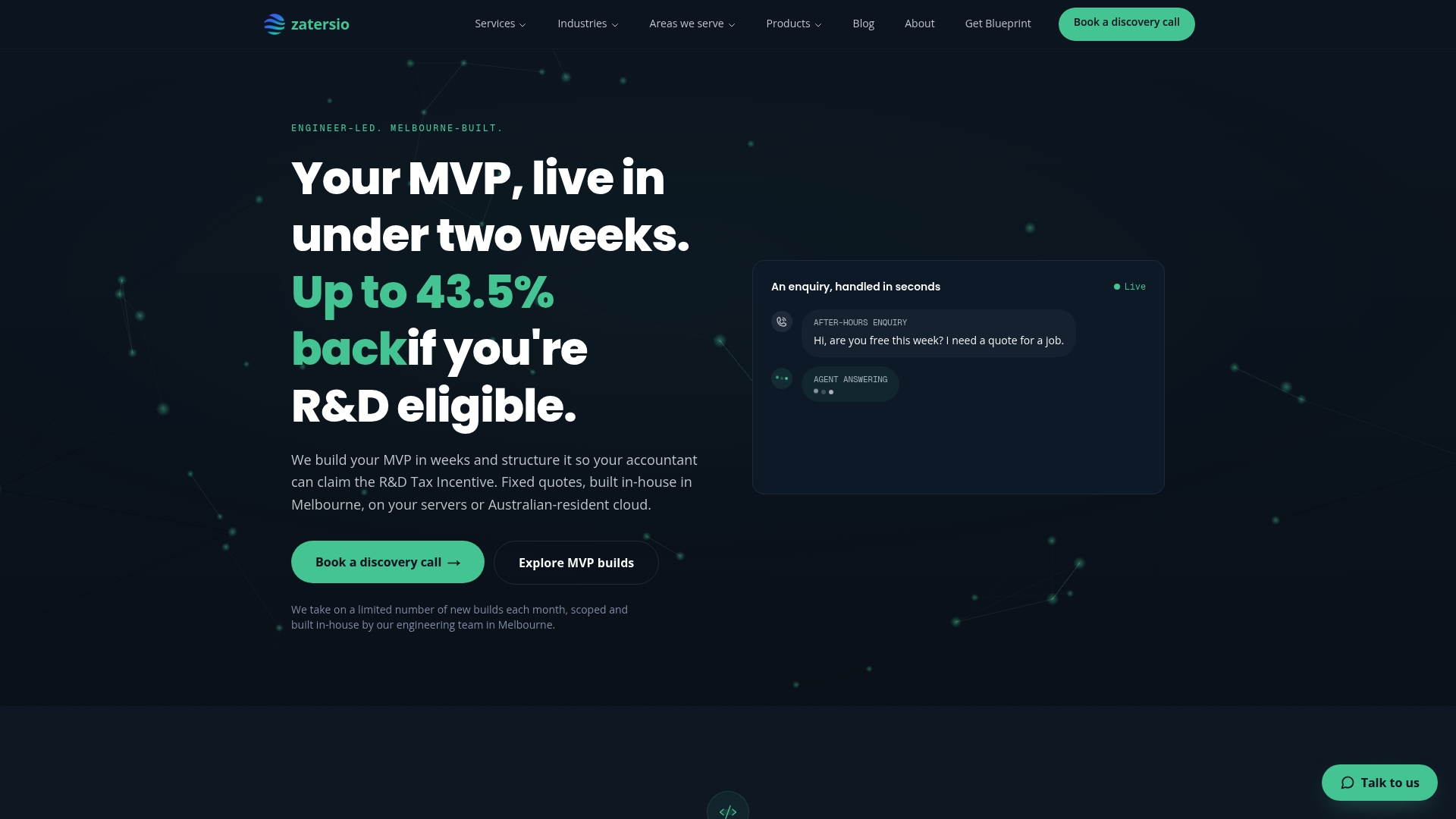
That direct-delivery model means clear scope documents, defined build phases, and Australian-resident infrastructure from the start, the kind of contemporaneous detail that supports an R&D claim rather than working against it. If you’re weighing project cost against expected offset value, our pricing page lays out packages for automation and custom builds, and our free automation blueprint is a practical way to scope the work before you commit.
Official Places to Check Before You Lodge
Go straight to the source rather than relying on summaries, including this one.
- ATO rates and entitlements page for current offset calculations.
- Business for the registration process and agency roles.
- The RSP register and ATO transparency reports for compliance benchmarks and approved service providers.
Sources
- R&D tax incentive rates and entitlements | Australian Taxation Office
- R&D stakeholder updates and transparency report excerpts | Department of Industry, Science and Resources
FAQ
What are the R&D tax incentives in Australia?
The R&D Tax Incentive offsets part of a company’s eligible research and development spending, jointly run by DISR for registration and the ATO for claims. Companies with aggregated turnover under $20 million typically get a refundable offset, while larger companies get a non-refundable one based on R&D intensity.
What is the 80% rule for R&D credit?
There’s no universal “80% rule” in the Australian R&D Tax Incentive; the scheme instead uses turnover thresholds, a $20,000 minimum notional deduction, and R&D intensity bands for larger companies to set offset rates. Definitions vary by context, so if you’ve seen this figure elsewhere, check it against the ATO’s own rate guidance rather than assuming it applies to your claim.
What grants does the Australian Government offer for startups?
Beyond the R&D Tax Incentive itself, the government supports research collaboration through programs like the Cooperative Research Centres (CRC) program, which funds industry-research partnerships. Specific grant availability and eligibility change over time, so check business.gov.au for current programs relevant to your sector.
How do I claim the R&D tax incentive as a startup?
You register your R&D activities with DISR within 10 months of your income year ending, then report your offset using the R&D tax incentive schedule in your company tax return. Registration must happen before you lodge the return claiming the offset, not after.
Can a startup with no revenue still claim the R&D offset?
Yes, the refundable offset pays out even when a company owes no tax, because it’s a cash refund tied to eligible R&D spending rather than a reduction against a tax bill. This makes it accessible to pre-revenue startups, provided they meet the $20,000 minimum notional deduction and other eligibility tests.