
Zendesk vs Intercom: Which to Pilot for Your Team
Zendesk vs Intercom: Which to Pilot for Your Team
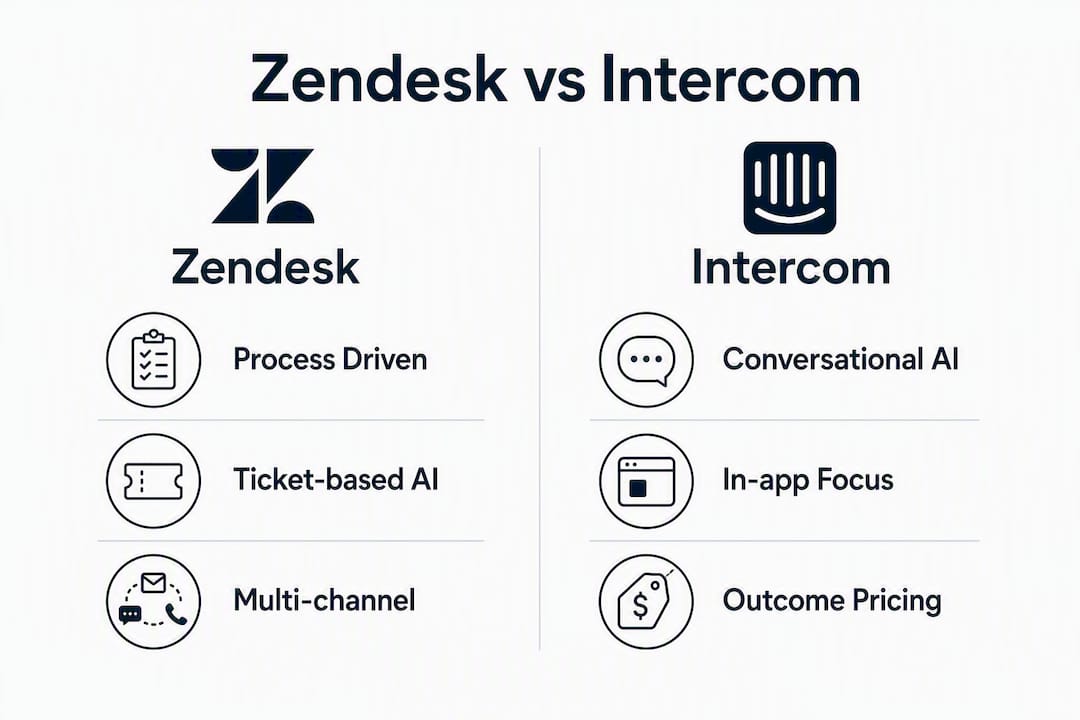
If your support resolves in one or two conversational turns inside your product, pilot Intercom Fin first. If you run multi-channel, multi-touch support with SLAs and voice, pilot Zendesk Suite. That is the core decision axis: conversational AI deflection versus structured ticketing and process excellence.
Both platforms have moved to outcome-based AI pricing in 2026, but they serve fundamentally different support shapes. Industry experts position Zendesk as the standard for service-process excellence and Intercom as an AI-first conversational layer, built for different stages of the support lifecycle. Run the wrong pilot and you will spend months fighting the platform instead of measuring results.
Two concrete starting points: run a 30-day Intercom Fin trial measuring autonomous resolution rate for in-app deflection, or configure a Zendesk Suite pilot with SLA policies and workforce management rules to test ticket routing accuracy.
Table of Contents
- Zendesk vs Intercom: side-by-side comparison
- How does Intercom Fin compare to Zendesk AI in practice?
- Which teams should actually use each platform?
- Key Takeaways
- What most pilots get wrong about these platforms
- Zatersio builds your AI pilot in two weeks, fixed price
- Useful sources for your due diligence
Zendesk vs Intercom: side-by-side comparison
| Platform | Best for | AI approach | Pricing model | Channels | Integrations | Implementation |
|---|---|---|---|---|---|---|
| Zatersio | Custom AI pilot or integration with fixed pricing | Bespoke AI agent builds, MVP delivery | Fixed-price project | Any channel via custom build | Fully custom | 2 weeks (MVP) |
| Zendesk Suite | High-volume, multi-channel ops with SLAs | Routing, agent assist, predictive triage | Per seat + add-ons (Copilot, Contact Center) | Chat, email, phone, social, in-app | 1,500+ apps | Weeks to months |
| Intercom (Fin) | Product-led SaaS, in-app-first teams | Autonomous conversational resolution | Per seat + per resolution (~$0.99/resolved) | Chat, email, in-app, social | 400–450 apps | Days to weeks | | Freshdesk | Cost-conscious omnichannel teams | Basic AI assist, no outcome pricing | Per agent, predictable tiers | Chat, email, phone, social | Large marketplace | Fast onboarding | | HelpCrunch | Small to mid-market conversational UX | Conversational inbox, lightweight flows | Per agent | Chat, email, in-app | Limited | Fast | | Crisp | SMB chat-first teams on a budget | Basic automation building blocks | Low-cost flat tiers | Chat, in-app | Limited | Very fast |
A few clarifications worth flagging:
- Intercom’s biggest cost risk is success itself. As Fin resolves more conversations, the usage bill rises proportionally with no hard ceiling. Model your expected AI resolution volume before signing.
- Zendesk’s biggest cost risk is add-on stacking. Copilot, Contact Center telephony, and Explore Advanced each carry separate fees that make high-end deployments expensive, though predictable per seat.
- Freshdesk, HelpCrunch, and Crisp are credible Zendesk alternatives for teams that do not need enterprise-grade workforce management or Fin-style autonomous AI.
How does Intercom Fin compare to Zendesk AI in practice?
The architectural difference matters more than the feature list. Zendesk is ticket-based on relational data structures suited to asynchronous, multi-touch workflows; Intercom is stream-based and focused on conversation threads. Retrofitting one mental model to the other produces reporting gaps and agent frustration.

Intercom Fin sits at the front of the conversation. It attempts autonomous resolution before a human ever sees the ticket, billing at roughly $0.99 per resolved conversation. It works best when your knowledge base is clean, your questions are bounded, and resolution genuinely happens in two or three turns. For product-led SaaS teams, Intercom’s native product tours, behavioral messaging, and in-app checklists also shorten onboarding in ways Zendesk cannot replicate without third-party tooling.
Zendesk AI operates differently. It routes, triages, and assists agents mid-ticket rather than replacing them at the front door. Autonomous resolutions are published at roughly $1.50–$2.00 per resolution, with agent Copilot as a separate per-seat add-on. The payoff is better SLA adherence and more accurate reporting across complex, multi-touch cases.
Strengths and limits at a glance:
- Fin excels at deflecting repetitive, bounded questions in-app; it struggles when your knowledge base is thin or your issues require multi-system lookups
- Zendesk AI excels at routing accuracy and agent productivity in high-volume queues; it adds cost fast when you layer Copilot on every agent seat
- Intercom starts cheaper due to lower seat tiers and free Lite seats, but its seat-plus-usage model becomes unpredictable as AI resolution volume grows
- Zendesk bundles telephony and workforce management more natively, which matters for voice-heavy operations that Intercom cannot serve well without workarounds
Pro Tip: Structure your 30-day AI pilot with a baseline week of manual handling first. Measure AI resolution rate, escalation-to-agent rate, and cost per effective resolution across the full period. Without the baseline, you cannot separate platform performance from seasonal ticket variation.
When neither platform’s native AI fits cleanly, a third-party autonomous agent or a custom overlay built on your own infrastructure can bridge the gap without locking you into per-resolution pricing.
Which teams should actually use each platform?
For large-scale operations with 50 or more agents, Zendesk is typically preferred for its administrative framework, native multi-channel routing including phone, and workforce management features. Intercom is favored by SaaS startups and product teams for UX and in-app engagement. Here is how that maps to real scenarios:
- Product-led SaaS (under 20 agents): Intercom Fin. Most questions resolve in-app, your team is small, and behavioral messaging drives retention. Start with Fin on your top five ticket categories.
- Mid-market service ops (20–60 agents, mixed channels): Zendesk Suite with a dedicated admin. You need SLA tracking, email and phone routing, and Explore reporting. Budget 6–8 weeks for configuration.
- Enterprise contact center (60+ agents, voice-heavy): Zendesk. Forcing Intercom into high-volume, multi-touch ticket workflows leads to inefficient workarounds, agent fatigue, and poorer reporting accuracy.
- SMB on a tight budget: Freshdesk for omnichannel coverage, or Crisp if chat-first is enough. Both onboard fast without enterprise pricing.
Three short scenarios:
A 10-person product team with 200 monthly tickets should pilot Intercom Fin with a clean FAQ knowledge base. Expected outcome: 40–60% autonomous resolution within 30 days if the knowledge base is well-groomed.

A 60-agent contact center handling email, phone, and social needs Zendesk Suite with workforce management enabled from day one. The integrations marketplace of 1,500+ apps reduces custom engineering overhead for connecting CRMs and telephony systems.
A hybrid mid-market team running both in-app chat and email should evaluate Zendesk first if ticket volume exceeds 1,000 per month, then layer a conversational AI agent on top rather than switching platforms entirely.
On integrations: Intercom’s 400–450 app marketplace means more custom engineering work for complex stacks. If your team lacks developer bandwidth, Zendesk’s larger marketplace reduces that risk considerably.
Key Takeaways
Zendesk wins on process and scale; Intercom wins on conversational AI deflection — and the right choice depends entirely on your support shape, not your headcount.
| Point | Details |
|---|---|
| Match platform to support shape | Conversational, in-app support fits Intercom; multi-touch, SLA-driven ops fit Zendesk. |
| Model AI resolution volume upfront | Intercom Fin bills ~$0.99 per resolved conversation with no hard ceiling; cost scales with success. |
| Zendesk rewards process maturity | Teams without a dedicated admin often find Zendesk slower to deliver value even when it is the right long-term fit. |
| Integrations affect engineering cost | Zendesk’s 1,500+ app marketplace reduces custom build overhead; Intercom’s 400–450 apps may require more developer work. |
| Zatersio for fast, fixed-price pilots | Zatersio builds custom AI agent integrations and MVPs in under two weeks, with fixed pricing and data residency choices. |
What most pilots get wrong about these platforms
The most common mistake is treating this as a features comparison when it is really an architecture decision. Teams pick Intercom because the demo looks clean, then spend three months trying to build SLA workflows on a stream-based conversation model. Teams pick Zendesk because it sounds enterprise-grade, then discover their five-person product team has no one to manage routing rules.
The second mistake is underestimating data grooming for Fin. Autonomous resolution rate is almost entirely a function of knowledge base quality, not Fin’s capability. A sparse or outdated help center will produce a 15–20% autonomous resolution rate regardless of how well Fin is configured. Budget two to three weeks of content work before you run any meaningful pilot.
Zendesk’s hidden tax is admin bandwidth. Teams without a dedicated admin often find Zendesk slower to deliver value even when it is the better long-term fit. Routing rules, SLA policies, and Explore dashboards all require someone who owns the configuration. If that person does not exist yet, factor their time into your implementation timeline.
One realistic expectation on timelines: in-app messaging with Intercom can go live in days. A full Zendesk Suite rollout with workforce management, telephony, and custom reporting takes months. Neither timeline is wrong; they just reflect different scopes of work.
Zatersio builds your AI pilot in two weeks, fixed price
If you have read this far, you know which platform fits your support shape. The harder question is whether your team has the bandwidth to build and validate the pilot without it becoming a six-month project.
Zatersio builds custom AI agent integrations and support automation MVPs in under two weeks, at a fixed price, with your choice of data residency. Rather than spending months configuring a platform you are not sure will work, you get a scoped, working pilot fast. That means a real resolution rate and real cost-per-conversation data before you commit to a long-term contract.
Whether you need a Fin integration, a Zendesk automation overlay, or a fully custom AI agent built from scratch, Zatersio’s engineering team scopes it, builds it, and hands it over. Eligible projects may also qualify for the R&D Tax Incentive, reducing your net build cost.
Pro Tip: When buying AI outcome-based services, always confirm the vendor’s definition of a “resolved” conversation, any monthly minimums, and data retention terms before signing. These three clauses drive most of the surprise costs in year one.
Request a scoped pilot at zatersio.com.au/mvp-development.
Useful sources for your due diligence
- Zendesk vs Intercom: features and pricing (HelpCrunch) — covers outcome-based pricing trends and migration ROI data; useful when building a business case for switching platforms.